



What is effort? (part two)
Effort is an important concept for understanding strength training. In a previous article, I explained why our perception of effort is closely related to the level of motor unit recruitment that we achieve in any given muscular contraction, and why that is important for appreciating how we improve our ability to access high-threshold motor units, and thereby produce gains in maximum strength (read more). In this article, I explain what disrupts the link between our perception of effort and the level of motor unit recruitment during a muscular contraction.
.
#1. What is the perception of effort?
The perception of effort is the feeling we associate with how hard we are working during a given movement. When we want to produce a low force (relative to our maximum capacity in a movement), we send a small signal from the brain to the muscle, which recruits only a small number of motor units. These motor units control a small number of fibers inside the muscle, which results in a low force. When we want to exert a high force (relative to our maximum capacity in a movement), we send a large signal from the brain to the muscle, which recruits a lot of motor units. These motor units control a large number of fibers within the muscle, which results in a high force.
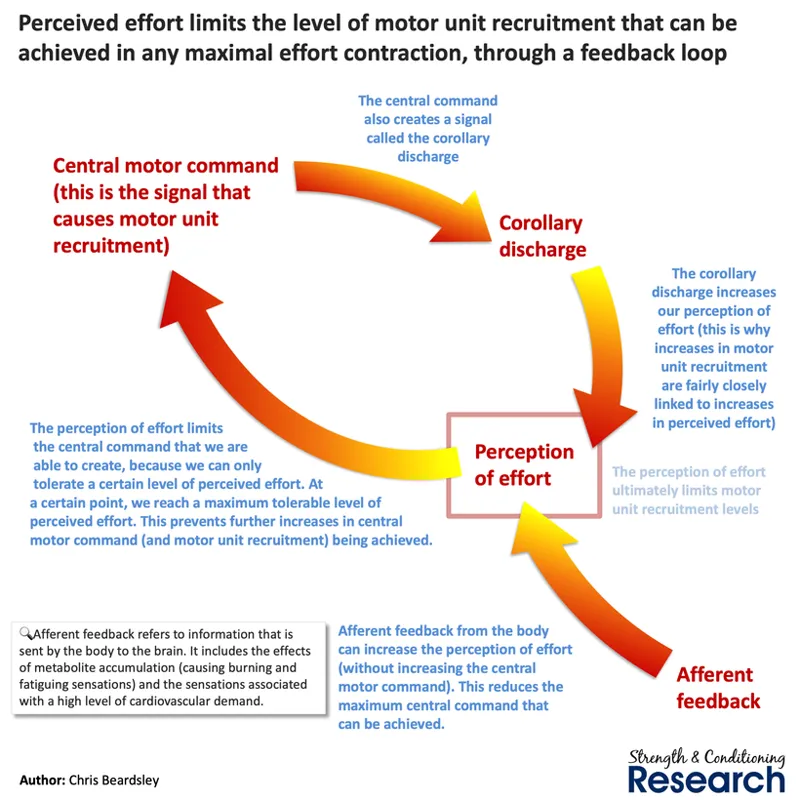
Our perception of effort seems to be caused by a secondary signal called the corollary discharge. This signal mirrors the signal that the brain sends to the muscle (which is called the "central motor command"). When the brain sends a small central motor command to the muscle to recruit a small number of motor units, the corollary discharge is small, so our perception of effort is small. When the brain sends a large central motor command to the muscle to recruit a lot of motor units, the corollary discharge is large, and so our perception of effort is large. Thus, our perception of effort is a readout of the number of motor units that we are recruiting to perform a task.
Since the perception of effort is discomforting, the maximum level of perceived effort that we are prepared to tolerate essentially limits the level of central motor command that we can exert, through a feedback loop.
.
During strength training, we often perform sets with a self-selected tempo to failure. Failure is reached once we hit a level of perceived effort that we find too disagreeable to tolerate. Therefore, if the corollary discharge were the only factor that influenced our perception of effort, we would always reach failure once we achieved maximum levels of motor unit recruitment. However, this does not happen, because other factors can increase our perception of effort, in addition to the level of the central motor command.
.
#2. Does the perception of effort always perfectly reflect the level of motor unit recruitment?
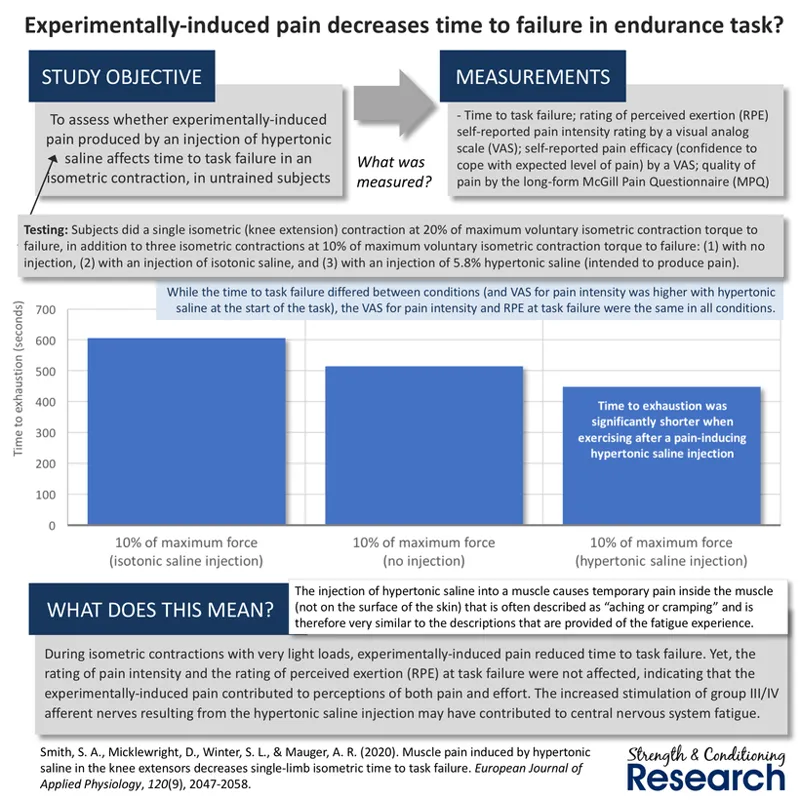
When we perform a strength training set to failure with a fairly light load, this causes a great deal of metabolite accumulation. This metabolite accumulation causes pain, as well as burning and fatiguing feelings in the working muscles. The greater the amount of metabolite accumulation, the greater the pain, and the greater the burning and fatiguing feelings that we experience.
.
When we perform tasks and the level of metabolite accumulation is higher, we tend to experience a larger amount of central nervous system (CNS) fatigue. The presence of this CNS fatigue indicates that we are unable to reach as high a level of motor unit recruitment as we would be able to do, if the metabolite accumulation were not present.
.
Similarly, when we experience pain at the same time as we are exercising, this also reduces our ability to achieve high levels of motor unit recruitment, and this results in a reduced level of exercise performance.
.
Pain, fatiguing feelings, and burning feelings that occur in response to the presence of metabolite accumulation inside muscles can increase our perception of effort, in the same way as the central motor command. However, they not increase the central motor command at the same time. Therefore, they increase our perception of effort without increasing the level of motor unit recruitment. Since perception of effort is the limiting factor in any physical task (especially tasks involve sustained force production and fatigue), the presence of pain, and fatiguing and burning feelings, can stop us from reaching maximum motor unit recruitment levels.
.
Consequently, when we perform strength training exercise that involves greater metabolite accumulation (such as light load training to failure), we will not achieve quite as high levels of motor unit recruitment at the end of the set as when we train with heavy or moderate loads. This seems to have little impact on hypertrophy, since research has shown that the same hypertrophy occurs with moderate (6–15RM) and light (16–30RM) loads. Yet, load does have a large effect on the increases in motor unit recruitment that occur after strength training, since voluntary activation increases after training with heavy and moderate loads, but does not increase after training with light loads.
.
Conclusions
The perception of effort is the feeling that we associate with how hard we are working in a movement. The main contributor to our perceived level of effort in a task is the level of central motor command that we send to the working muscles to recruit motor units. In this way, our perceived effort level provides an indicator of the level of motor unit recruitment we are achieving. However, the metabolite accumulation that occurs during some types of strength training can cause pain, as well as fatiguing and burning feelings, that also increase our perception of effort. Since we likely reach failure on a set once we reach a certain level of perceived effort (one that we can no longer tolerate), the presence of such metabolites can cause us to stop a set before we achieve maximal levels of motor unit recruitment. While this does not seem to influence the hypertrophy that results from training with light loads to failure, it probably reduces gains in maximum strength, by failing to stimulate increases in the access to high-threshold motor units.

Comments (2)
Anazing article Chris! Thanks so much. Based upon your stimulating repetitions model it would seem that the metabolite accumulation would retard our ability to hypertrophy during light load training to failure in comparison to moderate or heavy loading. But you state that the science does not indicate this. So I'm intrigued by the myofilament packing density. Is this in a sense a "internal hypertophy" benefit garnered from the enhanced high threshold motor unit recruitment with heavier loading? And is this a visual benefit for bodybuilders? Do we actually appear more dense/tone? Thanks!
I think the afferent feedback due to metabolite accumulation probably does lead to a loss of one or two reps due to CNS fatigue during a workout, but this doesn't cause a big enough effect to be detected in research.