




What is effort? (part one)
Effort is an important concept for understanding strength training. In this short article, I explain how we can best understand what the perception of effort means in physiological terms, and what that then means for how we can employ effort during strength training programs.
.
#1. What is the perception of effort?
The perception of effort can be described as the feeling that we associate with how hard we are working during a given movement. When we throw a tennis ball casually across the room, we can tell that we are not working very hard, and we experience a low perception of effort in that movement. If we go outside and throw the same tennis ball as far as we possibly can, we can tell that we are working hard to achieve a long throwing distance, and we experience a high perception of effort during that movement.
When we want to produce a low force (relative to our maximum capacity in a movement), we send a small signal from the brain to the muscle, which recruits only a small number of motor units. These motor units control a small number of fibers inside the muscle, which results in a low force. When we want to exert a high force (relative to our maximum capacity in a movement), we send a large signal from the brain to the muscle, which recruits a lot of motor units. These motor units control a large number of fibers within the muscle, which results in a high force.
Our perception of effort seems to be caused by a signal called the corollary discharge that mirrors the size of the signal that the brain sends to the muscle. When the brain sends a small signal to the muscle to recruit a small number of motor units, the corollary discharge is small, and so our perception of effort is small. Conversely, when the brain sends a large signal to the muscle to recruit a lot of motor units, the corollary discharge is large, and so our perception of effort is large. Thus, our perception of effort is essentially a readout of the number of motor units that we are recruiting to perform a task.
.
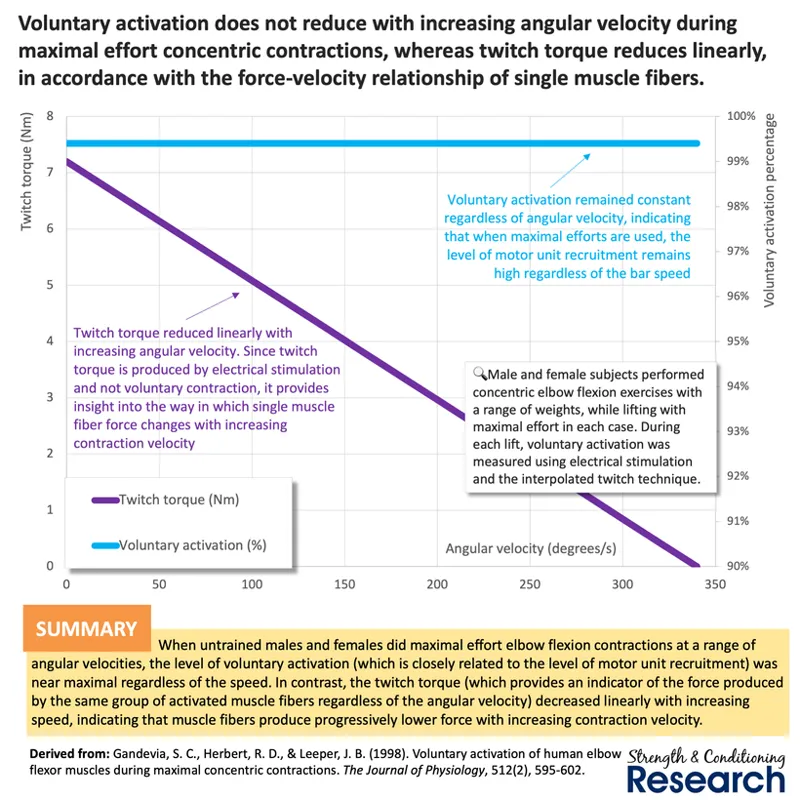
It is important to note that we can achieve maximal efforts and therefore maximal levels of motor unit recruitment regardless of the actual speed that we move. If we lift a light weight, we can still achieve a maximal level of motor unit recruitment so long as we move as fast as possible (which is also what happens when we throw a tennis ball as far as we can). Motor unit recruitment can be maximal regardless of the movement speed, so long as we work as hard as possible to produce as much force as possible at that speed. The smaller forces that are always produced at faster movement speeds are produced by the muscle fibers producing smaller forces as they shorten more quickly (this is called the force-velocity relationship).
.
#2. How does the perception of effort differ from proximity to failure during strength training?
Proximity to failure during a strength training set can be measured by reps in reserve (RIR). This measurement is sometimes described as being equivalent to a rating of perceived effort (RPE). However, the RIR in a set can only be identical to the RPE if we do each rep with a self-selected tempo. In contrast, if we lift each rep with a maximal effort, then by definition the RIR will not change (because we are still at the same proximity to failure), but the RPE will now be maximal on each rep.
This has implications for understanding how motor unit recruitment levels change over the course of a set.
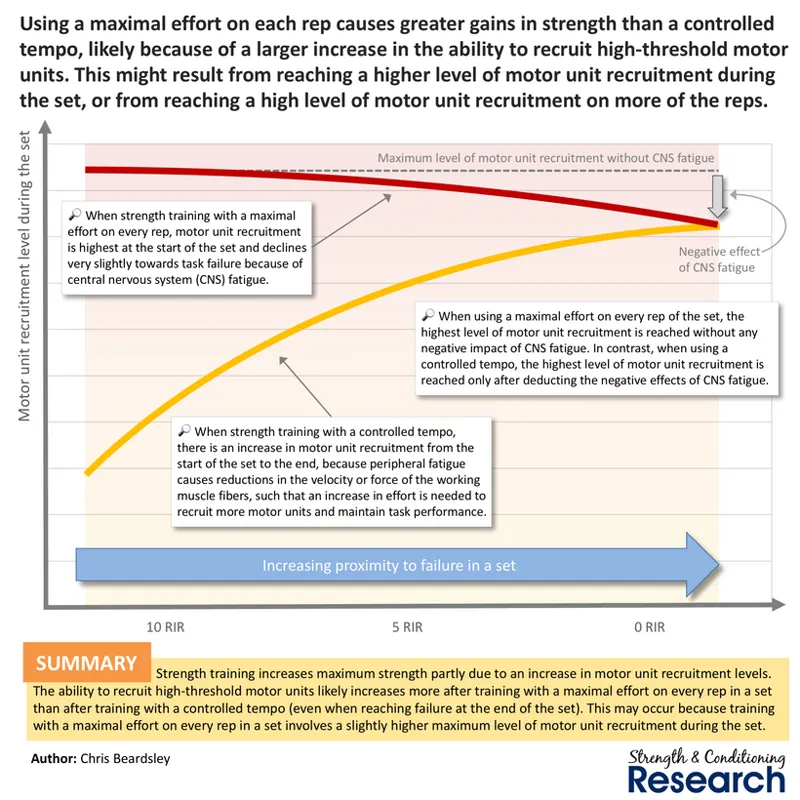
When we lift each rep of a set with a maximal effort, then motor unit recruitment levels are high in the early reps, and actually decline very slightly towards the end of a set. In contrast, when we lift each rep with a self-selected tempo, then motor unit recruitment increases gradually over the course of the set and reaches a maximal level on the last rep. Therefore, if we want to link effort to the level of motor unit recruitment, then we can only use RIR for that purpose if we are using a self-selected tempo. If we lift with maximal efforts on each rep, then the proximity to failure does not provide an indicator of the level of motor unit recruitment on each rep.
.
#3. What causes motor unit recruitment levels to increase after strength training?
One important adaptation that contributes to increases in maximum strength after training is an increase in the number of high-threshold motor units that we can access. This is a very well-known adaptation that occurs after heavy strength training. Increasing the access to more high-threshold motor units allows us to exert higher forces because each motor unit controls a set number of muscle fibers. Thus, by increasing our access to more motor units, we increase the number of muscle fibers that work during a muscular contraction, which increases the force that are able to produce, thereby increasing our maximum strength.
.
Although the exact stimulus that causes increases in our ability to access high-threshold motor units is not known, it has been observed to occur after programs involving vertical jumping. This is very insightful, because it tells us that an increase in the ability to recruit high-threshold motor units is not limited to heavy strength training programs. Yet, during both vertical jumping and during heavy strength training, we produce maximal efforts to exert as much force as we possibly can. This process requires us to recruit as many motor units as we possibly can. Therefore, it is likely the act of recruiting as many motor units as we possibly can during a movement that stimulates the increase in our ability to recruit more motor units in the future.
.
Conclusions
The perception of effort can be defined as the feeling associated with how hard we are working during a task. The main contributor to our perceived level of effort is the level of central motor command that we send to the muscles to recruit motor units. Thus, our perceived effort level provides an indicator of the level of motor unit recruitment we are achieving. We can alter how hard we work in a task voluntarily, which means that we can exert maximal efforts when lifting any load (or when moving at any speed). Also, we can choose to lift the early reps of a set (while far from failure) with maximal efforts, such that these reps involve high levels of motor unit recruitment. Achieving a high level of motor unit recruitment is likely what enhances our ability to access more high-threshold motor units, because voluntary activation levels increase after high-velocity training without fatigue as well as after heavy strength training. Thus, working with maximal efforts on the early reps of a set (while far from failure) will likely enhance our ability to access more high-threshold motor units and increase maximum strength, and this adaptation will likely occur regardless of whether the set is then continued to failure.
Comments (6)
Hi Chris, are the terms voluntary activation and neural drive the same? Or do they mean something different?
Voluntary activation refers to the measurement of the state of activation of the muscle (by comparing voluntary and involuntary force). Neural drive refers to the central motor command signal that creates the voluntary activation.
Good article Chris. Is the same level of motor unit recruitment achieved in either high speed or slow heavy movements when effort is maximal, or is there an additive effect when loads are heavier? Was just curious if the strength gains from motor unit recruitment specifically, would be the same with heavy or light loads when effort is maximal. Thank you!
The perception of effort seems to be a readout for the central motor command (in addition to any other sensations relating to fatigue). So in unfatigued reps (as during high speed or heavy load movements), the perception of effort will directly correspond to the level of motor unit recruitment. In other words, if we push the bar as hard as we possibly can, then the weight on the bar will not affect the level of motor unit recruitment, it will be maximal (as far as our voluntary activation deficit permits). In terms of the differences in adaptations between light and heavy loads with maximal efforts, these will most likely relate to (1) differences in firing frequency adaptations, and (2) differences in joint angle-specific activation, since working with light loads generally involves parts of the lift when the agonist stops working (either because of a deceleration phase or because the antagonist is working).
Amazing article - thanks! Chris my quick reaction is it seems like based upon your articles I never should be training to failure. Regardless of the goal training to failure is unnecessary and might be overstressing me. Is that true?
I have an article planned about training to failure. Sometimes, it does make a lot of sense to avoid training to failure. Other times, it can be done with relatively few problems. It mainly depends on the training goals, the number of sets, and the rep range that is being used.