






External focus of attention
It is often suggested that strength coaches who are working with athletes should always make use of an external focus of attention during strength training exercises. Yet, I think that this recommendation is an oversimplification, because of the mechanisms that bring about enhanced strength and performance gains when using an external focus of attention. In reality, I think that only those exercises that closely match the movements that are used in sport should always be done with an external focus of attention. Other exercises are probably better performed with cues that enhance effort (and therefore motor unit recruitment levels).
.
#1. Immediate effects on repetition strength
Using an external focus of attention improves strength training performance, when assessed by the number of reps performed to failure with a given percentage of 1RM. This advantage can be observed both relative to an internal focus of attention and also relative to a neutral focus of attention (no instruction provided). This comparison shows that the effect of the external focus of attention is real, and is not merely the lack of an internal focus of attention. Yet, the improved exercise performance is accompanied by a reduced level of muscle activation.
.
#2. Immediate effects on maximum strength
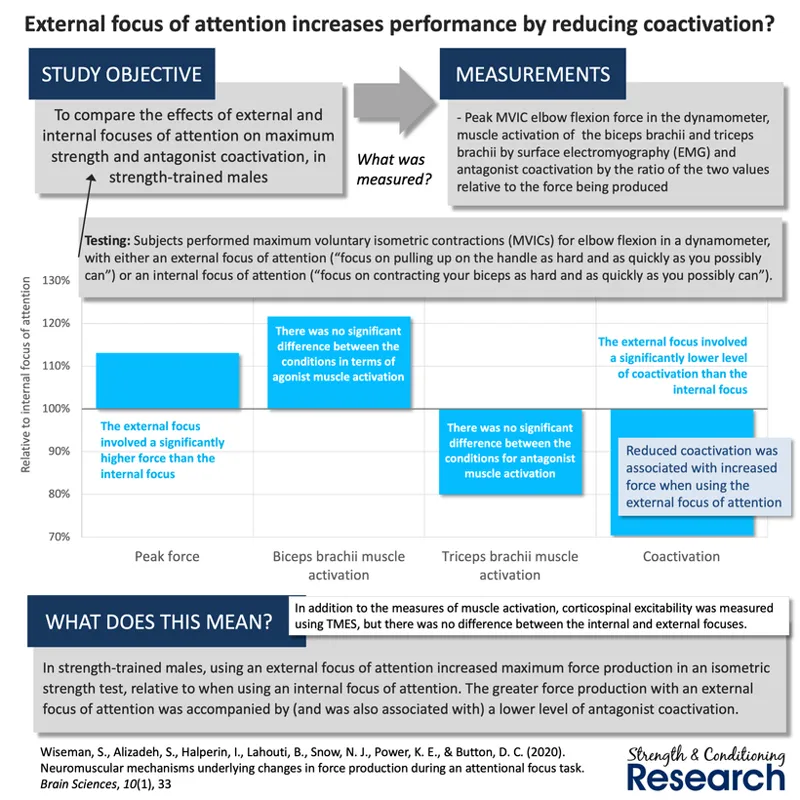
Using an external focus of attention also improves maximum strength during maximal effort lifts (even though this superior display of strength is again accompanied by a lower level of muscle activation). The reduced level of muscle activation when using an external focus of attention is an important observation, because it suggests that this psychological technique does not work in the same way as most other psychological techniques (such as verbal encouragement, autonomy, and feedback), which appear to work by increasing motivation, which increases effort, which increases the level of motor unit recruitment (and therefore the level of muscle activation).
.
Indeed, one mechanism that seems to contribute to this higher level of strength when using an external focus of attention is a reduced level of antagonist coactivation. This reduced level of antagonist coactivation could permit a superior level of external force to be displayed even if the level of agonist muscle force were similar or even lower.
.
#3. Immediate effects on athletic performance
Using an external focus of attention improves many measures of athletic performance, including throwing distance, vertical jumping height, horizontal jumping distance, and sprint running speed. This superior level of performance seems to be associated with real changes in movement patterns (and not just alterations in the amount of external force produced at a joint relative to the force produced by the agonist muscle, which result from changes in the level of antagonist coactivation). This is particularly obvious when looking at the standing long jump, in which the take-off angle plays a large role in the distance that can jumped. Using an external focus of attention improves this take-off angle, which suggests that the movement pattern itself has been altered.
.
#4. Long-term effects on strength and athletic performance
As might be expected based upon the way in which an external focus of attention works, long-term skill-based training with an external focus of attention improves motor learning. In this way, we might expect the use of an external focus of attention to enhance strength training performance in a particular exercise, such as the squat or deadlift. However, we might not expect any major transfer effects of this enhancement to other exercises that make use of the same muscle group.
.
In this way, using an external focus of attention differs from the other psychological techniques (such as verbal encouragement, autonomy, and feedback). These techniques probably work predominantly by increasing motivation, which increases effort, which in turn increases the level of motor unit recruitment. Consequently, their beneficial effects on long-term strength gains are probably caused by superior increases in voluntary activation (which is the ability to recruit high-threshold motor units).
.
This is important, because increases in the ability to recruit high-threshold motor units are very transferable between exercises that use the same muscle group. Thus, when we employ these psychological techniques to enhance strength gains in a strength training exercise, those improvements will transfer easily to the movements used in sport. This contrasts with the strength gains that occur due to coordination improvements, which will not.
.
Having said that, there is evidence that autonomy also enhances motor learning. Interestingly, when this happens, the effects of using an external focus of attention and experiencing autonomy are additive. Whether this is because the two techniques are working through the same or different mechanisms is unclear, however.
.
Conclusions
Adopting an external focus of attention can bring about immediate improvements in repetition strength, maximum strength, and many measures of athletic performance (including throwing distance, vertical jump height, horizontal jump distance, and sprinting speed). An external focus of attention appears to improve the coordination of the movement, while reducing the level of antagonist coactivation. Indeed, when using an external focus of attention during a training program, the rate of motor learning is enhanced, which accelerates gains in movement skill (and likely exercise performance). Yet, by working through this mechanism, training with an external focus of attention probably predominantly benefits only the exercise that was trained. We should expect little transfer to other movements, in contrast to other psychological techniques that enhance voluntary activation levels (both during a bout of exercise and also over a long-term training program).