





Internal focus of attention
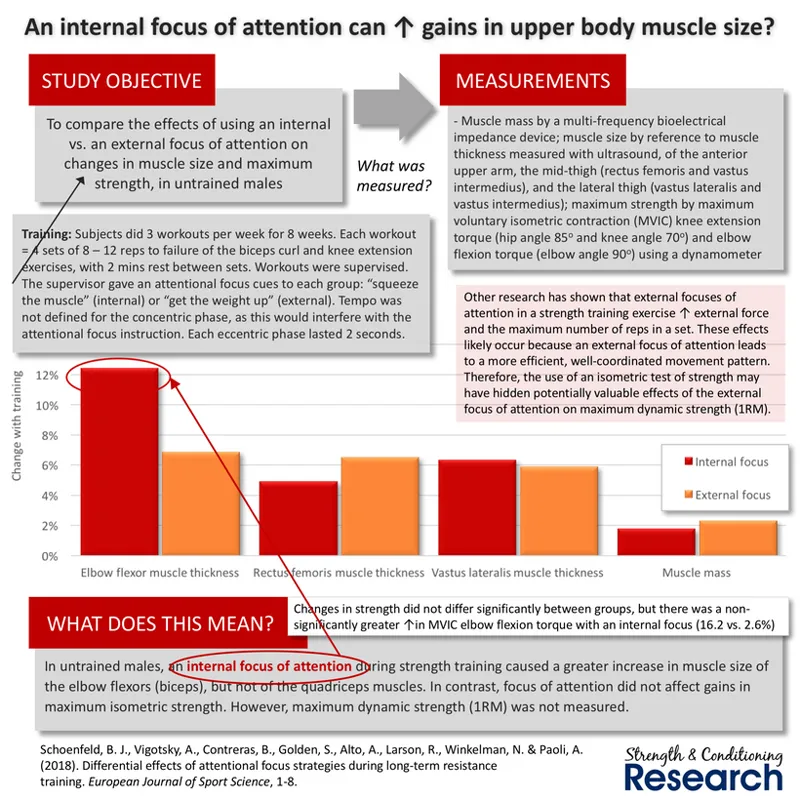
Bodybuilders have used an internal focus of attention (the mind-muscle connection) during training for many years, in the belief that it enhances muscle growth. Yet, the benefit of using an internal focus of attention for hypertrophy was only demonstrated in the research literature relatively recently. When it was discovered, it was very surprising, because a great many other studies have shown that using an external focus of attention is superior for enhancing external force production during exercise.
.
#1. Using an internal focus of attention increases hypertrophy
Using an internal focus of attention during strength training seems to enhance muscle growth. This contrasts with studies that have found that using an external focus of attention seems to enhance gains in maximum strength and other measures of exercise performance. Moreover, the exact mechanism by which an internal focus of attention might enhance hypertrophy is unclear.
.
#2. Using an internal focus of attention reduces performance, but increases muscle activation
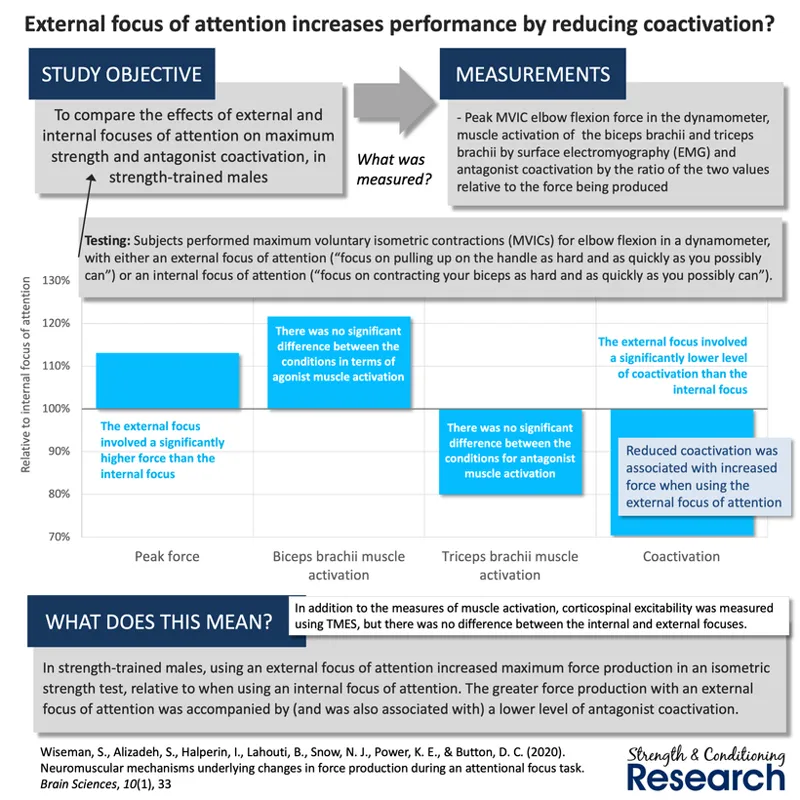
When trying to identify why an internal focus of attention increases hypertrophy, researchers have often noted that the same technique tends to increase muscle activation during a rep, even when this rep is performed with maximal effort. Nevertheless, despite this greater level of muscle activation, the maximum external force that is exerted is actually lower when using an internal focus of attention.
.
Additionally, the maximum number of reps that can be performed in a set of a strength training exercise taken to muscular failure is also lower when using an internal focus of attention. This observation is probably linked to the fact that maximum force is lower during a maximal effort. In both cases, the internal focus of attention leads to higher levels of muscle activation for a given level of force, which means that the exercise is much less efficient.
.
#3. Why does using an internal focus of attention increases muscle activation?
When trying to identify why greater levels of muscle activation occur during an effort that is performed with an internal focus of attention (compared to either no focus of attention or to an external focus of attention), researchers have found that coactivation levels are increased with an internal focus of attention. This makes sense, because an increased level of antagonist activation would make the exercise less efficient, and lead to higher levels of agonist muscle activation for a given level of external force.
.
Nevertheless, a higher level of antagonist coactivation when using an internal focus of attention cannot explain why using an internal focus of attention produces greater hypertrophy. Antagonist coactivation acts essentially like external resistance as far as the agonist muscle is concerned. Thus, using an internal focus of attention with a load that would normally be 8RM converts that set into a 6RM or a 7RM, which has no effect on its hypertrophic effect.
So what might be causing the benefit of an internal focus of attention?
One recent study provides a useful insight. When performing static cocontractions (flexing), activation levels of the agonist and antagonist can vary relative to each other, depending on the internal focus of attention that is used, and yet this does not cause the joint to move (even though the joint is free to move). This tells us that the activation of a muscle can increase without this increasing joint torque. The only way that this could happen would be if a region of the muscle were activated that had very poor leverage for producing joint torque at that particular joint angle.
.
Normally, during any given movement, the motor units of a muscle will be recruited such that only the regions that have the best leverage for the movement are activated. This occurs as a result of the principle of neuromechanical matching. However, if the command sent to the muscle is associated with a static "flexing" motor pattern rather than with a movement pattern (as occurs with an internal focus of attention), then this might interrupt the general effect of the principle of neuromechanical matching and cause regions of the muscle to be activated that do not actually have very good leverage for the movement.
.
Conclusion
Using an internal focus of attention (a mind-muscle connection) increases levels of muscle activation in muscular contractions, even while it reduces the level of external force that is produced. This seems to occur partly due to increased coactivation, because increased antagonist muscle activation reduces external force for a given level of agonist muscle force. Yet, a higher level of coactivation cannot explain the greater hypertrophy that is observed after long-term strength training with an internal focus of attention. One plausible explanation for this is that an internal focus of attention activates additional regions of a muscle that have very poor leverage for the movement in defiance of the principle of neuromechanical matching (which explains why external force is not increased despite increased muscle activation and also explains why hypertrophy is greater, because additional regions are stimulated to grow).
Comments (3)
Love the implications here in working with folks with hypermobility to encourage cocontraction.
Great article. Completely off subject - any chance to see best way to train abdominal with anatomy/regional anatomy/internal moment arm length/working sarcomere length/susceptibility to muscle damage (proportion of fiber type and voluntary activation)?
TBH, I don' think there is enough information to build the article. But I will be revisiting muscles later in the year, so I will take another look.