



Plyometrics
Plyometrics are commonly used to enhance athletic performance, and are often believed to work by enhancing stretch-shortening cycle (SSC) function. But how does this actually happen?
.
#1. What is a stretch-shortening cycle (SSC)?
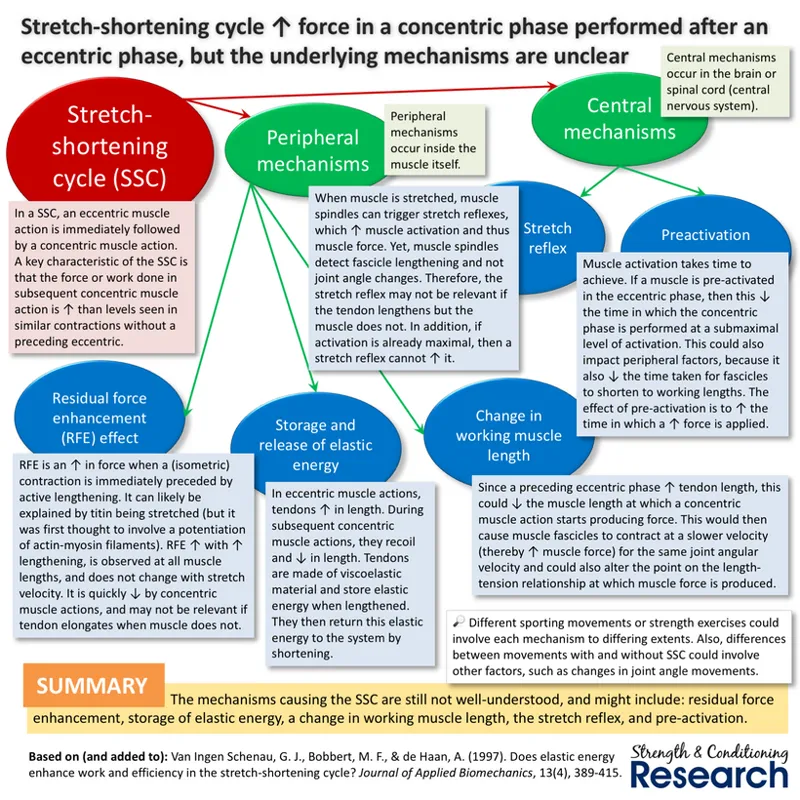
A SSC is a concentric contraction that is immediately preceded by an eccentric contraction. The SSC effect is the extent to which concentric speed, power, and force are increased when the concentric phase is preceded by an eccentric, compared to when it is performed from a standing start. While the SSC is often described as a single phenomenon, it is probably produced by at least five mechanisms.
.
#2. How important is the SSC in high-velocity movements?
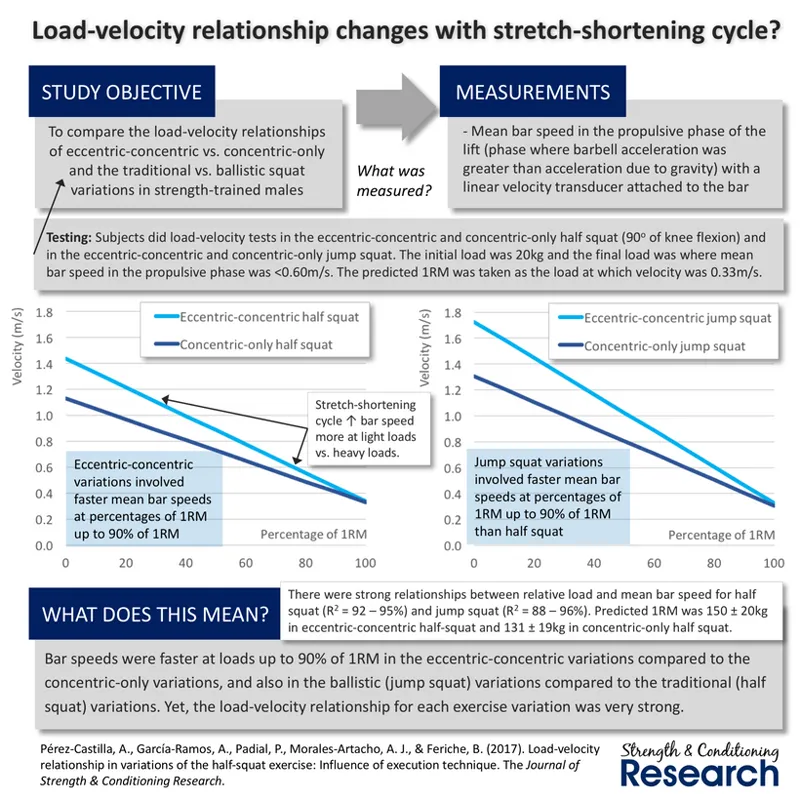
The SSC is far more important in high-velocity movements (like plyometrics). This can be established simply by calculating the SSC effect over a range of loads. The SSC effect is larger with lighter loads.
.
This observation has been made repeatedly in a number of similar investigations of different exercises.
.
#3. Can the SSC adapt after plyometric training?
The SSC does seem to adapt after plyometric training. Specifically, the way in which the muscles and tendons interact with one another changes. After plyometric training, the muscle fascicles shorten to a smaller extent in the concentric phase, and they shorten less quickly. This must happen because the tendon lengthens more in the eccentric phase, and hence shortens more in the concentric phase. This benefits [1] elastic energy storage in the tendon (since tendon elastic energy storage is greater when tendon lengthening is greater), and also [2] muscle force (since less muscle shortening means that the muscle shortens more slowly for the same movement speed and hence generates a higher force due to the force-velocity relationship).
.
#4. How does the SSC adapt after plyometric training?
Although it is commonly assumed that plyometrics improve SSC and therefore athletic performance by increasing tendon stiffness, this is probably not the case. Indeed, several studies have shown that tendon stiffness is not increased after plyometric training, despite large improvements occurring in measures of athletic performance.
.
This makes sense, given that tendon stiffness is probably increased after it experiences a high mechanical load. Owing to the fast movement speeds, the tendon forces that are produced during plyometrics are relatively low in comparison with heavy strength training. Tendon stiffness often increases after heavy strength training, and increases are greatest after isometric training, which involves higher forces at the tendon due to the force-velocity relationship.
.
It seems more likely that plyometrics produce their adaptation in the SSC by increasing eccentric strength (also called active muscle stiffness) relative to tendon stiffness. When tendon stiffness exceeds active muscle stiffness, the tendon pulls the muscle to a longer length in the eccentric phase, which means that it must shorten to a greater extent in the concentric phase. In contrast, when active muscle stiffness exceeds tendon stiffness, the muscle pulls the tendon to a longer length in the eccentric phase, which means that the muscle shortens less in the concentric phase, and thereby produces a higher force in that phase.
.
Conclusions
A stretch-shortening cycle (SSC) is any concentric contraction that is immediately preceded by an eccentric contraction. The SSC effect can be measured as the extent to which concentric phase exercise performance (measured by speed, power, or force) is increased when the concentric phase is preceded by an eccentric contraction, compared to when it is performed without a preceding eccentric contraction. The SSC effect is probably caused by at least five separate physiological mechanisms. During high-velocity, plyometric movements, the most important SSC mechanisms are [1] elastic energy storage in the tendon due to tendon elongation, and [2] reduced muscle fiber shortening velocity, also due to tendon elongation. Hence, we can see that the extent to which the tendon lengthens during plyometric movements is a key determinant of the SSC. Plyometric training seems to increase the SSC effect by increasing eccentric muscle strength relative to tendon stiffness, such that the tendon elongates to a greater extent during the plyometric movement. By lengthening more, the tendon [1] stores more elastic energy, and [2] allows the muscle to lengthen and shorten less (and therefore shorten more slowly for the same joint angular velocity). This means that the muscle can produce more force during concentric contractions in accordance with the force-velocity relationship.
Comments (4)
Hi Chris, are there any adaptations occurring in the tendon itself that benefit high velocity strength as a result of high velocity training?
Good question. Currently, it looks like the major adaptations happen in the muscle rather than in the tendon. I wouldn't rule out some minor changes in tendon elasticity or compliance, but they don't seem to be as important as the muscle.
I completed an essay explaining that hypertrophy has a correlation to sprint speed and plyometrics (as the bigger you get the faster you are and more power you can produce). The marker seemed to think differently but I would like to have you opinion on this?
This question is difficult to answer for two reasons. Firstly, while increased muscle size does contribute substantially to increased force production (and power output) at slow contraction velocities, it does not always have the same beneficial effect at fast contraction velocities, because of a simultaneous increase in the muscle moment arm length and an increase in tissue inertia (which have negative effects). Therefore, when muscle size is increased by strength training, the increase in the ability to produce force (and power) at fast speeds is much, much smaller than the increase in the ability to produce force (and power) at slow speeds. Indeed, it is well-known that gains in maximum strength after strength training are much smaller than the gains in speed.