





Blood flow restriction – hypertrophy
Training with blood flow restriction (BFR) in combination with either light (16–30RM) or very light (lighter than 30RM) loads is often wheeled out as a "proof of concept" that metabolite accumulation causes hypertrophy. However, looking at the fatigue mechanisms provides a different story.
.
#1. How does applying BFR during exercise affect peripheral fatigue?
It is well known that the application of BFR accelerates the development of fatigue. It does this by reducing the blood flow out of the muscle, which reduces the ability of metabolites to leave the muscle during exercise. Therefore, a key effect of BFR is to accelerate the rate at which metabolite-related fatigue mechanisms develop. Importantly, when considering muscular contractions without BFR, intramuscular pressure differs quite a lot between moderate loads and light or very light loads. With moderate loads, the intramuscular pressure is high enough that blood cannot flow out of the muscle anyway (irrespective of whether there is BFR in place or not). In contrast, when lifting light loads, the intramuscular pressure is not sufficient to prevent blood (and metabolites) from leaving the muscle during the lifting phase of the exercise. Thus, we might expect that BFR will change the rate at which metabolite-related fatigue develops far more when it is applied to the muscle while we are lifting light or very light loads compared to when it is applied to the muscle while we are lifting moderate loads.
.
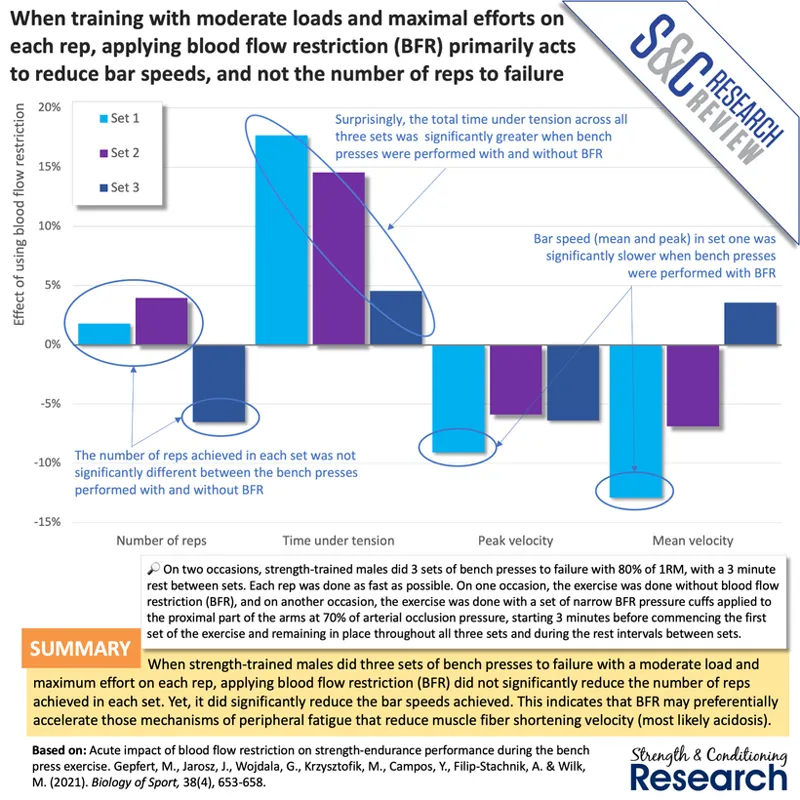
Indeed, this is exactly what happens. When applying BFR during strength training with moderate loads, the number of reps that can be achieved when training to failure is not actually reduced. This is because the blood flow out of a muscle is already occluded when contracting against a moderate load. Any effect of BFR is very small, since it only alters the situation in the very small period of time between each rep, when the muscle is relaxed.
.
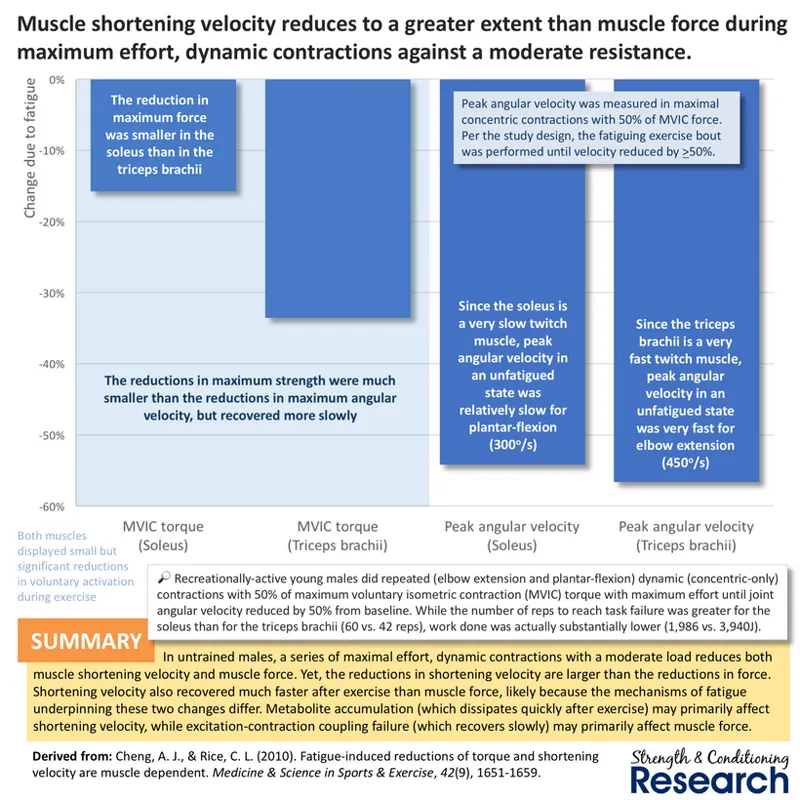
Even so, when lifting moderate loads, BFR does still reduce the maximum bar speed that can be achieved on each rep. This makes sense, because metabolites produce a much greater effect on muscle fiber shortening velocity than on muscle fiber force. This suggests that the metabolite-related fatigue is an important contributor to overall fatigue during a strength training set performed with BFR.
.
#2. How does applying BFR during exercise affect central nervous system (CNS) fatigue?
Since BFR involves a high level of discomfort, and therefore must involve a high degree of afferent feedback from the muscle to the brain, it seems plausible that it could generate a high degree of CNS fatigue. This CNS fatigue could then prevent the muscle from reaching a high level of motor unit recruitment, which is a key requirement for stimulating hypertrophy of the whole muscle. Even so, when researchers have compared strength training with and without BFR with the same load and the same number of reps, they have found that the increased fatigue produced with BFR predominantly causes greater peripheral fatigue (likely through metabolite-related mechanisms) and only slightly greater CNS fatigue.
.
#3. How does BFR affect motor unit recruitment?
When BFR is applied to a muscle while subjects are doing a a submaximal isometric contraction at a prescribed level of force, the level of motor unit recruitment is increased. The presence of the BFR (and hence of metabolites) causes the subjects to fatigue more quickly. To maintain the required level of force, they then have to increase their effort levels, which in turn is what increases the level of motor unit recruitment. While it has often been suggested that metabolite accumulation can directly cause increased motor unit recruitment, this is actually not correct. Motor unit recruitment levels are entirely under voluntary control.
.
#4. Does the accumulation of metabolites cause hypertrophy?
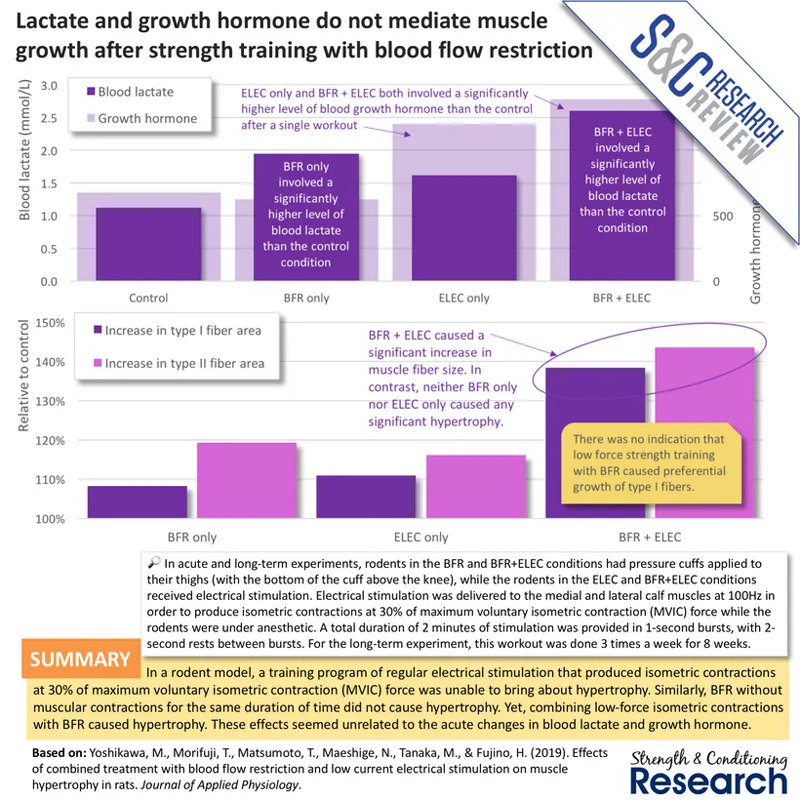
Recent research has demonstrated that the accumulation of metabolites in and around the muscle by the application of BFR does not stimulate hypertrophy in humans or in rodents, when cuffs or wraps are applied to resting muscles. This strongly suggests that the presence of the metabolites alone is not a stimulating event for muscle fibers to increase in size.
.
Research has also shown that lactate and growth hormone specifically are not involved in producing hypertrophy. Similar results would be expected for the other key metabolites, such as hydrogen ions and phosphates.
.
#5. How does BFR produce hypertrophy?
Nevertheless, it is clear that when using BFR during light load strength training, this produces similar hypertrophy to more conventional strength training methods. This contradicts suggestions that the only increases in muscle size that occur after training with BFR are produced by muscle swelling.
.
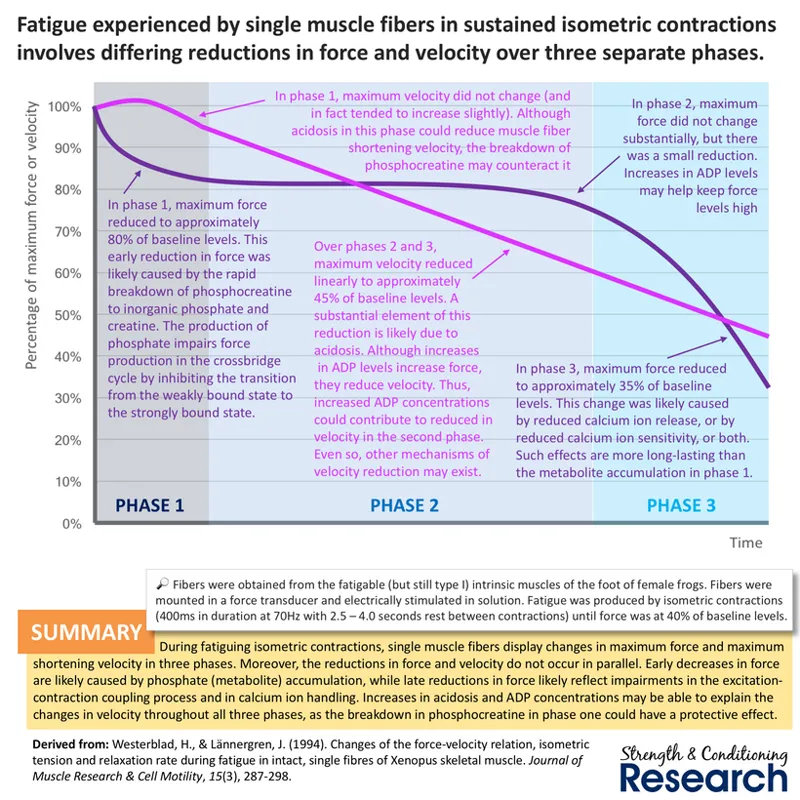
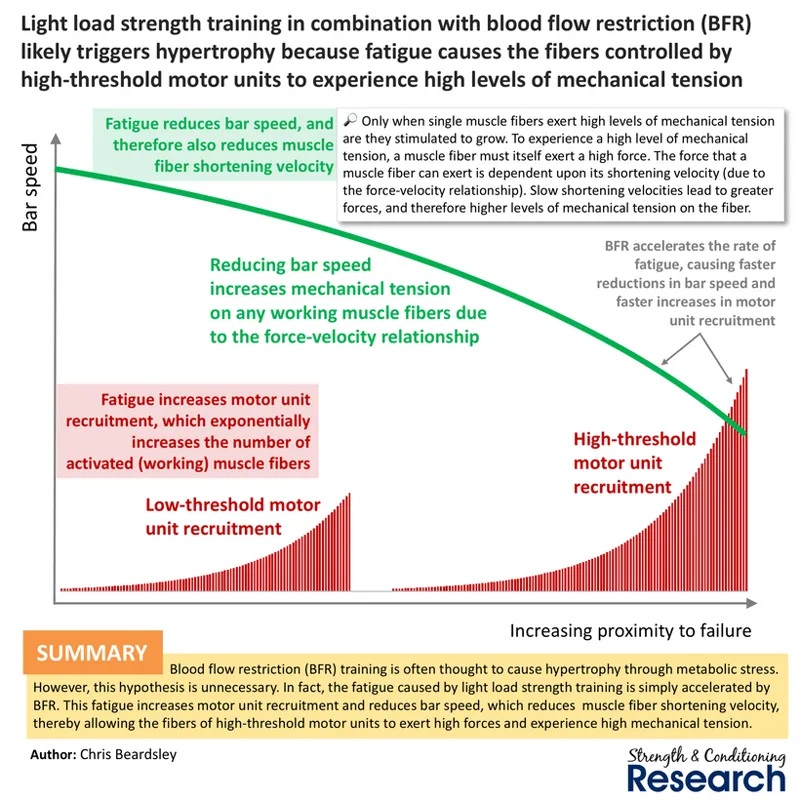
To understand how light load strength training with BFR produces hypertrophy, it helps to understand how the slow twitch and fast twitch muscle fibers fatigue during a set performed to failure. Indeed, the peripheral fatigue that during strength training occurs in phases. After the initial phase that relates mainly to the breakdown of phosphocreatine, the main mechanism involves a reduction in muscle fiber shortening velocity as a result of acidosis, while muscle fiber force (and therefore mechanical tension) is not affected. Later on, as muscle fibers are continually stimulated, they experience excitation-contraction coupling failure, which affects muscle fiber force quite markedly.
.
During light load strength training with BFR, effort levels are low at the start of the set, which means that only the muscle fibers of low-threshold motor units are activated. These muscle fibers remain activated throughout the set all the way to muscular failure. As a result of being activated for a long period of time, they tend to move through all three phases of peripheral fatigue, and therefore their single fiber forces are reduced before the end of the set. Also, slow twitch muscle fibers tend to experience proportionally more excitation-contraction coupling failure than metabolite-related fatigue, due to their more oxidative nature. As the set progresses and the slow twitch muscle fibers that belong to low-threshold motor units experience fatigue, effort must be increased to recruit some high-threshold motor units to compensate for the losses in force that are occurring. When this happens, the muscle fibers quickly start experiencing losses in shortening velocity, and this leads the lifter to exert additional effort to maintain the desired tempo. Even so, the effect on muscle fiber force (and therefore mechanical tension) is much smaller than the effect on muscle fiber shortening speed. Thus, the end result is that the muscle fibers high-threshold motor units end up shortening quite slowly at the end of the set, and this allows them to exert high forces, in accordance with the force-velocity relationship.
.
Conclusions
Training with blood flow restriction (BFR) in combination with light (16–30RM) or very light (lighter than 30RM) loads is often wheeled out as a "proof of concept" that metabolite accumulation causes hypertrophy. Even so, this proposal is based on an incorrect understanding of how muscle growth is stimulated. Hypertrophy requires [1] a high level of motor unit recruitment, and [2] a high level of single muscle fiber mechanical tension produced by a slow concentric movement speed. If we review how fatigue mechanisms develop as a result of adding BFR to a strength training set, we can see that neither of these features are negatively affected. During a strength training set, applying BFR reduces the flow of blood out of a muscle. This causes metabolites to accumulate more quickly, such that mechanisms of metabolite-related fatigue develop faster. Since metabolite-related fatigue does not negatively affect the single muscle fiber mechanical tension that stimulates hypertrophy, we should not expect this to produce any negative impact on the ability of a strength training set to stimulate muscle growth. Also, while central nervous system (CNS) fatigue does occur in strength training sets performed with BFR, such that motor unit recruitment levels are slightly reduced, levels of CNS fatigue are not greater than when BFR is absent, despite the apparently greater negative sensory feedback that is often reported. Again, we should not expect BFR to produce any negative impact on the ability of a strength training set to stimulate muscle growth. It seems clear that strength training with light or even very light loads in combination with BFR produces hypertrophy by means of exactly the same mechanisms as normal strength training with heavy or moderate loads.
Comments (6)
Hey Chris Is it fair to say that in light of the published research on BFR muscle hypertrophy is similar between moderate loads without BFR and light/very light loads with BFR? Would this still be the case for trunk muscles? It would appear that in terms of research most studies employ a variation of 20-30% RM, 4 sets, 30 reps/15 reps/15 reps/15 reps, with 15 to 30 seconds rest between sets for training a muscle group. Do you have reasons to believe this might not be optimal? Lastly, if you were to design a training regimen using BFR, how many muscle groups would you be inclined to target per session (perhaps there’s a difference in upper vs lower body?), and how many such sessions would be part of a week? Thanks!
(1) Hypertrophy is similar after training with the same number of sets of moderate loads (to failure) or light loads (to failure), whether BFR is applied or not. In addition, hypertrophy is similar after training with the same number of sets of moderate loads (to failure), light loads (to failure), and very light loads with BFR (to failure).
Thats very interesting. It makes sense why bfr training seems to be superior for strength when compared to done without it at the same load with the increased motor unit recruitment yet less central fatigue. Has there been any research done on bfr with moderate or heavy loads, or even with high velocity movements? Wondering if this phenomena would lead to greater strength there as well?
To my knowledge, there's only a couple of acute studies assessing the effects of BFR during maximal effort strength training with moderate loads (one of those studies is the second infographic in the above article). So it's not clear how what kind of long-term effects would occur. However, the acute research seems to indicate a very large reduction in bar speed, which is totally logical given that the main effect is to produce a more rapid accumulation in metabolites (which mainly affect muscle fibers shortening velocity). So my expectation would be that BFR would not be as effective for high-velocity strength as for maximum strength.
Hey Chris, I remember in a previous scrr issues, sometime last year, you mentioning the possibility that bfr training could potentially cause specific type 2 fiber growth. Do you still have these same thoughts and if so is it because of the increased fatigue and high threshold motor units being recruited more quickly than in normal strength training? Thanks!
I actually can't find that edition where I expressed that opinion, LOL. I expect that I was trying to emphasize that it is more likely that BFR training would cause more type II rather than type I muscle fiber growth, in contrast to the suggestions that have been made to the contrary. Currently, I think that BFR training probably causes very similar local adaptations to moderately-heavy strength training, for two reasons. Firstly, metabolite-related fatigue occurs at a very fast rate, compared to similar load training without BFR. Secondly, CNS fatigue seems to be suppressed in some way by the presence of the blood flow restriction, which is currently not easy to explain because the increased metabolite accumulation would be expected to cause increased CNS fatigue due to afferent feedback. This is a paradox that I think about quite often, since it must involve an interesting mechanism that I don't understand yet. Certainly, I don't think that there would be preferential type II hypertrophy after BFR training to the extent that it happens after supramaximal, eccentric-only training.