







Immediate strength gains
Although we tend to think of strength as a fixed quality that we possess, our strength actually varies a great deal depending on the environment in which we find ourselves. By understanding how the environment affects our strength levels (and how this happens), we can enhance our ability to produce force in any given situation, and also affect the adaptations that we experience after a workout.
.
#1. The presence of other people
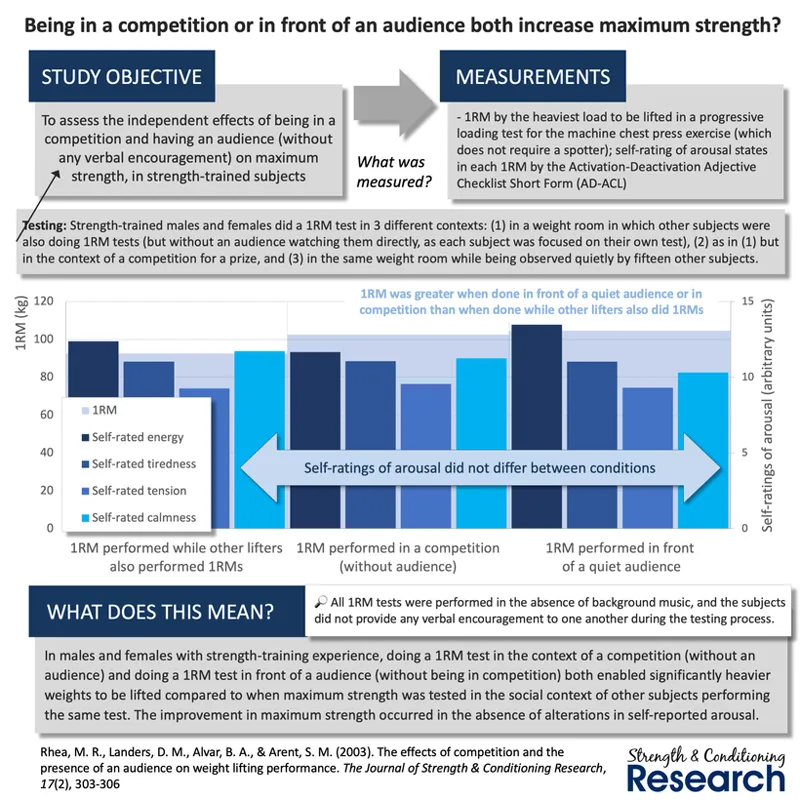
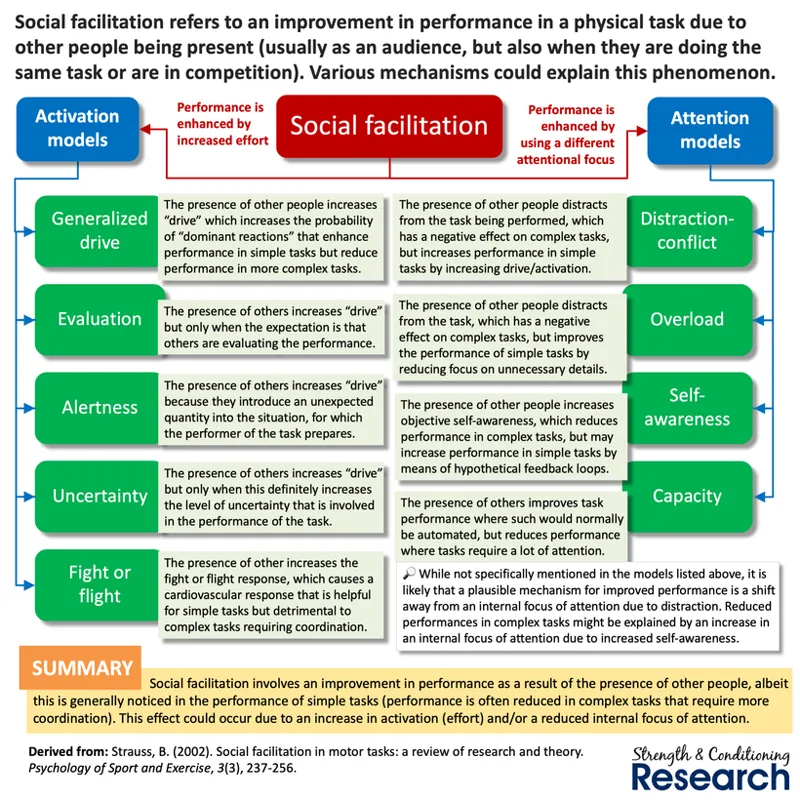
When other people are present, our ability to produce force can be increased due to a phenomenon known as "social facilitation". Typically, social facilitation only occurs when the physical task being performed is relatively simple (which includes many tests of maximum strength). In contrast, the presence of other people often has a negative effect when the physical task being performed is both complex and unfamiliar.
.
Researchers have proposed many mechanisms to explain the phenomenon of social facilitation, although these tend to fall into one of two categories. One category of mechanisms involves an increase in what psychology researchers have called "activation" and which seems to correspond to an increased state of arousal that increases motivation and therefore effort. Physiologically, this would be expected to increase strength by increasing the ability to access high-threshold motor units. A second category of mechanisms involves a shift in attentional focus, such that the individual performing the task is either distracted from themselves (leading to an increase in performance due to a reduction in any internal focus of attention) or alternatively made more self-aware (leading to a reduction in performance due to an increase in an internal focus of attention). Physiologically, a reduction in any internal focus of attention would be expected to increase strength by improving coordination, thereby making the movement more efficient.
.
#2. Autonomy
Autonomy refers to the amount of control that an individual has (or in reality perceives that they have) over their immediate environment. When autonomy is increased, individuals display higher levels of exercise performance, including strength.
.
While interventions designed to increase autonomy often influence the nature of the workout being performed (such as by altering exercise selection or order), this is probably not actually necessary. Autonomy can be provided over many simple aspects of the environment, such as which bench to use for a bench press exercise, which squat rack to use for squatting, and which barbell or plates to use for deadlifting. Just like social facilitation, autonomy probably works mainly by increasing motivation, which in turn increases the level of effort, and therefore also the level of high-threshold motor unit recruitment.
.
Importantly, this increase in the ability to recruit high-threshold motor units not only enhances strength gains, but also increases the amount of hypertrophy that occurs after strength training.
.
Nevertheless, there are also indications that experiencing more autonomy improves the rate of motor learning that occurs for a physical task. Such improvements would not be expected to occur by means of increased effort, but must occur instead due to an increased level of coordination during the task. This suggests that autonomy has a dual effect on exercise performance, and both increases levels of motor unit recruitment and coordination.
.
#3. Verbal encouragement
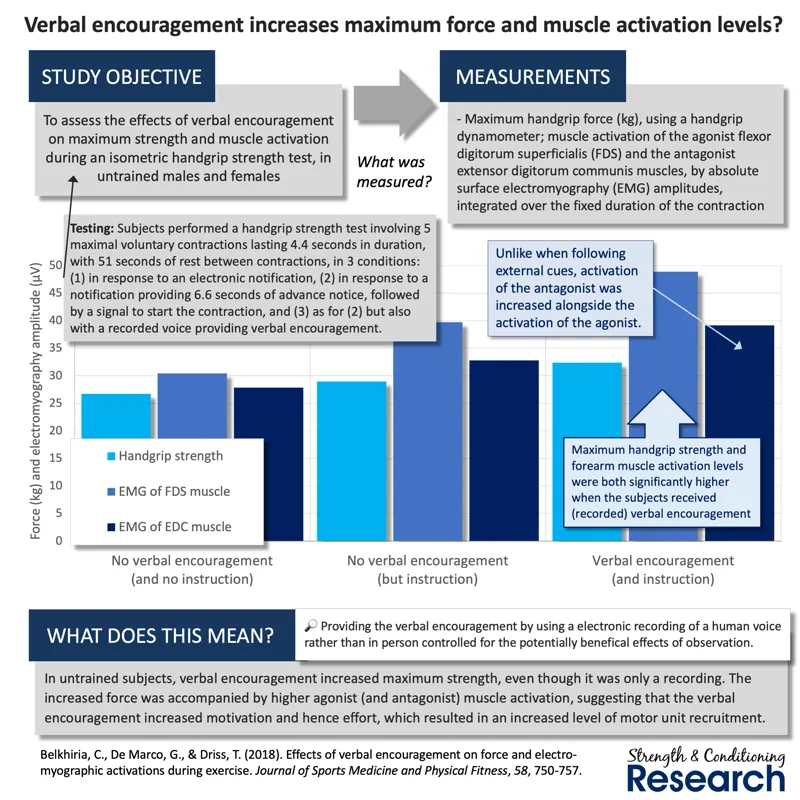
Verbal encouragement surprisingly does not always enhance performance in exercise tasks. Even so, when it does cause a beneficial effect, it seems to work by increasing the level of effort (and therefore motor unit recruitment), as indicated by increases in agonist muscle activation.
.
#4. Music
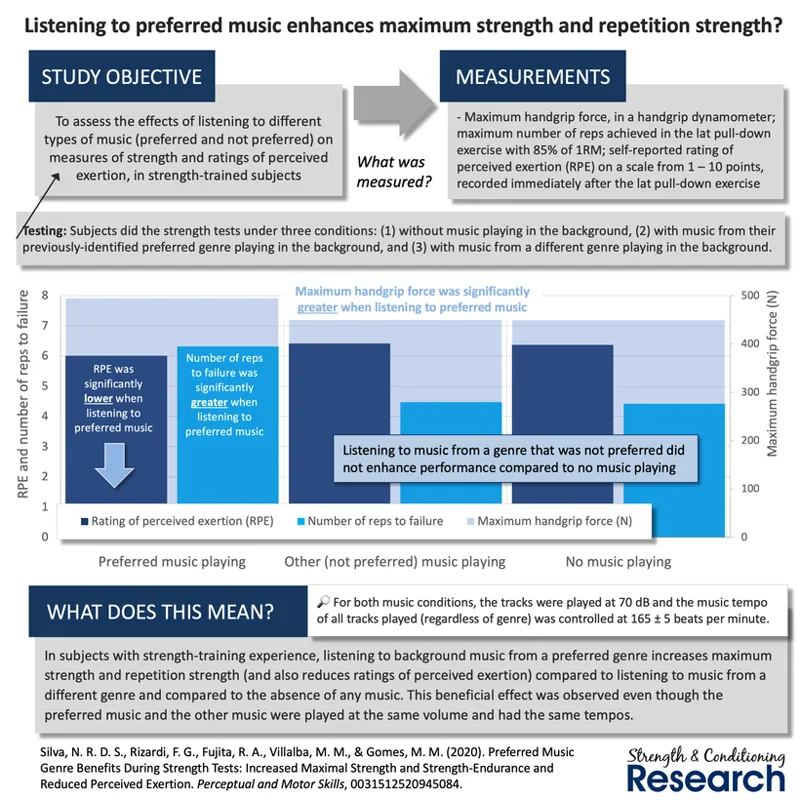
Background music often improves the ability to produce force, particularly when this music is louder or has a fast tempo. Given the beneficial roles played by volume and tempo, it seems likely that the mechanism involves an increase in arousal and therefore an increase in motivation and effort, and subsequently motor unit recruitment.
.
The type of music being played also affects performance improvements, even when the volume and tempo are controlled. Preferred music seems to lead to greater strength gains than music from a genre that is not preferred. Such effects may also occur due to the effects of the music on motivation, since listening to preferred music may improve mood. Alternatively, listening to music from a genre that is not preferred may have a demotivating effect that reduces effort.
.
#5. Being provided with performance feedback
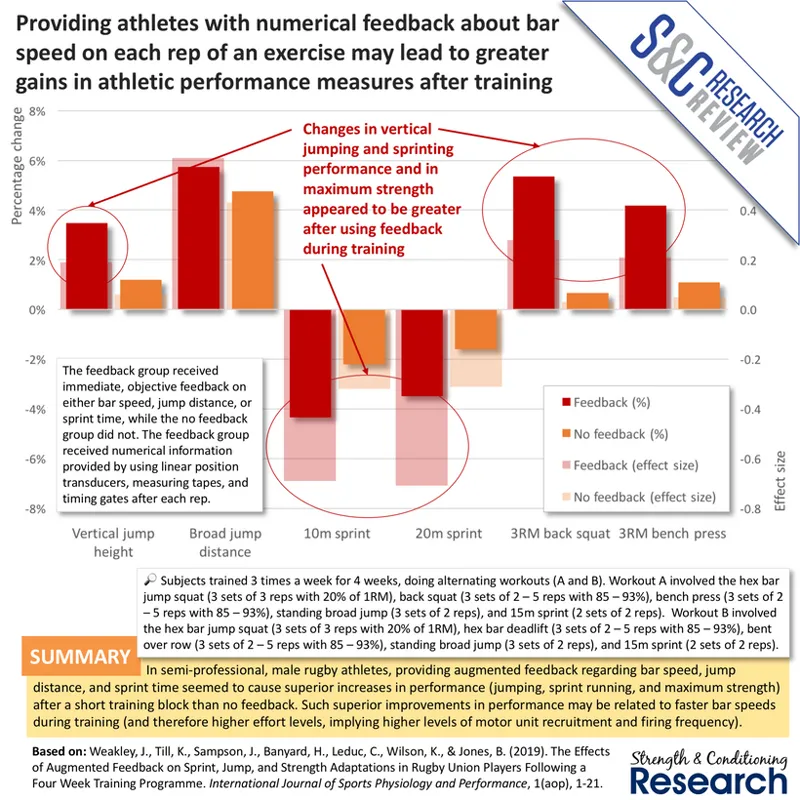
When individuals are provided with feedback about their performance (either during a sustained task, or after each individual rep during a sequence of reps in a set), they display higher levels of strength. This increased strength is associated with an increased level of voluntary activation, which indicates that the effect is mediated by an increase in motor unit recruitment, caused by an increase in effort.
.
Importantly, research has shown that the provision of feedback in the workouts of a strength training program leads to enhanced gains in both maximum strength and also in athletic performance, which would be expected if the mechanism of the increased ability to produce force was an increase in voluntary activation, since this would lead to larger long-term increases in the ability to recruit high-threshold motor units, which would transfer well to increases in strength in any movement.
.
#6. Being provided with a performance target
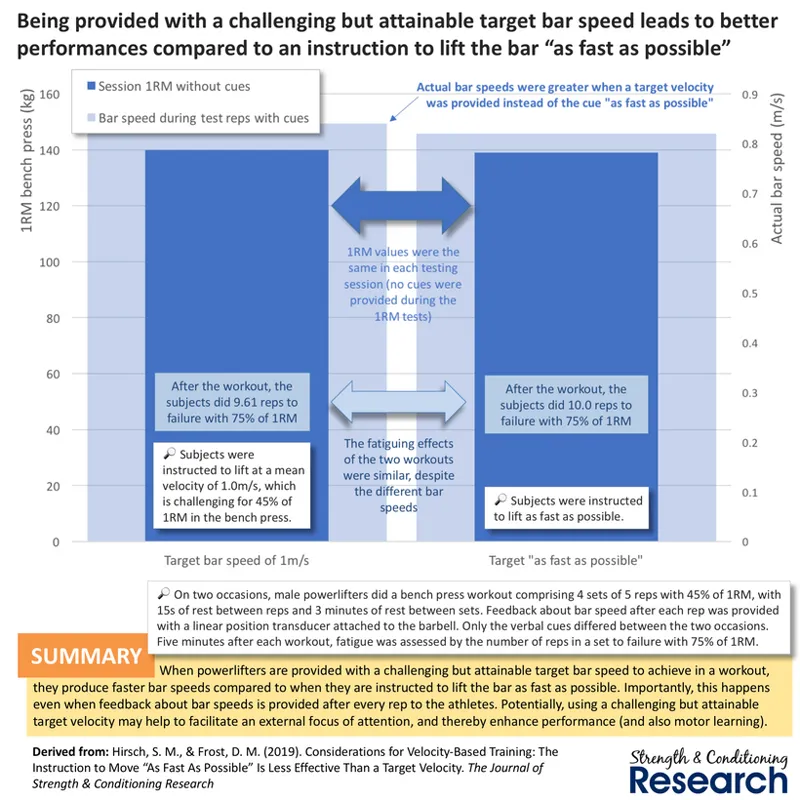
When lifters are provided with a challenging numerical target to attain during a strength training exercise (such as a bar speed), they tend to produce superior numbers. Importantly, this target is not a visible target, which would lead to an external focus of attention, and an improvement in performance due to enhanced coordination. Indeed, it seems likely that the numerical target is primarily motivating, by providing a goal to be achieved. In this way, the provision of a performance target probably works by increasing motivation and effort, and therefore by increasing the level of high-threshold motor unit recruitment that occurs.
.
#7. Being provided with an external focus of attention cue
When individuals use an external focus of attention, this is associated with improved external force production but reduced levels of muscle activation. This can only occur due to improved efficiency, due to increased coordination in the movement. Consequently, training with an external focus of attention is likely to produce larger strength gains in the trained exercise or movement than using no focus of attention or an internal focus of attention. However, the extra strength gains will not transfer particularly well to other exercises or movements (read more).
.
#8. Remote voluntary contractions
Many studies have shown that strength in an exercise can be enhanced when force is also produced in another part of the body by a “remote voluntary contraction” that causes “concurrent activation potentiation” in the exercise by means of a phenomenon known as "motor overflow". These related concepts are best illustrated by way of a simple example. When a lifter performs a handgrip contraction while performing a maximal knee extension strength test, then the handgrip exercise would be the remote voluntary contraction, and we would expect an increase in knee extension force (which is the concurrent activation potentiation phenomenon) by means of motor overflow from the forearm muscles to the quadriceps. Motor overflow involves a central motor command signal that is sent by the brain to one part of the body involuntarily spilling over to produce activation of another muscle in the body. By virtue of affecting the size of the central motor command, remote voluntary contractions must affect force production by increasing motor unit recruitment levels, albeit unusually not by increasing effort.
.
Conclusions
Although we tend to think of strength as a fixed quality that we possess, strength actually varies a great deal depending on our environment. Strength can be enhanced by an increase in the level of effort that is produced (since this increases the level of motor unit recruitment) or by an improvement in our coordination of a movement (since this makes the movement more efficient). Some environmental conditions (such as the presence of observers, background music, verbal encouragement, the provision of feedback, and the provision of a numerical performance target) seem to work mainly by increasing effort, while using an external focus of attention seems to work mainly by increasing coordination. Interestingly, autonomy seems to work through both mechanisms. For increasing transferable strength and hypertrophy, increasing effort is the priority. However, for increasing performance in the movement task being practiced, increasing coordination is the priority.
