





Fiber type proportion
Muscle fibers can be classified into types according to various criteria. One key factor that differs between muscle fibers is the maximum shortening speed that they are capable of achieving. Indeed, some (slow twitch) muscle fibers can only reach very slow maximum shortening speeds, while other (fast twitch) muscle fibers can reach very fast maximum shortening speeds.
.
#1. Fiber type proportion affects the velocity-specificity of force production
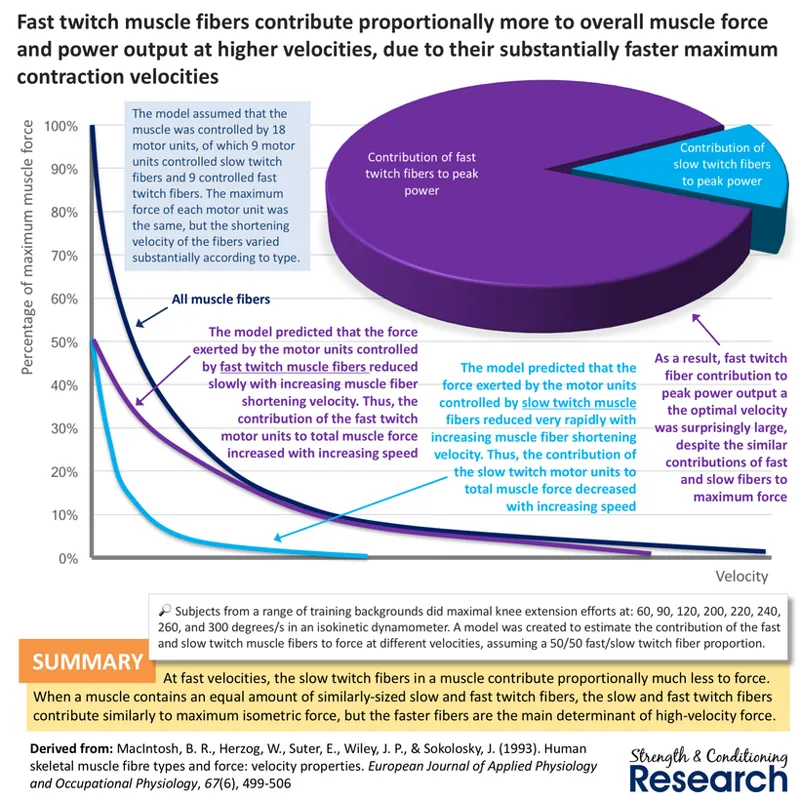
Some (slow twitch) muscle fibers have a slow maximum shortening speed (approximately 0.5 – 1.0 fiber lengths per second). Other (fast twitch) fibers have faster maximum shortening speeds. However, some fast twitch (type IIA) fibers have only moderately fast maximum shortening speeds (approximately 3 – 4 fiber lengths per second), while other fast twitch (type IIX) fibers have extremely fast maximum shortening speeds (approximately 5 – 6 fiber lengths per second). This makes for big differences between the maximum shortening speeds of most muscle fiber types. Such differences are much larger than the differences in muscle fiber size or maximum strength.
.
When we test strength in high-velocity contractions, force can only be produced by those fibers that are capable of shortening at the required speed. Thus, in many high-velocity strength tests (and in many athletic movements such as vertical jumping), force is only produced by fast twitch muscle fibers. The slow twitch muscle fibers are activated, but they cannot produce force at those fast speeds, since their maximum shortening speeds are too slow.
.
Consequently, when we test strength at a range of speeds, we find that individuals who have a higher proportion of fast twitch muscle fibers typically achieve superior performances (relative to other individuals) at fast speeds, but not necessarily at slow speeds.
.
Conversely, fiber type proportion does not affect powerlifting performance. Individuals with a greater proportion of fast twitch muscle fibers do not necessarily display superior maximum strength. This is because there are only minor differences between muscle fibers of each type in terms of the force that they produce per unit cross-sectional area. In contrast, there are very large differences in maximum shortening velocity.
.
#2. What causes fiber type shifts?
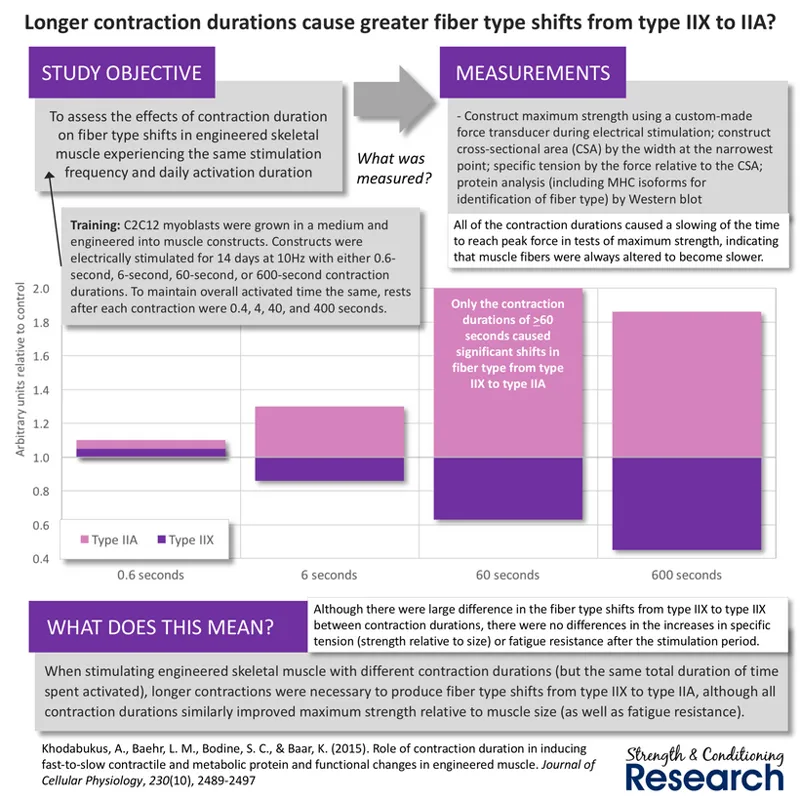
Muscle fiber type shifts commonly occur after most types of exercise, including aerobic exercise and strength training. The fastest and most common shift after all types of exercise is from the fastest fiber type (type IIX) to a moderately-fast type (type IIA). When targeting improvements in the ability to produce high-velocity force, training programs should avoid fiber type shifts. Recent research has shown that fiber type shifts are greater when higher volumes of strength training are performed.
.
Moreover, it has been demonstrated that while higher volumes of strength training are beneficial for improving maximum strength (which is measured at low velocities), lower volumes are actually superior for improving the ability to produce force at fast speeds, which is essential for athletic performance.
.
Also, training closer to muscular failure appears to produce greater shifts in muscle fiber type (from type IIX to type IIA) as well as smaller improvements in high-velocity strength measures.
.
The exact mechanisms that are involved in fiber type shifts are not known. Given that higher volumes and a closer proximity to failure (which involves a higher number of reps in each set) seem to produce larger fiber type shifts, researchers have suggested that the key stimulus could be either [A] the total amount of time that the muscle fiber spends being activated in the workout, or [B] the fatigue that the muscle fiber experiences. Recent research suggests that it is more likely to be the fatigue rather than the time spent being activated, because when total daily exercise volume is controlled, more sustained contractions (involving less fatigue) cause greater fiber type shifts.
.
Indeed, if the key mechanism that leads to fiber type shifts is fatigue rather than exercise volume, this would explain why cluster set configurations are superior to normal strength training configurations for improving the velocity end of the force-velocity profile, even when the exact same number of reps are performed in each case.
.
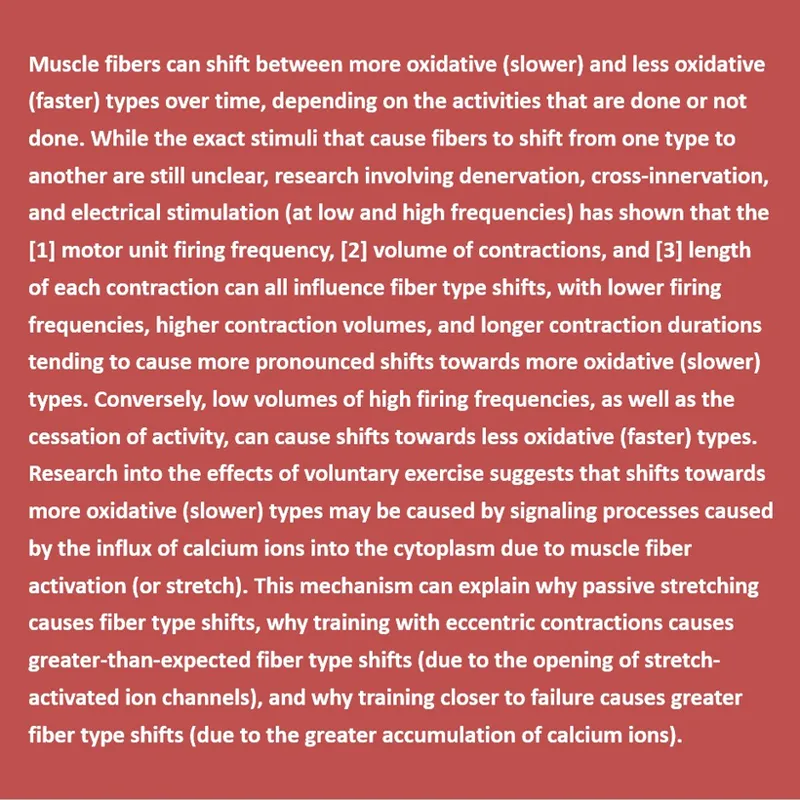
Overall, it seems very likely that the mechanism by which muscle fiber type shifts occur towards more oxidative types is by means of calcium ion accumulation (read more).
.
Conclusions
Athletes who have larger proportions of fast twitch muscle fibers are able to produce larger forces at fast speeds compared to athletes with smaller proportions of fast twitch muscle fibers, even when they have similar levels of maximum strength. This happens because slow twitch muscle fibers only contribute to whole muscle force if their maximum shortening speeds are faster than the shortening speed of the muscle in the movement. For this reason, slow twitch muscle fibers cannot contribute to whole muscle force production in fast movements like jumping and throwing, even though they are still activated. Since the maximum shortening speed of the working muscle fibers is the key to achieving high movement speeds and a high degree of high-velocity force production, it makes sense to preserve the fastest (type IIX) fibers as much as possible during strength training programs. Muscle fibers shift from type IIX to type IIA during strength training programs that involve higher volumes and closer proximities to failure (most likely because the mechanism by which muscle fibers shift towards a more oxidative type is by means of an accumulation of calcium ions during exercise). Consequently, lower workout volumes, velocity-based training (with small losses in bar speed over a set), and cluster set configurations are able to cause smaller muscle fiber type shifts and enhance gains in high-velocity strength.

Comments (9)
Thanks, Chris. I must try and find some more of your info on FV profiling.
Thank you, Chris. That is very helpful. I probably need to do some force velocity profiling. Something I find interesting about force velocity profiling is that the movement chosen nearly always seems to be vertical jumping and squatting, even though this may not be most important movement pattern to assess. Especially for rotational athletes. Force velocity profiling in rotational exercises is slightly more of a challenge though!
Yes, and the problem is that the force-velocity profile of an athlete probably is movement-specific, which is why researchers have started measuring force and velocity during sprinting for sprinters, instead of using the jumping movement.
Chris, these graphics are fantastic. In jumping and throwing, how much can type II A contribute? Are these movements slow enough? Can we we do enough stimulating reps far away from failure to cause hypertrophy of the type IIX, or does trying to promote hypertrophy of these fibers risk a negative shift to type IIA? What’s more valuable for jumping and throwing, maintaining type IIX or bigger type IIA? Sorry for the length questions!
In terms of maximum contraction velocity, the difference between type IIA and type IIX is much smaller than the difference between type I and type II (A or X). So I would expect that type IIA and type IIX always contribute to fast movements including jumping and throwing, but that the contribution of type IIA is smaller than the contribution of type IIX, because each fiber is working closer to its maximum contraction velocity, and therefore produces a smaller force.
Great article. Chris would this essentially also mean no periodization for athletes. I always heard the blocks for strength, hypertrophy, endurance matter. It would seem irrelevant or negative if any danger of reducing 2x fiber. Also do you know of any way to increase the 2x?
It does suggest that traditional block periodization of loads is unsuitable, yes. However, other factors can also be periodized, including exercises, and there is no reason why that cannot be done and still avoid reductions in type IIX proportion.
How would you design a protocol intended to produce some reasonable hypertrophy in key sprint muscles (glute max, hamstrings, hip flexors) with minimal "collateral" hypertrophy while also minimizing deleterious fiber shifts?
To minimize fiber type shifts, we just have to avoid fatigue as far as possible. That can be achieved either by using velocity-based training or cluster protocols, or simply by training with heavy loads and avoiding failure.