


Detecting CNS fatigue
Central nervous system (CNS) fatigue can be caused by strength training workouts, and often lasts for several days. When it is present, CNS fatigue prevents the recruitment of all high-threshold motor units, and this can reduce the adaptations that are stimulated by a workout. Thus, it can be helpful to identify whether CNS fatigue is still present before beginning a workout.
.
#1. Post-workout CNS fatigue can last for several days
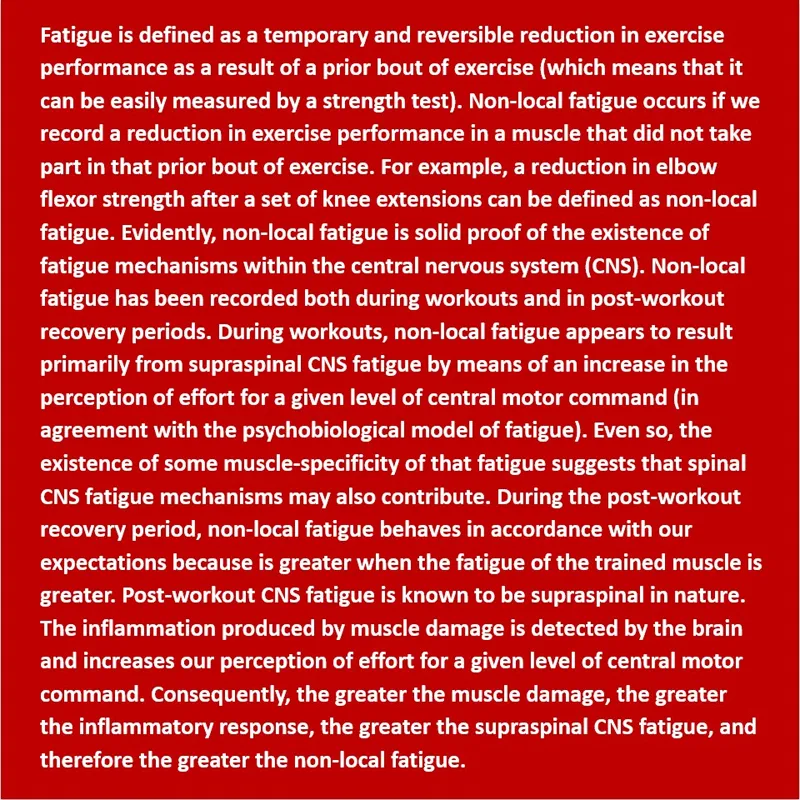
CNS fatigue often lasts for days after a strength training workout. It seems to be caused by the inflammatory response to the muscle damage that is caused by exercise (read more).
.
#2. Non-local measurements can be used to detect CNS fatigue
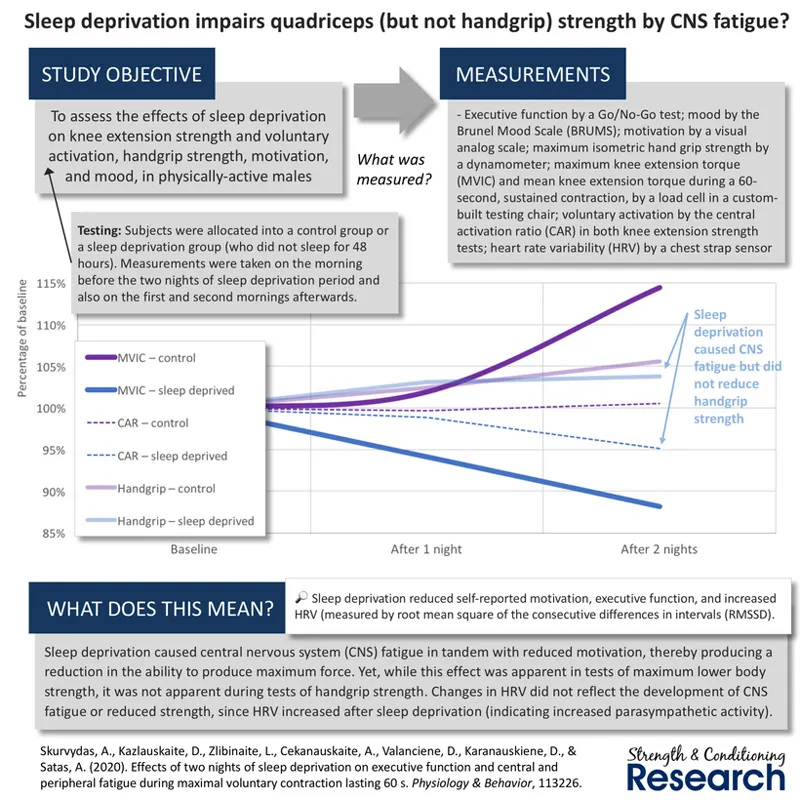
In the laboratory, CNS fatigue is measured by reference to reductions in voluntary activation. Such measurements are not practical for use with athletes in the gym. Yet, CNS fatigue can also be detected by reference to the presence of non-local fatigue. Non-local fatigue refers to the presence of fatigue in an untrained limb after a workout (read more).
.
Non-local fatigue is fairly straightforward to assess when an upper-lower training split is being used (by athletes) or when a body part split is being used (by bodybuilders). In such cases, an upper body exercise test can be performed in the days after a lower body workout, and a lower body exercise test can be performed in the days after an upper body workout. In the case of an upper-lower split, a lower body exercise test will likely be done immediately before a lower body workout (since this will be done a day or two after an upper body workout). Similarly, an upper body exercise test will likely be done immediately before an upper body workout (since this will be done a day or two after a lower body workout).
.
#3. Handgrip strength is not a useful measurement
Some strength coaches implement handgrip strength tests to screen for the presence of CNS fatigue. Even so, the research has shown that CNS fatigue can be present even when handgrip strength is not affected. This is probably because smaller muscles tend not to experience as much CNS fatigue as larger muscles. Thus, handgrip strength is not a useful measurement for detecting the presence of CNS fatigue.
.
#4. High-velocity measurements are probably most sensitive
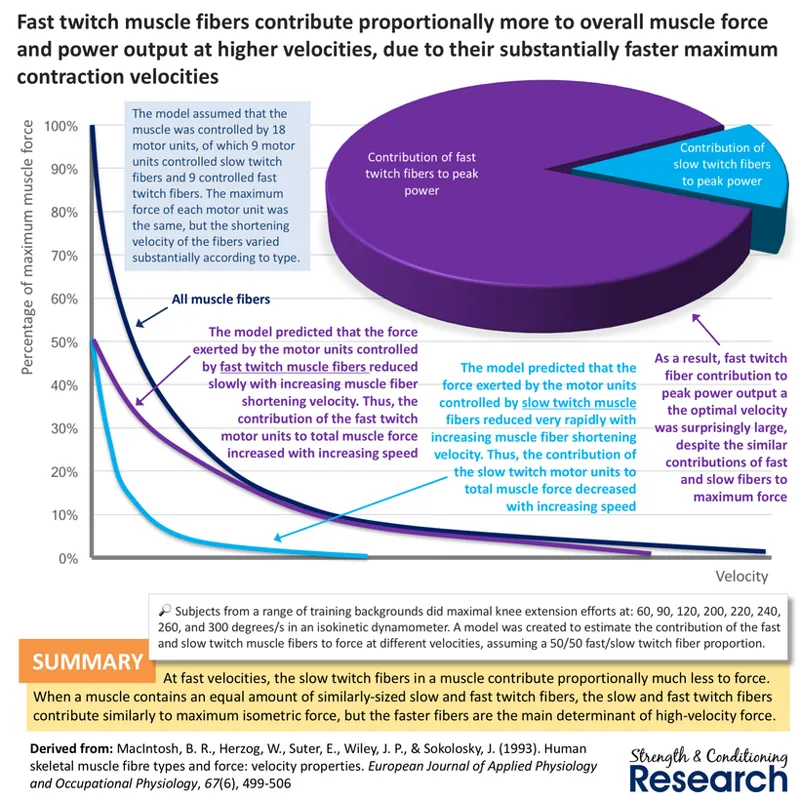
Physiologically, we would expect a high-velocity strength test to be a more sensitive measurement of CNS fatigue than a low-velocity strength test. This is because low-velocity strength tests involve force being produced by all muscle fibers within the muscle. In contrast, high-velocity strength tests involve force being produced by only the fast twitch fibers of the muscle (even though all muscle fibers are activated). This happens because only the fast twitch fibers can shorten fast enough to produce force in a high-velocity strength test, such as a vertical jump or a throwing action. Therefore, vertical jump height and throwing distance (or velocity) are probably the best ways to assess the presence of CNS fatigue, by recording non-local fatigue.
.
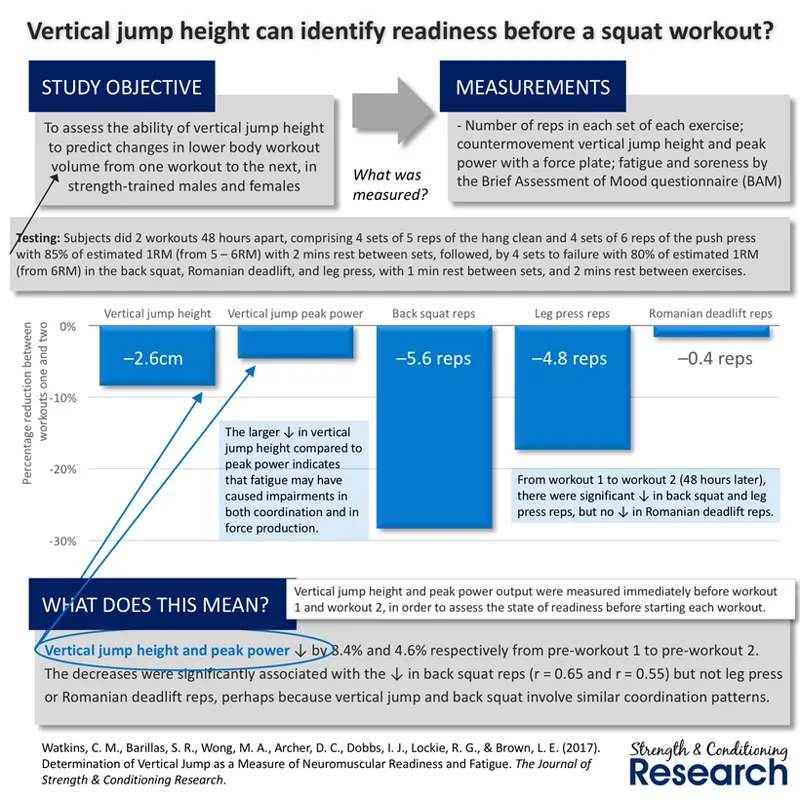
Indeed, research has shown that vertical jump heights are a very sensitive measurement for identifying the ability of an athlete to perform in a squat workout.
.
Conclusions
Central nervous system (CNS) fatigue can be caused by exercise, and often lasts for several days. When it is present, CNS fatigue impairs the recruitment of high-threshold motor units, which can reduce the adaptations that are stimulated by a workout. Thus, it can be helpful to identify whether CNS fatigue is present before beginning a workout. Gold-standard laboratory measurements are not practical for use in the gym, but the presence of CNS fatigue can be inferred by the presence of non-local fatigue (fatigue in muscles that were not used in a previous workout). While handgrip strength is popular in this regard, it does not seem to be a very sensitive measurement. Theoretically, high-velocity measurements such as vertical jump height or throwing distance should be the most sensitive, as their performance relies entirely on the production of force by the fast twitch muscle fibers of the highest threshold motor units. For example, while 100% of the muscle fibers in a muscle might contribute to muscle force production in a slow movement like a heavy back squat, only 50% of the muscle fibers in the same muscle might contribute to force production in fast movement like a vertical jump. Thus, we might expect post-workout fatigue mechanisms that produce a 5% reduction in maximum strength in the back squat to produce a 10% reduction in vertical jump height, which is much easier to measure.

Comments (3)
Thank you, Chris. Again, very helpful.
Hi Chris. Your comment that slow twitch muscle fibers cannot contribute to high velocity movements has me thinking. What is a high velocity movement? How can we classify? I train golfers for more swing speed!
Based on the effects of different types of training, I would classify high-velocity movements as unloaded movements (jumps, sprints) or minimally loaded movements (throws with the lightest possible load). Additional loads that reduce movement velocity by about 10–15% or so are probably also in this category, but there isn't much research to help us determine the exact cut-off point. Traditional power training (30-40% of 1RM in jump squats etc.) definitely isn't in this category, since it tends to have a larger effect on force than on velocity, when testing its effects on the force-velocity profile.