





Overreaching and overtraining
High volume strength training is currently very popular for hypertrophy. Such high volume training may sometimes cause overreaching in some lifters, leading to a temporary reduction in workout performance. However, whether this overreaching block is useful or not is unclear. In this article, I propose that overreaching is not actually helpful, and it is better to avoid it where possible.
.
#1. What are overreaching and overtraining?
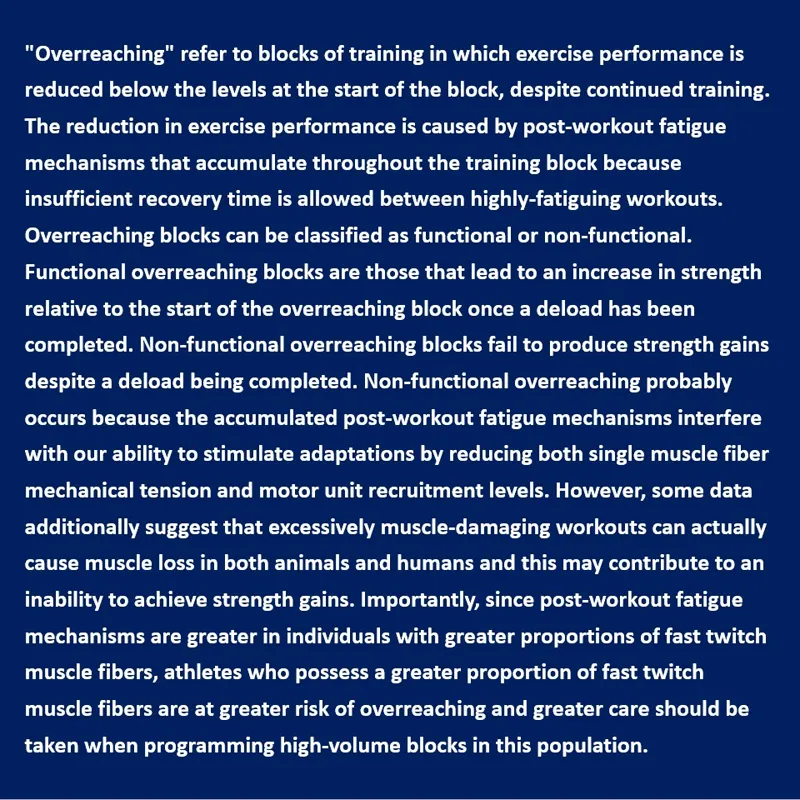
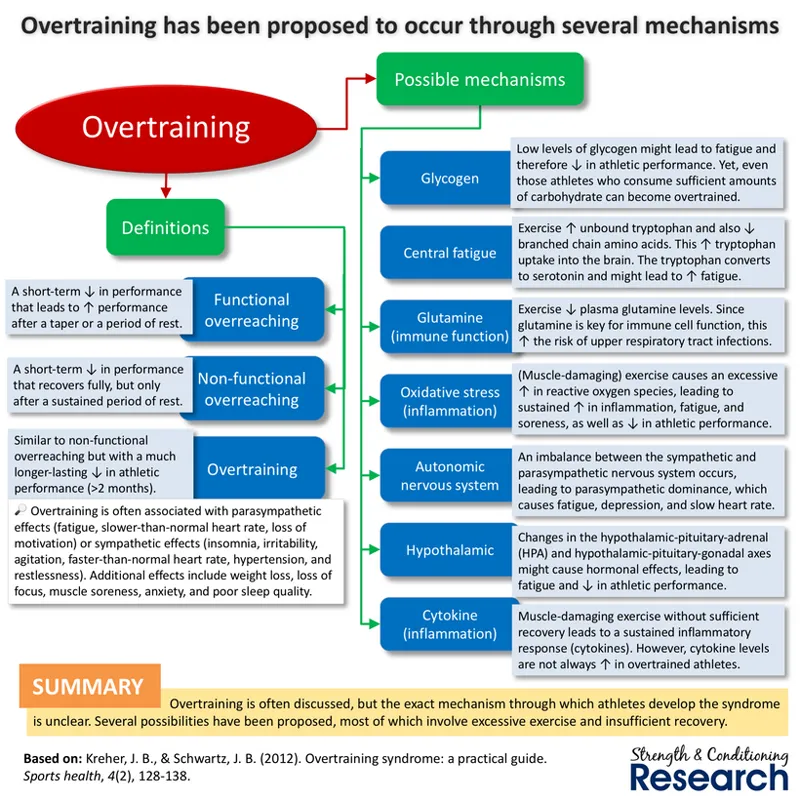
The terms "overreaching" and "overtraining" are often used quite loosely, but they have very specific meanings. Overreaching and overtraining both refer to a period or block of training in which exercise performance (such as the rep max or the working weight on a strength training exercise) is reduced below the levels that were present at the start of the block, despite continued training. Overreaching and overtraining can then be subdivided into functional overreaching, non-functional overreaching, and overtraining depending on how long it takes to return to previous levels of exercise performance.
.
#2. What is the most likely mechanism that produces overreaching and overtraining?
Many mechanisms have been proposed as explanations for overreaching and overtraining. The simplest explanation is that they involve a larger-than-normal amount of the same types of fatigue that are present after a single workout. The main three types of fatigue that occur after strength training workout are: muscle damage, excitation-contraction coupling failure, and (due to the inflammatory response produced by the muscle damage), central nervous system fatigue.
.
Indeed, although overreaching and overtraining during strength training are often assumed to involve systemic fatigue of the cardiac autonomic system, this is not always the case. In fact, there is better evidence that overreaching caused by strength training involves local muscular fatigue and not systemic fatigue.
.
It is important to note that the recovery of different systems occurs at different rates after different types of training. While the cardiac autonomic system probably takes the longest to recover after endurance exercise, it is the peripheral muscular system (and the associated central nervous system) that takes the longest to recover after strength training workouts.
.
#3. Which athletes (and muscles) are more at risk of overreaching and overtraining?
Athletes who have more fast twitch fibers seem to be at a greater risk of overreaching after any type of exercise. Such athletes are likely to include power athletes such as sprinters, throwers, and other track and field athletes.
.
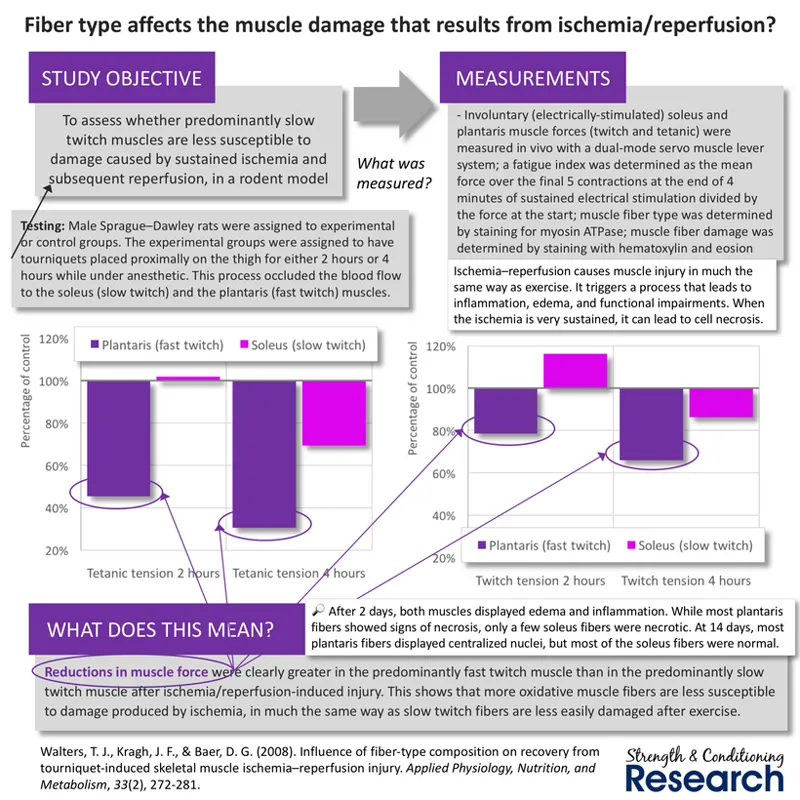
Similarly, rodent studies have shown that those muscles that have a greater proportion of fast twitch fibers are also at a greater risk of overreaching or overtraining.
.
Interestingly, athletes with greater proportions of fast twitch fibers also display more fatigue after single workouts, as well as greater risk of overreaching. This supports the idea that the fatigue that builds up during overreaching and overtraining is the same type of fatigue that occurs after single workouts.
.
Similarly, muscles with greater proportions of fast twitch fibers also display more fatigue after single workouts, as well as greater risk of overreaching. This also supports the idea that the fatigue that builds up during overreaching and overtraining is the same type of fatigue that occurs after single workouts.
.
#4. Do overreaching and overtraining produce adaptations, even after a taper?
It is often assumed that overreaching causes greater adaptations, and that we just have to wait until after a taper to see these benefits. However, there is evidence that this does not happen. In fact, recent research has shown that overreaching during endurance training fails to produce the underlying adaptations that benefit performance, and that this then leads to a lack of performance improvements even after a suitable taper.
.
Similarly, when considering strength training, it seems that overreaching causes a stagnation in the gains that occur as a result of each workout, despite continued training. Although hypertrophy occurs at the start of the program, the increases in muscle size are partly due to muscle swelling and do not increase further after the first week of training. This suggests that the accumulated fatigue is preventing workouts from stimulating further gains.
.
Indeed, rodent research has shown that when workouts are performed before recovery from the previous workout has reached a certain level, these workouts do not stimulate muscle growth.
.
These studies demonstrate that the excessive oxidative stress produced by muscle damage provides a clear mechanism through which stagnation can occur during a block of strength training that produces overreaching.
.
#5. Do overreaching and overtraining reduce muscle mass?
If a failure to make gains in muscle size were not bad enough, there is rodent research showing that a high volume, high frequency training program that causes overreaching also causes losses in muscle size.
.
Once again, however, this should not be surprising, because single strength training workouts that cause very large amounts of fatigue can also cause losses in muscle mass. Indeed, this has even been reported in humans.
.
Conclusions
"Overreaching" and "overtraining" refer to a block of training during which exercise performance is reduced below the levels at the start of the block, despite continued training. This effect seems to be produced by the same type of fatigue that occurs after individual workouts within the program. For strength training, this means excitation-contraction coupling failure, muscle damage, and the associated central nervous system fatigue. Athletes (and muscles) with a greater proportion of fast twitch muscle fibers are at greater risk of overreaching, just as they are more susceptible to greater fatigue after single workouts. Although it is often assumed that overreaching improves performance so long as a taper is employed afterwards, this does not seem to be the case. In fact, the accumulated fatigue that occurs during overreaching blocks often seems to blunt adaptations to both endurance and strength training exercise, and may even cause muscle loss.
Comments (9)
Interesting article Chris! My question is somewhat related to this text. There have been different studies which looked at volume and hypertrophy outcomes. A couple of them showed a clear correlation between total volume and hypertrophy where the highest volume groups (30+ sets per week per muscle group) showed the best outcomes, which I find surprising. I would suspect such amount of volumes would also surpass the maximum amount of recoverable volume for many individuals, which is somewhat in contrast with your conclusions here. Do you have any explanation for the outcomes of these studies?
I am aware of 3 studies that show the benefits of really high volumes: radaelli e.a., Brigatto e.a. and Schoenfeld e.a.
What do you mean by "in most cases" above? Do you mean depending on session volume or muscle? I do find that sometimes chest and arms can be difficult to train twice a week i.e. every 3-4 days as sometimes they only recover every 5 days, only using 3-4 sets in the session gone. This naturally leads to twice some weeks and once in others.
Thanks for an awesome article. This seems to lend credibility to the bro bodybuilder split. Train the muscle once per week and emphasize recovery. Is this true and also to not trash or damage the muscle. Chris is low volume and low frequency the best approach? I believe this corresponds with your moderate to high load in combination with a low to moderate volume recommendation.
Yes, the body part split can be a very effective way of getting full recovery between workouts, although I tend to think that training a muscle twice a week is possible in most cases. TBH, I'm not sure what is defined as low, moderate, and high volumes these days. Obviously, we have good definitions of heavy (1–5RM), moderate (6–15RM), light (16–30RM), and very light (30RM+) loads, but to my knowledge there is no similar definition of volumes, in terms of the number of sets per muscle group per workout (and per week).
Despite this many of the coaches and practitioners are using “controlled” overreaching in their training plans. Practise shows that it can be useful in some sports. Or the effect is achieved not due to, but in spite of?
That's often the problem with deriving evidence from practical data. There is no control group, so it is impossible to know whether a better result could have been achieved without overreaching. Based on the underlying physiology presented in the above article, I think it is more likely that avoiding overreaching is always going to produce a better result than overreaching.
Would this suggest that a better approach would be to plan to reach MRV during a mesocycle, instead of overreaching?
I don't think that overreaching increases the adaptations that occur relative to a lower volume that allows full recovery between workouts. In fact, it may actually produce a smaller amount of hypertrophy, either because (1) the fatigue from the previous workout impairs the stimulus from the subsequent workout or because (2) the excessive fatigue actually causes muscle loss.