


Non-local fatigue
Fatigue is defined as a temporary and reversible reduction in exercise performance as a result of a prior bout of exercise (thus it is an outcome measure that can be measured by a strength test). Non-local fatigue occurs if we measure a reduction in exercise performance in a muscle that did not take part in that prior bout of exercise. For example, a reduction in elbow flexor strength after a set of knee extensions would be defined as non-local fatigue. Evidently, non-local fatigue is solid proof of the existence of fatigue mechanisms in the central nervous system (CNS).
.
#1. Non-local fatigue during strength training workouts
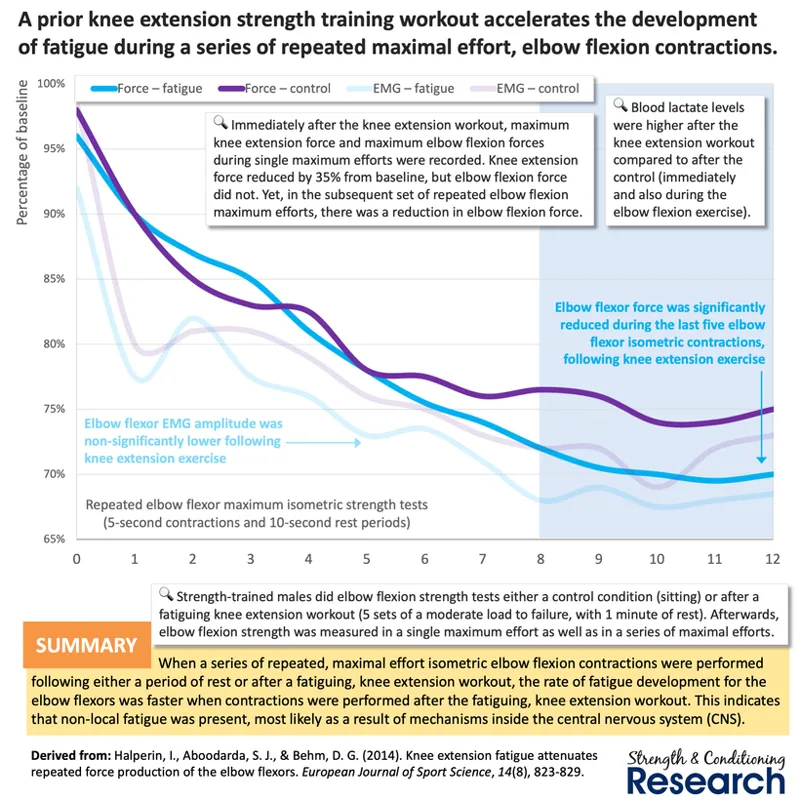
Non-local fatigue occurs during strength training workouts. For example, when we do lower body exercise first, a subsequent bout of upper body exercise displays more rapid fatigue development.
.
We can see that this more rapid fatigue development of the non-local muscle groups occurs in tandem with a more rapid increase in the rating of perceived exertion. This tells us that the main fatigue mechanism responsible for this non-local fatigue effect is supraspinal (inside the brain).
.
Even so, non-local fatigue does display some specificity during exercise. It is greater in the exact contralateral limb of the exercised ipsilateral limb. Since supraspinal CNS fatigue functions at the global level (by changing the perceived effort in the brain), it cannot contribute to this specificity effect. Thus, this tells us that spinal CNS fatigue mechanism also contributes to non-local fatigue.
.
#2. Non-local fatigue during static stretching bouts
Non-local fatigue also occurs immediately after static stretching bouts, indicating that there is also a supraspinal CNS fatigue effect of this type of activity. The magnitude of the fatigue effect was about half of the fatigue experienced by the stretched limb, which was likely because calcium ion-related fatigue mechanisms also happen during static stretching.
.
As for strength training, static stretching also displays indications of spinal CNS fatigue mechanisms.
.
#3. Non-local fatigue after workouts
Non-local fatigue can be observed for several days after strength training workouts, which tells us that there is a CNS fatigue mechanism contributing to fatigue in the post-workout period. Indeed, we have a good understanding of how this works because researchers have shown that the inflammatory process that occurs in response to muscle damage causes an increase in our perceived effort levels, which is a well-known supraspinal CNS fatigue mechanism.
.
Indeed, non-local fatigue in the untrained limb is greater when fatigue in the trained limb is greater. This is exactly in line with our understanding of how supraspinal CNS fatigue during the post-workout period works. The greater the muscle damage, the greater the inflammatory response, and the greater the supraspinal CNS fatigue (and the non-local fatigue effect).
.
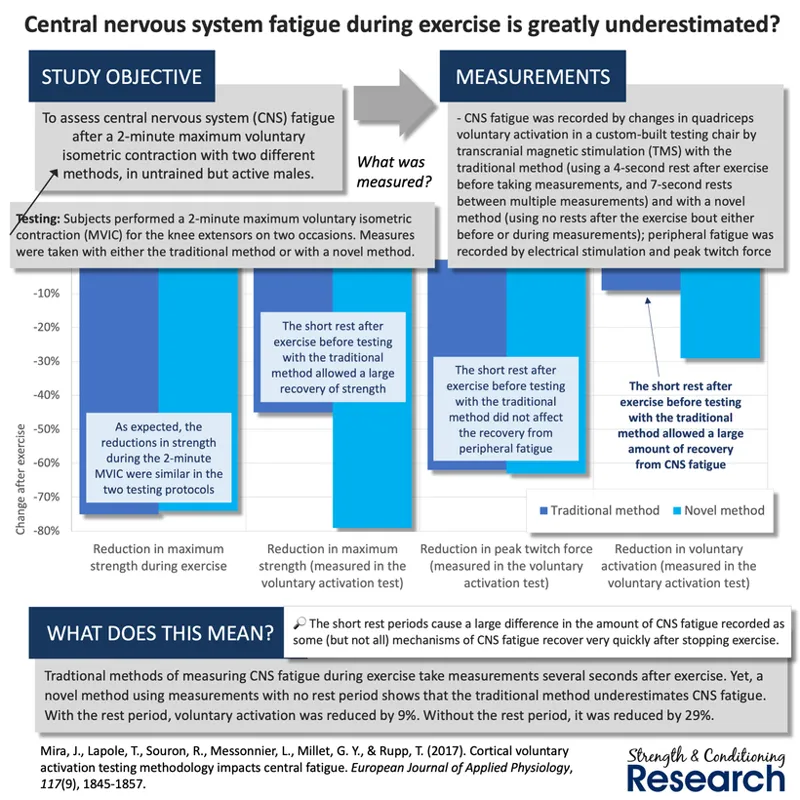
Importantly, researchers have shown that non-local fatigue (which is a fairly exact measurement of the impact of CNS fatigue) is a much more sensitive measurement than our gold standard measurement of CNS fatigue (voluntary activation using the interpolated twitch). Thus, when we rely upon voluntary activation measurements, we are probably underestimating the magnitude of the CNS fatigue effect.
.
Indeed, previous researchers have very often argued that the traditional methods of measuring CNS fatigue greatly underestimate the magnitude of the effect for various reasons.
.
Conclusions
Fatigue is defined as a temporary and reversible reduction in exercise performance as a result of a prior bout of exercise (which means that it can be easily measured by a strength test). Non-local fatigue occurs if we record a reduction in exercise performance in a muscle that did not take part in that prior bout of exercise. For example, a reduction in elbow flexor strength after a set of knee extensions can be defined as non-local fatigue. Evidently, non-local fatigue is solid proof of the existence of fatigue mechanisms within the central nervous system (CNS). Non-local fatigue has been recorded both during workouts and in post-workout recovery periods. During workouts, non-local fatigue appears to result primarily from supraspinal CNS fatigue by means of an increase in the perception of effort for a given level of central motor command (in agreement with the psychobiological model of fatigue). Even so, the existence of some muscle-specificity of that fatigue suggests that spinal CNS fatigue mechanisms may also contribute. During the post-workout recovery period, non-local fatigue behaves in accordance with our expectations because is greater when the fatigue of the trained muscle is greater. Post-workout CNS fatigue is known to be supraspinal in nature. The inflammation produced by muscle damage is detected by the brain and increases our perception of effort for a given level of central motor command. Consequently, the greater the muscle damage, the greater the inflammatory response, the greater the supraspinal CNS fatigue, and therefore the greater the non-local fatigue.
Comments (3)
Thank you I couldn’t remember the term.
Do you think this measured supraspinal fatigue in the contralateral non-exercise limb could have some type of relationship similar to when a person sustains an injury and is told to still train the uninjured limb to help prevent muscle loss in the injured limb?
They are both described as "cross-over" effects but whether the mechanisms are the same is unclear.