






Inter-set stretching
Inter-set static stretching is a relatively popular technique for enhancing muscle growth. Even so, if we look closely at the underlying physiology, we can see how the hypertrophic stimulus can be maximised while the resulting fatigue is minimised.
.
#1. Agonist inter-set static stretching can enhance hypertrophy
Often, bodybuilders will statically stretch the working (agonist) muscle between strength training sets. The agonist muscle is the muscle that is being trained during the strength training sets. Some studies have reported that this practice can enhance the overall hypertrophy stimulus of the workout.
Here, the study protocol involved loaded stretching. The application of load is not important. It is just a method of providing the necessary external resistance such that the required range of motion can be reached. When the static stretch involves a passive movement and the muscle is not activated, the only factor that determines the amount of passive mechanical tension is the range of motion.
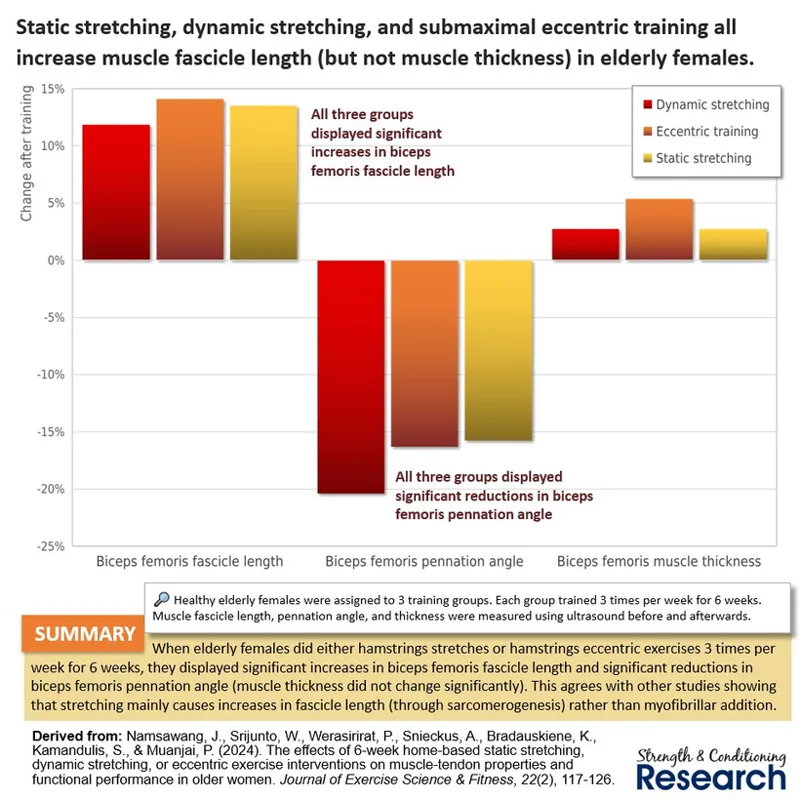
These findings are not really surprising because we know that static stretching can cause hypertrophy by means of increases in muscle fascicle length, especially in previously-untrained populations who have previously not experienced any stretch-mediated hypertrophy (sarcomerogenesis).
#2. Agonist inter-set static stretching reduces the number of reps in a set
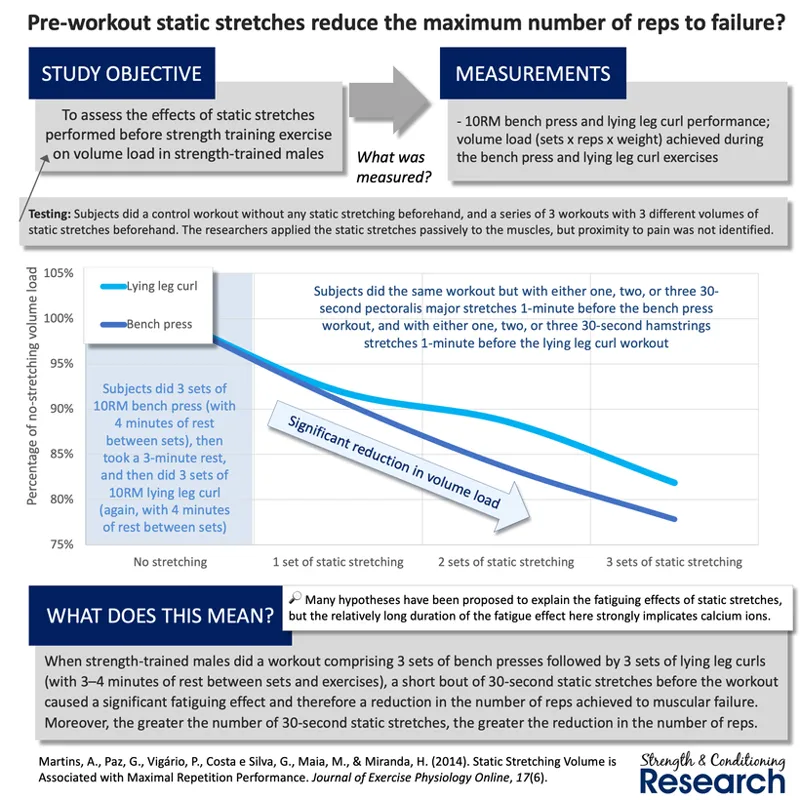
Importantly, agonist inter-set static stretching reduces the number of reps that can be achieved during the accompanying strength training sets. Evidently, this occurs due to the fatigue produced by the static stretches that are performed during the rest periods of the strength training workout.
Indeed, it is well-known that static stretching causes fatigue in a strength training context. Doing static stretches prior to a workout reduces the number of reps that we can perform with the same muscle.
#3. The fatigue mechanisms caused by static stretching impair the hypertrophy stimulus
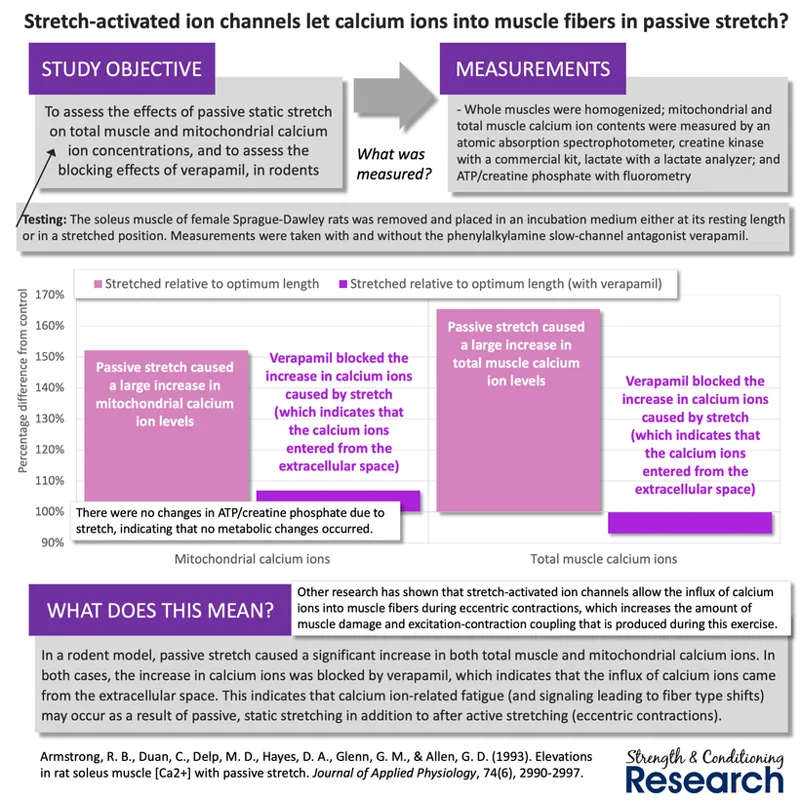
Although the exact mechanisms by which static stretching causes fatigue are contentious, we can be reasonably certain that they include calcium-ion related fatigue mechanisms. Indeed, static stretching causes a prolonged fatigue effect that lasts for at least 20 minutes. No other fatigue mechanisms last for this duration of time. This is very important because calcium ion-related fatigue mechanisms act to reduce the amount of mechanical tension that muscle fibers can generate. Evidently, this impairs the hypertrophy stimulus that can be generated by strength training sets performed after static stretches.
Providing further evidence for the presence of calcium ion-related fatigue after static stretches, we know that static stretching opens the stretch-activated ion channels inside of muscle fibers and permits the entry of the calcium ions that cause calcium ion-related fatigue mechanisms to occur.
Similarly, we can see that the calcium ion-related fatigue generated by static stretches produces muscle damage which then creates an inflammatory response in exactly the same way as strength training. This confirms that static stretching is indeed producing calcium ion-related fatigue.
Moreover, it is noteworthy that passive static stretching causes a repeated bout effect. Physiologically, the repeated bout effect is simply the name we give to a set of adaptations that produce resistance to calcium ion-related fatigue mechanisms. Obviously, they only happen when the muscle experiences calcium ion-related fatigue. This provides more evidence that stretching causes those types of fatigue.
Yet, passive static stretching also appears to produce spinal central nervous system fatigue, which would be expected to reduce the levels of motor unit recruitment that we can achieve in subsequent strength training sets. This would also reduce the size of the hypertrophy stimulus of those sets.
#4. The fatigue mechanisms caused by strength training have a much smaller negative effect on the hypertrophy stimulus
Strength training sets produce a variety of fatigue mechanisms whose relative importance varies depending on the exercise range of motion or strength curve and the repetition range that is used. Even so, metabolite-related fatigue mechanisms are very prevalent during strength training sets.
Yet, passive mechanical tension does not require the crossbridge cycle. Hence, metabolite-related fatigue mechanisms do not impede the generation of passive mechanical tension by the stretching of titin in static stretches. Consequently, the hypertrophy stimulus generated by a static stretch will not be negatively affected by a prior fatiguing strength training workout.
Conclusions
Inter-set static stretching is a popular technique for enhancing muscle growth. Indeed, some studies have reported superior hypertrophy from including static stretching for the working (agonist) muscle between the sets of a strength training workout. This result is not surprising because static stretching can stimulate muscle growth. Passive mechanical tension causes sarcomerogenesis, which can be observed as an increase in muscle fascicle length. Even so, static stretching bouts do produce fatigue. The main fatigue mechanisms seem to be [1] calcium ion-related fatigue mechanisms, and [2] spinal central nervous system (CNS) fatigue. Calcium-ion related fatigue mechanisms reduce the amount of mechanical tension that the muscle fibers can produce and this reduces the hypertrophy stimulus in subsequent exercise bouts until the fatigue mechanisms have dissipated. Similarly, spinal CNS fatigue mechanisms reduce the degree of motor unit recruitment that can be achieved and this also reduces the hypertrophy stimulus in subsequent exercise bouts until the fatigue mechanism has dissipated. For this reason, inter-set static stretches will have a negative effect on the hypertrophy stimulus produced by the strength training sets that they accompany. In contrast, the main fatigue mechanisms produced during strength training sets likely have minimal negative impact on the ability of static stretches to generate the passive mechanical tension that stimulates sarcomerogenesis. For this reason, we can probably maximize the benefits of the strength training sets and the static stretching by performing all of the static stretches after completing all of the strength training sets.