



Aerobic exercise warm-ups
Whether to perform an aerobic exercise warm-up prior to a strength training workout (in addition to a specific warm-up for each strength training exercise) is somewhat contentious. Yet, there is evidence to support doing so and there is a logical physiological basis as well.
.
#1. Aerobic exercise warm-ups may benefit strength training workouts
Experimental evidence has shown that performing an aerobic exercise warm-up for the muscles to be used in the subsequent strength training workout can be beneficial for maximizing exercise performance. Yet, the aerobic exercise warm-up must be of sufficient duration (15-20 minutes) and it must be low-intensity (no more than 60% of maximum heart rate). Shorter durations of aerobic exercise (5 minutes) do not seem to provide the same benefit. Higher aerobic exercise intensities (80% of maximum heart rate) also do not provide the same benefit, most likely since they cause fatigue that interferes with subsequent strength training performance.
.
#2. Increased muscle temperature is likely the underlying mechanism
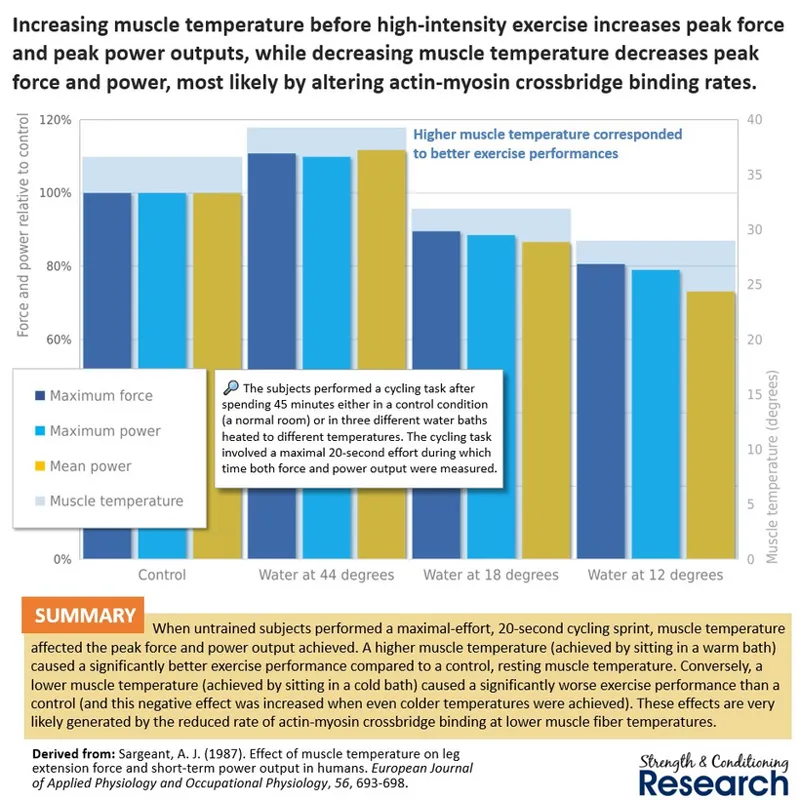
When researchers have investigated the underlying reasons for why aerobic exercise warm-ups increase subsequent anaerobic exercise performance, they have found that the temperature of the working muscles is key. When water baths are used instead of aerobic exercise warm-ups, we can see how the muscle temperature directly affects subsequent sprint exercise performance.
.
This phenomenon can be observed in single muscle fibers and it can be related to the rate of ATP usage. The higher the muscle fiber temperature, the faster the rate of ATP usage and the faster the rate of actin-myosin crossbridge formation (which affects muscle fiber mechanical tension). Yet, since the greater muscle fiber mechanical tension arises due to a faster rate of ATP usage, this means that metabolite-related fatigue would occur more rapidly. Therefore, we might expect to see beneficial effects on instantaneous force and velocity during single, maximal efforts (as is common during athletic training) but repetition maximums might not be similarly improved and the number of stimulating reps per set is probably not affected.
.
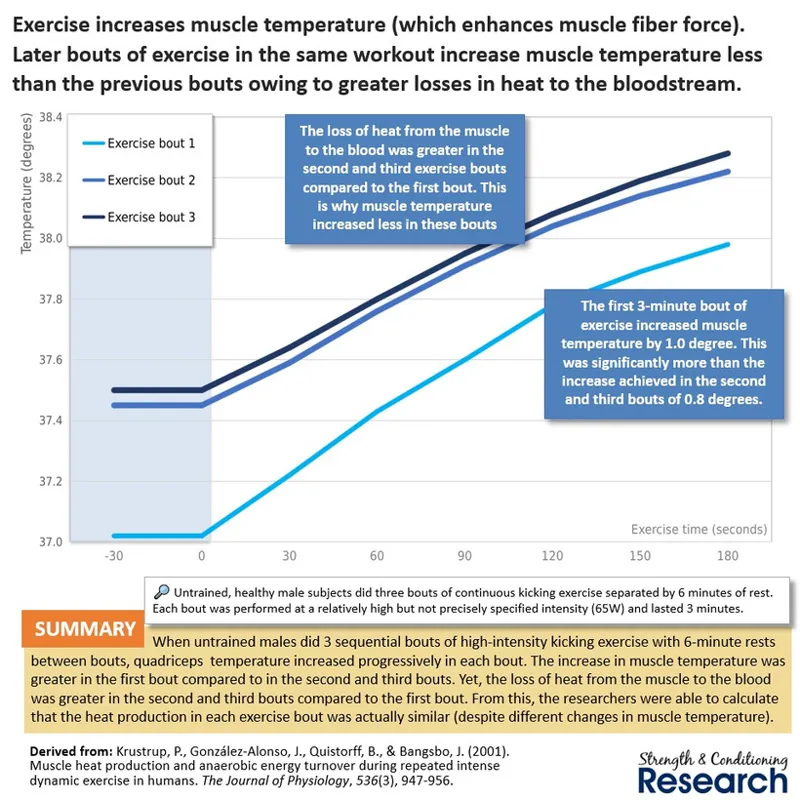
Naturally, aerobic exercise itself for the target muscle does produce meaningful changes in muscle temperature in the same way as a warm external environment.
.
Conclusions
Lifters often perform an aerobic exercise warm-up prior to starting strength training workouts. Does this enhance strength training adaptations? Studies have shown that sufficient durations of aerobic exercise increase muscle temperature. Muscle temperature affects anaerobic exercise performance by altering the rate at which ATP is used to power the formation of actin-myosin crossbridges. Higher muscle temperatures allow a faster rate of ATP usage and hence a faster rate of actin-myosin crossbridge formations and therefore also a higher magnitude of mechanical tension. Yet, a faster rate of ATP usage also increases the rate of metabolite-related fatigue accumulation. Thus, we might indeed expect an aerobic exercise warm-up to increase instantaneous muscle force and shortening velocity (which could then enhance certain strength-related and speed-related adaptations that benefit athletes) but it is unlikely to affect either repetition maximums (or the magnitude of the hypertrophy stimulus achieved in a set) to the same extent. Finally, excessive intensities or durations of aerobic exercise prior to a strength training workout will reduce our ability to stimulate adaptations by producing fatigue mechanisms that reduce motor unit recruitment or mechanical tension. Hence, it is important to identify the optimal dosage. Studies have shown that an aerobic exercise warm-up at approximately 60% of maximum heart rate that lasts 15-20 minutes can increase strength training performance.
Comments (3)
Hi Chris, I have a question: can we judge if the body temperature is sufficiently high to switch PAPE on when we break a sweat?
Go to sauna before your workout, not after))
this would also imply that afternoon workouts, assuming one follows a normal circadian rhythm and wakes up in the morning, would be better suited for hypertrophy by virtue of the same mechanism (body temperature naturally peaks in the afternoon). in regard to the body temperature topic, i was under the impression that injuries would follow the same body temperature cycle as well, albeit i'm not sure if this is something that you've seen in the literature as well, chris?