




Neural adaptations to eccentric training
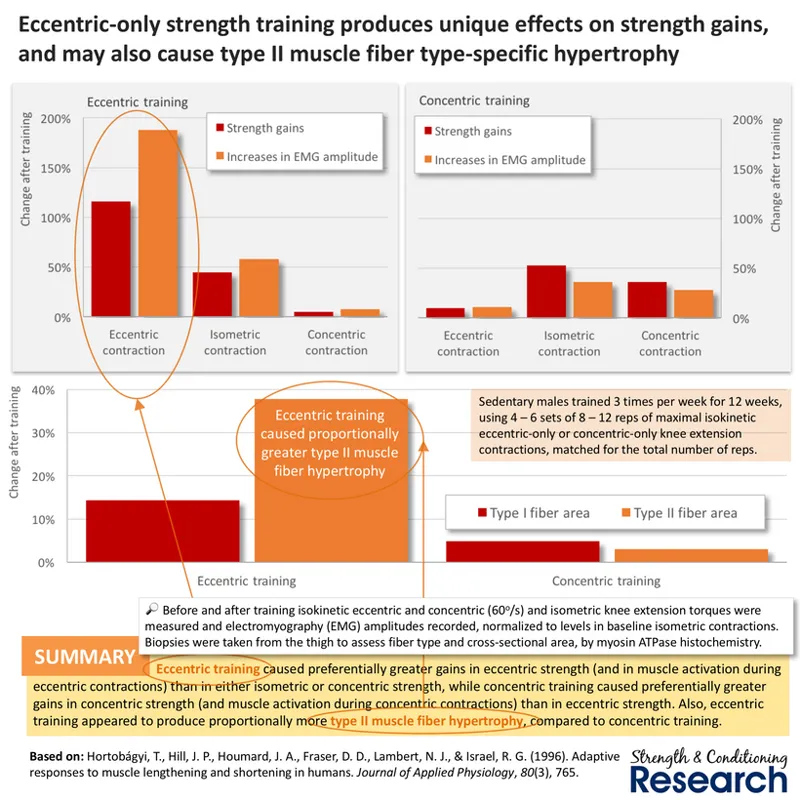
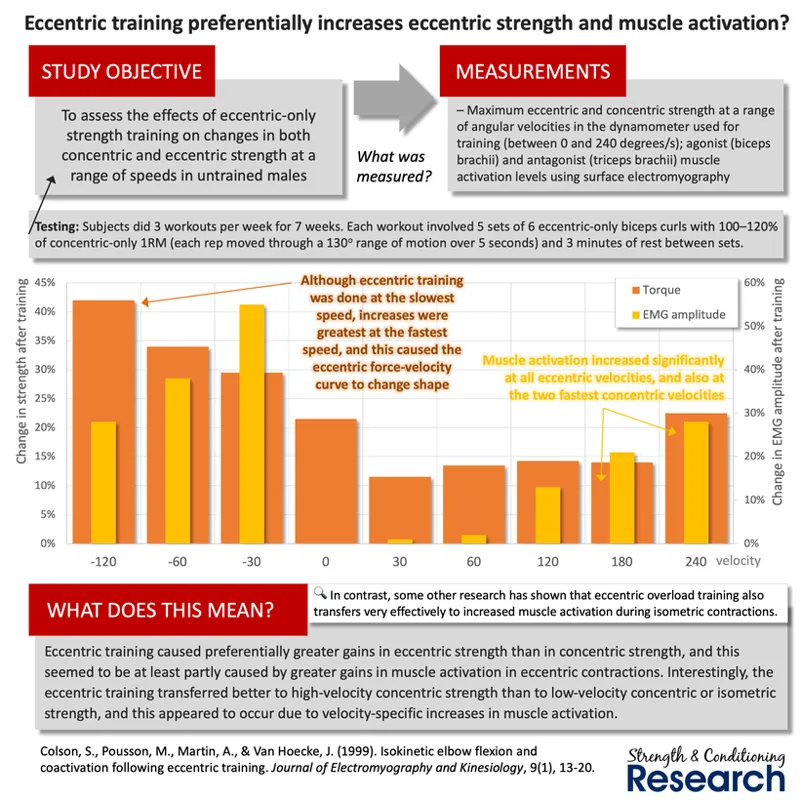
Eccentric-only strength training tends to produce very substantial increases in eccentric strength and smaller increases in concentric strength. Consequently, we often say that it causes contraction mode-specific strength gains. Research has identified that neural adaptations are a major contributor to these preferential gains in eccentric strength. But what are the neural adaptations?
.
#1. Preferential gains in eccentric strength and eccentric phase muscle activation
Eccentric-only strength training causes larger increases in eccentric strength relative to both isometric strength and concentric strength. (And, typically, concentric-only strength training does the opposite, causing larger increases in concentric strength than in isometric or eccentric strength). Moreover, this preferential increase in eccentric strength often accompanied by a much larger increase in muscle activation in the eccentric phase of the exercise.
.
Indeed, preferential increases in muscle activation in the eccentric phase after eccentric-only training have been reported by several studies. This seems to imply that an increase in the ability to recruit high-threshold motor units is the main neural mechanism by which eccentric-only strength training causes a preferential increase in eccentric strength. But is this the full story?
.
#2. What limits motor unit recruitment?
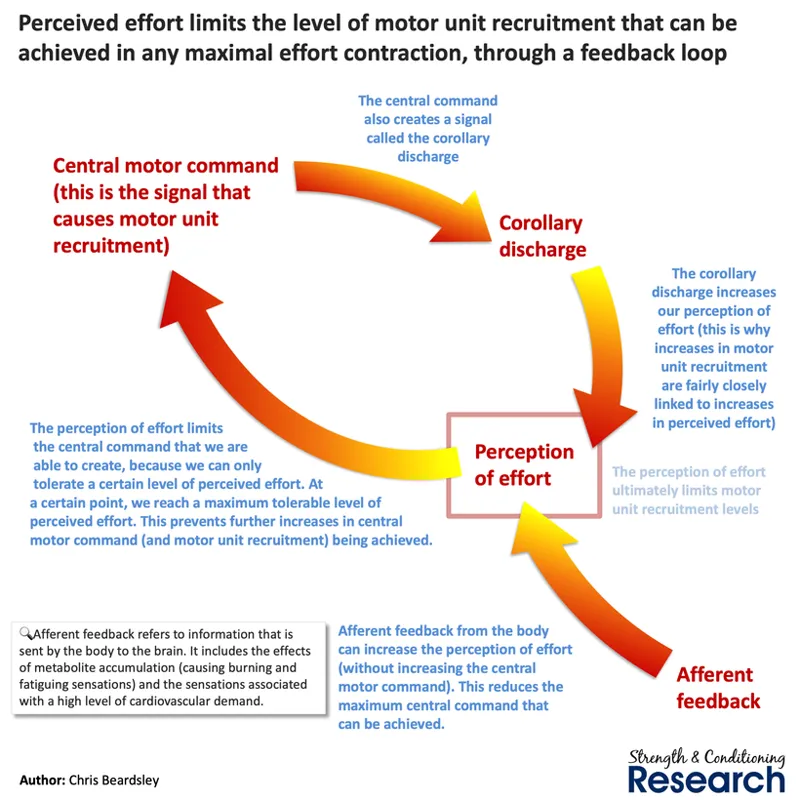
The maximum number of motor units that can be recruited during a muscle contraction is limited by our maximum tolerable perception of effort. The central motor command creates a copy signal called the corollary discharge. We register this corollary discharge as a perception of effort and therefore a larger central motor command causes a larger corollary discharge and a larger perception of effort (as well as a higher level of motor unit recruitment).
.
Nevertheless, other physiological factors can also increase the perception of effort that is associated with a given level of central motor command. When this happens, we obviously reach the maximum tolerable perception of effort at a lower level of central motor command. The most common example of this during normal strength training is the fatiguing and burning sensations that occur in response to metabolites accumulating inside the muscles.
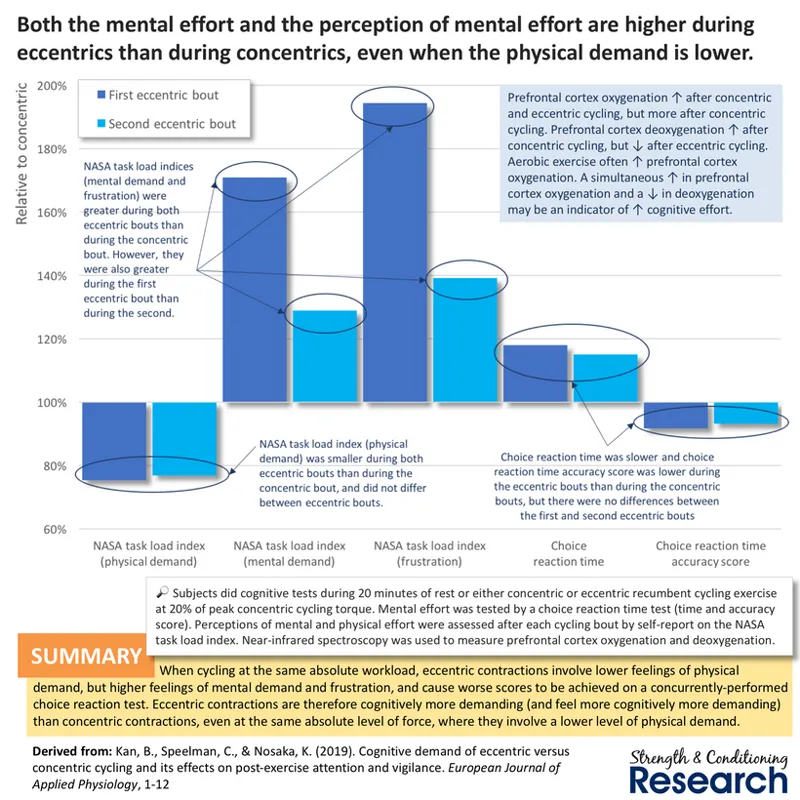
In the case of eccentric contractions, metabolite accumulation does not really occur very substantially. However, there is a large increase in perceived effort as a result of the problem of coordination that is very pronounced during this contraction mode. The mental effort that is associated with coordinating this unusual and difficult type of contraction causes an increase in our perceived effort level for any given level of central motor command.
.
#3. How does motor unit recruitment increase in the eccentric phase after eccentric-only strength training?
At the start of a strength training program, coordination tends to improve very rapidly and contributes substantially to gains in maximum strength. Although coordination itself is not frequently measured, we can observe that these early improvements in strength are very specific to the type of training performed. For example, they are specific to the velocity that is used in training.
.
Similarly, they are specific to the exercise that is used in training.
.
Consequently, it seems likely that the preferential gains in eccentric strength that occur after eccentric-only strength training are also the result of improvements in coordination, and not only because of the direct contribution in improved coordination to increased strength, but because this improvement in coordination reduces the mental effort associated with a given level of central motor command, thereby permitting a higher level of central motor command to be achieved at the maximum tolerable perception of effort. Indeed, coordination during the eccentric phases of a lift has been observed to reduce only after eccentric-only training.
.
Moreover, the improvement in coordination is quite substantial and occurs over a large number of workouts. This indicates that there is a lot of scope for such improvements to occur. This has important practical implications because increases in coordination are much less transferable to other movements than increases in motor unit recruitment.
.
Conclusions
Eccentric-only training causes larger increases in eccentric strength than in concentric strength. An increase in the maximum level of motor unit recruitment (MUR) in the eccentric phase seems to be a key contributor to these preferential gains in eccentric strength. But how can this happen? The maximum level of MUR that we can attain in a muscle is limited by our maximum tolerable level of effort, since the central motor command (CMC) that causes MUR also generates a copy signal that we register as a perception of effort in the sensory part of the brain. Clearly, therefore, any increase in the CMC for a given level of effort, or any increase in the maximum tolerable level of effort, will generate increases in the maximum level of MUR in all contraction modes similarly. Indeed, when increases in CMC and MUR occur after normal strength training, they are very transferable between contraction modes, velocities, and exercises. So, it seems most likely that the increase in MUR that is unique to the eccentric phase occurs through a reduction in the perception of mental effort that is associated with the coordination demand of eccentric contractions. Indeed, coordination in eccentric contractions does reduce rapidly after eccentric-only training programs. Practically, this may mean that increases in eccentric strength measured in exercises after eccentric-only training are less transferable to eccentric force production in other movements and exercises than is often assumed.
Comments (5)
Hi chris hope you are doing great. You said that a individual can lift 125 % of the concentric phase during an eccentric only contraction. Do you think that the eccentric strength can be interpreted as a ceilling for the ability of a trainee to develop strength in the concentric phase, and if so, could the ratio of eccentric strength compare to the concentric strength be usefull to assess the strength potential of someone ? For example, if a trainee has a small difference between his eccentric strength and his concentric strength, could the improvment in concentric strength be limited due to the lower «ceilling » in eccentric contraction ? Or do you think that they are two differents things and improvment in these type of contractions are independant of each other ? Thanks in advance
Hi Chris, i have searched for studies on EMG and eccentric overload training. I found several. They all showed higher EMG values when doing eccentric overload compared to more concentric based modalities, in cases of equal intensity. How is this possible when eccentric contractions are more demanding coordination-wise?
It's probably the way the comparison is set up. If the comparison is between the eccentric overload and the eccentric phase of a normal strength training exercise, the eccentric overload will report higher EMG amplitudes
In your Strength is Specific book you hypothesized that since we can lift 125% ish more in the eccentric, using supramaximal eccentrics might potentially increase adaptations such as Lateral Force Transmission quicker/more effectively because of the higher dosage of mechanical tension. Do you still have this opinion or has it changed?
Yes, I still think that the main mechanism by which supramaximal eccentrics might cause greater concentric/isometric strength gains compared to normal strength training is a greater increase in lateral force transmission.