







Fatigue after exercise
Here are the various fatigue mechanisms that contribute to overall post-workout fatigue, irrespective of the type of strength training that has been performed.
.
#1. What mechanisms comprise post-workout fatigue?
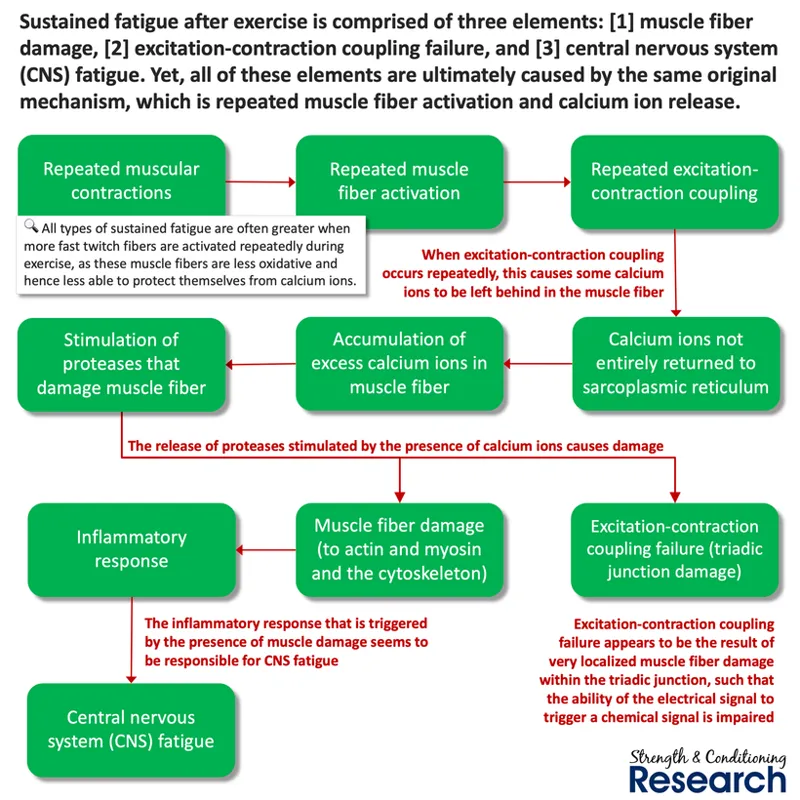
Post-workout fatigue is made up of three main mechanisms, being [1] excitation-contraction coupling failure (ECCF), [2] supraspinal central nervous system (CNS) fatigue, and [3] myofibrillar damage. There is also a fourth mechanism that involves a reduction in coordination (and therefore efficiency), which is caused by the presence of any other peripheral fatigue mechanism.
.
#2. What causes these post-workout fatigue mechanisms?
These three post-workout fatigue mechanisms all arise from the accumulation of calcium ions during a workout. When calcium ions accumulate during a strength training set, this stimulates the production of calpains inside the cytoplasm. These calpains attack the minor proteins of the triadic junction and cause ECCF towards the end of the set (typically during the last two reps before failure). After the workout, the calpains continue attacking proteins inside the cytoplasm and this starts producing myofibrillar damage. The presence of myofibrillar damage causes an inflammatory response that then in turn causes more myofibrillar damage as well as some supraspinal CNS fatigue.
.
#3. When does myofibrillar damage happen?
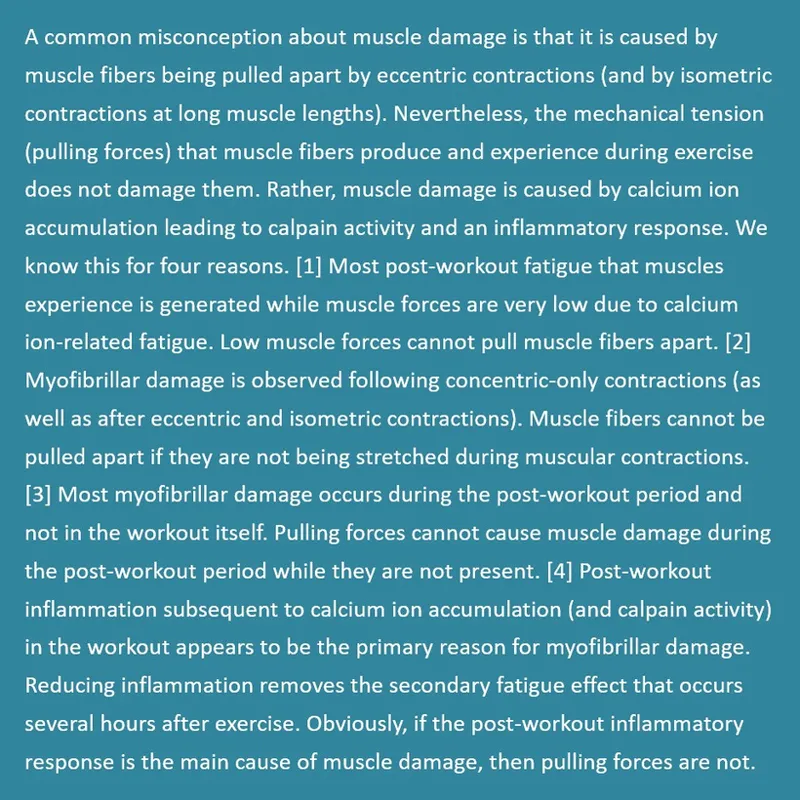
Contrary to popular belief, myofibrillar damage does not happen during a workout due to eccentric contractions pulling muscle fibers apart. In fact, we can easily dismiss this mechanism (despite its huge popularity) for four very well-established reasons (read more).
.
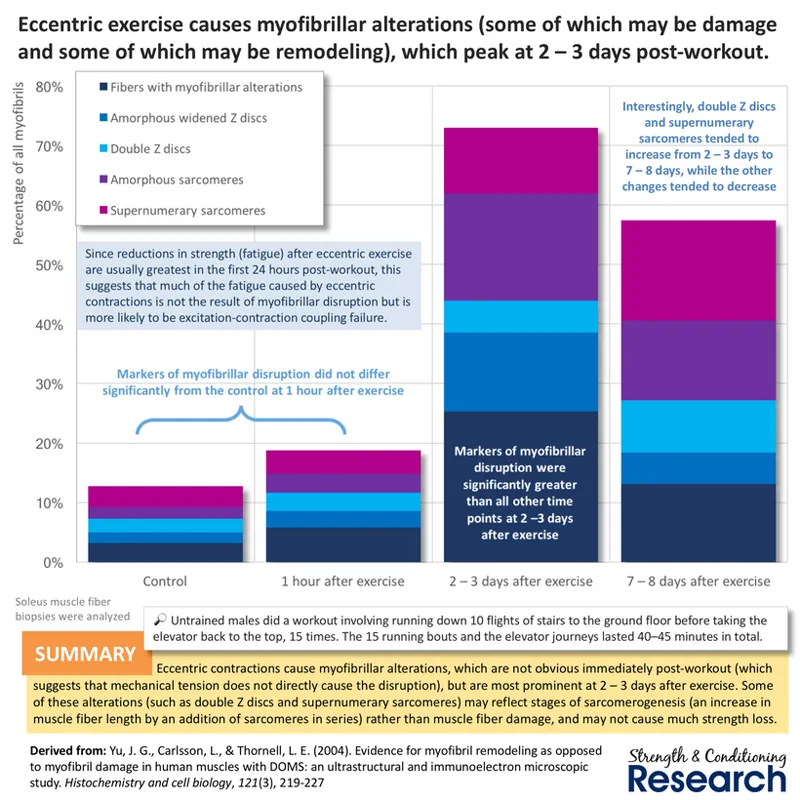
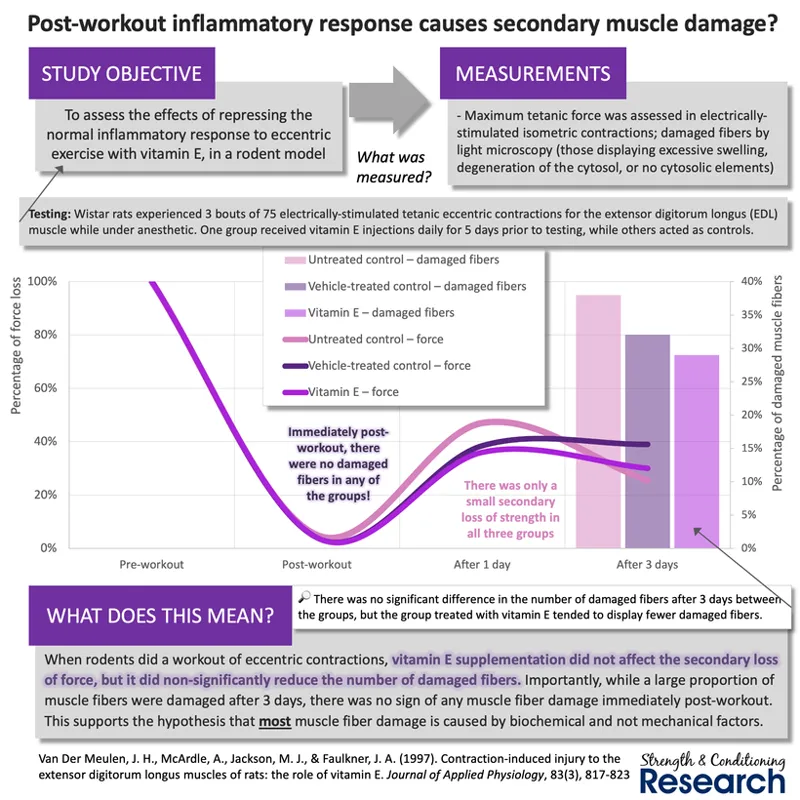
Indeed, the majority of the myofibrillar damage that is observed after strength training workouts appears during the hours and days after the workout. It does not appear during the workout itself. This similarly indicates that the myofibrillar damage is not caused by mechanical damage induced by eccentric contractions, but rather by a biochemical effect.
.
This biochemical effect begins with the actions of calpains, which are the same proteases that cause ECCF to occur by damaging the minor proteins of the triadic junction. After causing ECCF, calpains go on to cause damage to the myofibrils inside the cytoplasm.
.
Nevertheless, this initial stage involving calpains cannot explain the entirety of the myofibrillar damage that is produced throughout the post-workout period. In fact, the inflammatory response seems to be key for causing additional damage (in a process that is known as the "secondary muscle damage effect"). Moreover, this secondary muscle damage effect likely contributes the majority of the damage that is experienced by the muscle fiber.
.
Indeed, the time course of the loss of myofibrillar proteins (which indicates that the damaged structures have been removed by the inflammatory process) is delayed for a couple of days following an eccentric training workout. This can be seen by the losses of actin and myosin from inside the muscle fiber.
.
Similarly, the protein degradation rate is also delayed and only peaks one or two days after the workout has been performed. As we can see, the protein degradation rate peaks just as the loss of myofibrillar proteins approaches its maximum level.
.
#4. When does ECCF happen?
ECCF is an important mechanism of fatigue that occurs within strength training workouts (read more).
.
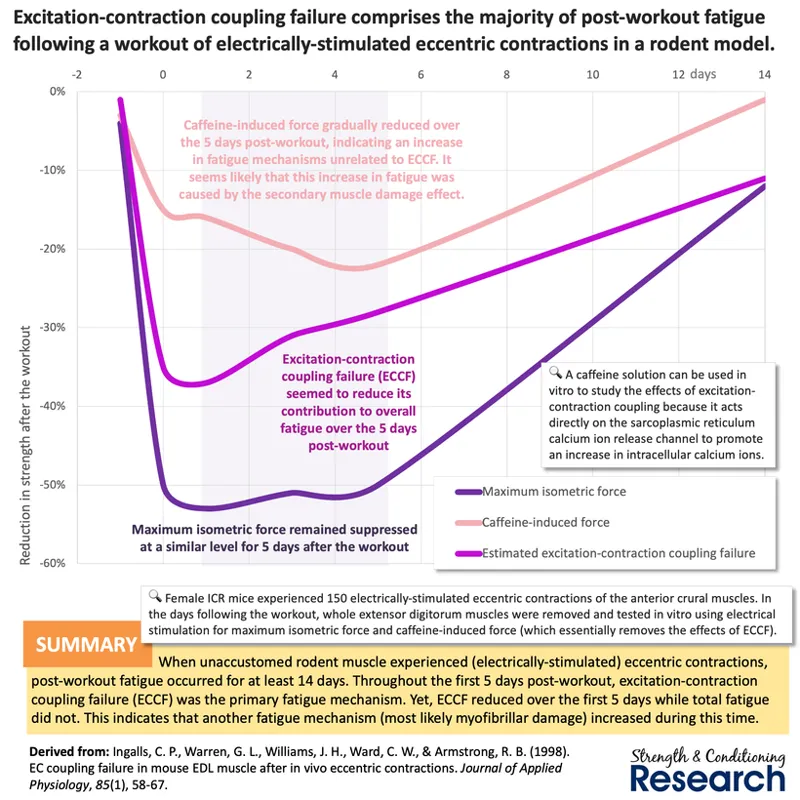
Since ECCF is actually caused during strength training workouts, it is present immediately after the workout and persists for many days. In contrast, the other fatigue mechanisms develop much later.
.
When analyzing the results of multiple studies, researchers have identified that ECCF is indeed the main mechanism of post-workout fatigue immediately post-workout, and that this then transitions to a loss of myofibrillar proteins (removed by virtue of the inflammatory process that removes damaged proteins) over course of the post-workout recovery period.
.
#4. When does post-workout supraspinal CNS fatigue happen?
Contrary to popular belief, supraspinal CNS fatigue in the post-workout period does not result from lifting heavy loads. Rather, it is a direct result of the inflammation that results from the production of post-workout muscle damage (read more).
.
Conclusions
Post-workout fatigue comprises 3 main mechanisms: [1] excitation-contraction coupling failure (ECCF), [2] supraspinal central nervous system (CNS) fatigue, and [3] myofibrillar damage. As a result of these fatigue mechanisms, there is a fourth mechanism, which is a reduction in coordination. All post-workout fatigue mechanisms are ultimately caused by calcium ion accumulation during a workout. Indeed, this can be observed by following the time-line of how the various post-workout fatigue mechanisms develop in the post-workout period. Firstly, ECCF occurs in the workout itself (as a result of proteases [calpains] being produced and attacking the triadic junction where excitation-contraction coupling occurs, in direct response to calcium ion accumulation). Secondly, myofibrillar damage develops throughout the early post-workout period, as the proteases continue to attack other structures inside the muscle fiber, and then subsequently an inflammatory phase occurs in response to this process, which then causes further damage. Thirdly, supraspinal CNS fatigue develops in response to the inflammatory process, which sends inflammatory mediators into the bloodstream, which are then detected by sensory part of the brain. Importantly, this series of events means that ECCF comprises the vast majority of the post-workout fatigue in the first few hours post-workout. Later, as myofibrillar damage develops, the various contributions of these three main mechanisms alters and there is a shift towards a much greater contribution from myofibrillar damage and supraspinal CNS fatigue.


Comments (1)
I assume the time scale on the X-axis is relative, i.e. 1-3 sets of 5-8 reps at 1RIR shouldn’t demand more than 48hrs of recovery, depending on the exercise and ROM?