


Excitation-contraction coupling failure
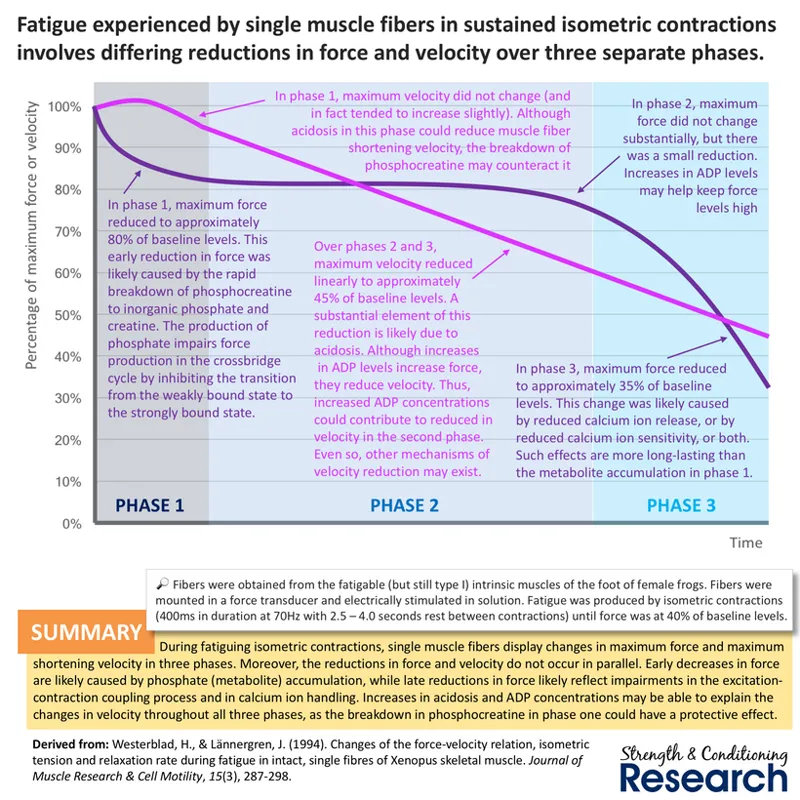
Fatigue is a temporary and reversible reduction in exercise performance (usually measured as a reduction in strength) caused by a preceding bout of exercise. Fatigue is caused by multiple mechanisms, some of which involve changes inside the central nervous system (CNS) and some of which involve changes inside the muscle. Mechanisms involving changes inside the muscle involve either metabolites or calcium ions. Perhaps the most important mechanism involving calcium ions is excitation-contraction coupling failure (ECCF).
.
#1. What is excitation-contraction coupling?
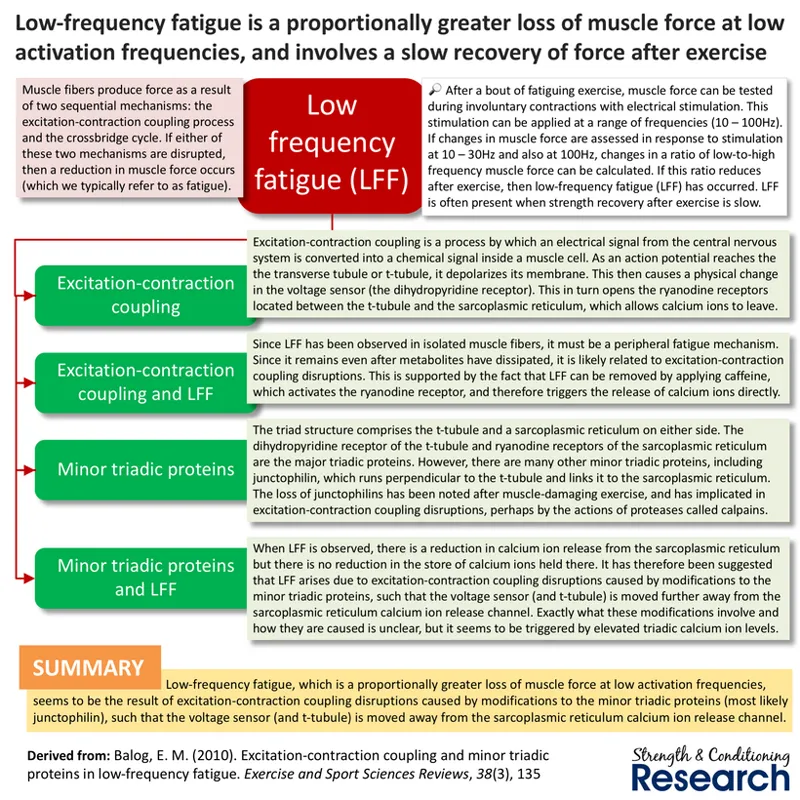
When the motor cortex creates a central motor command signal to recruit motor units, an electrical signal is sent down the spinal cord to the muscle. Subsequently, at the neuromuscular junction, another electrical signal is propagated along the cell membranes of the muscle fibers belonging to the recruited motor units. When this electrical signal reaches the transverse tubules, it goes down inside them and reaches with the voltage sensor. When the voltage sensor receives the signal, it interacts with the calcium ions store on the other side of the triadic junction, causing it to release calcium ions into the cytoplasm. In this way, an electrical signal is turned into a chemical signal. This process is called excitation-contraction coupling.
.
#2. What is excitation-contraction coupling failure (ECCF)?
ECCF refers to a disruption in the normal process of excitation-contraction coupling. We say that ECCF occurs when an electrical signal no longer turns into a chemical signal. In other words, even though electrical signals arrive at the voltage sensor, this does not cause calcium ions to be released into the cytoplasm. Several mechanisms have been proposed to explain how ECCF works. One likely mechanism (which can explain why ECCF lasts for a long time after exercise) notes that sustained periods of excitation-contraction coupling tend to cause calcium ions to accumulate inside the cytoplasm. This stimulates the release of the proteases (calpains) that cause muscle damage to occur.
.
Calpains do not only damage the cytoskeleton and myofibrils. They also damage the minor supporting proteins that hold the triadic junction in alignment. This allows the two sides of the triadic junction to drift apart, such that the voltage sensor can no longer interact with the calcium ion store. Thus, the arrival of the electrical signal at the voltage sensor no longer causes the release of calcium ions into the cytoplasm.
.
#3. How can we measure ECCF?
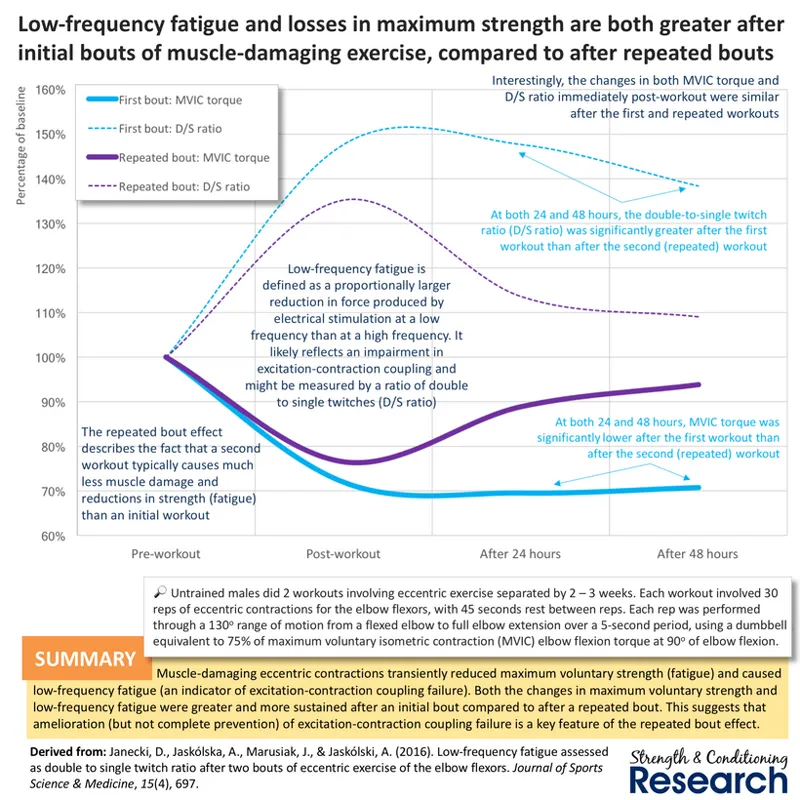
The magnitude of the ECCF that occurs after a bout of exercise can be assessed by measuring the changes in low-frequency fatigue (LFF). When LFF is present, there is a proportionally greater reduction in strength when muscles are stimulated at low frequencies than at high frequencies.
.
Interestingly, the amount of LFF is reduced due to the repeated bout effect (RBE). The RBE is the observation that fatigue is less after the second workout of a training program compared to after the first workout. The fact that LFF is also less after the second workout suggests that a key mechanism by which fatigue is reduced is that the accumulation of calcium ions (or the effects of the accumulation of calcium ions) has been decreased by some very rapid adaptation or adaptations.
.
#4. Why is ECCF pronounced after full range of motion strength training, strength training at long maximum muscle lengths, and eccentric training?
Overall fatigue and LFF are greater when muscles are trained at long maximum muscle lengths (as during full range of motion strength training exercises) compared to when they are trained at short maximum muscle lengths (as during partial range of motion strength training exercises).
.
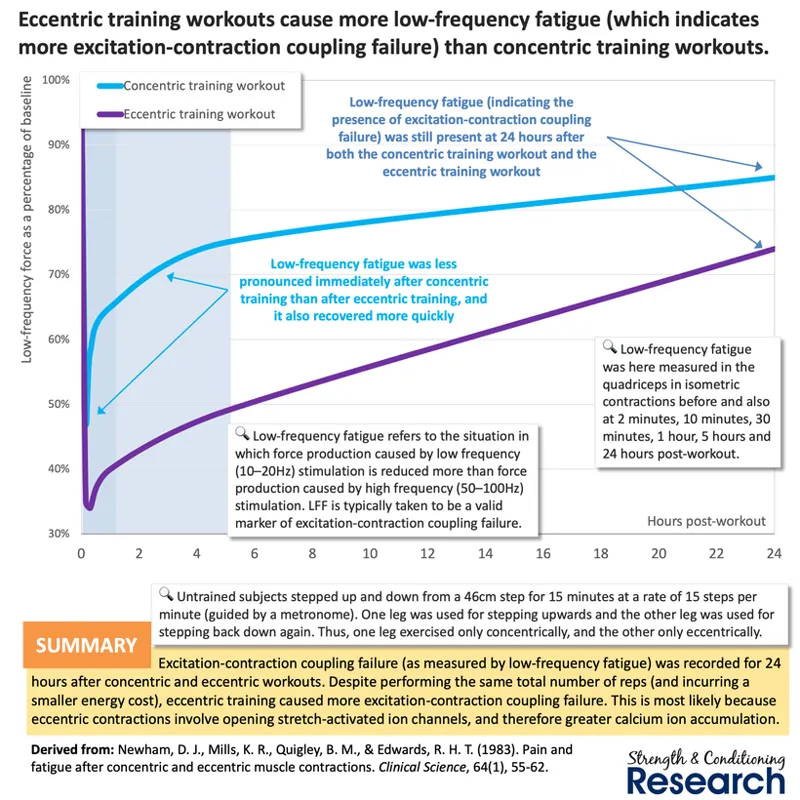
In the same way, both overall fatigue and LFF are greater when muscles are trained with eccentric contractions, compared to when they are trained with concentric contractions.
.
When muscles experience greater stretch during exercise (as during strength training with a long maximum muscle length or eccentric training), this causes more ECCF because it causes the opening of stretch-activated ion channels in the muscle cell membrane. The opening of these channels is stimulated when an activated muscle fiber is stretched. When open, the channels allow more calcium ions into the cytoplasm, which then stimulates the release of calpains that cause ECCF.
.
#5. Why does ECCF occur after static stretching?
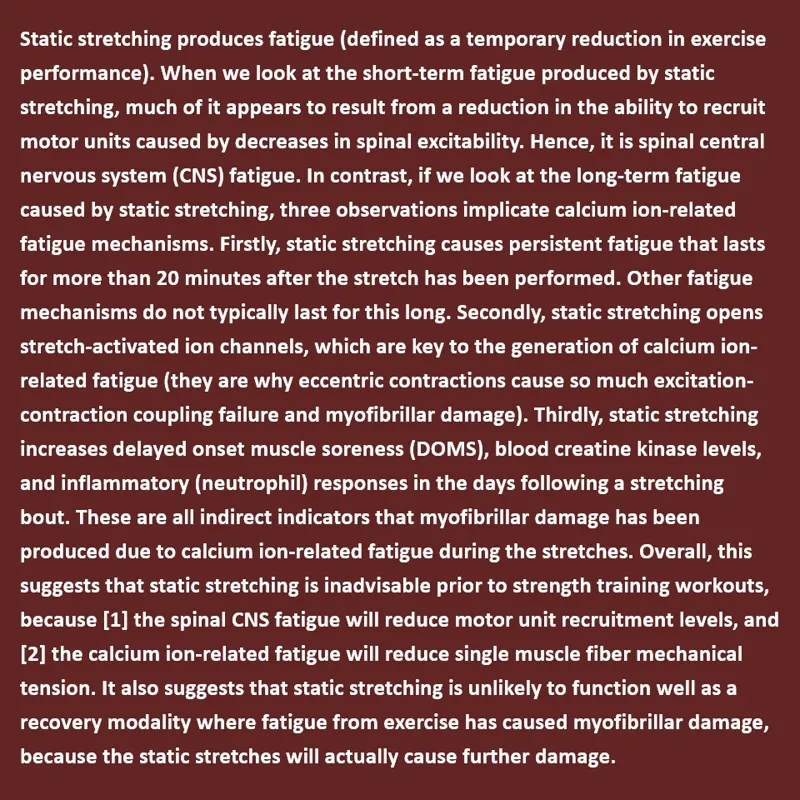
It is very likely that ECCF happens after static stretching for the same reason as it occurs to a greater extent after strength training exercises that involve a greater degree of stretch (due to the opening of the stretch-activated ion channels) (read more).
.
#6. Why is ECCF pronounced after light load strength training?
Additionally, overall fatigue and LFF are also greater when muscles are trained with light loads to muscular failure compared to when they are trained with moderate or heavy loads to muscular failure. This observation cannot be explained by greater opening of stretch-activated ion channels, however.
.
Instead, we can explain the greater ECCF after light load strength training to failure by the fact that ECCF takes time to build up since it is caused by calcium ion accumulation inside the cytoplasm. Light load strength training involves a greater period of time in which the muscle fibers are activated, and this allows them more time to then accumulate calcium ions and stimulate ECCF.
.
Conclusions
Excitation-contraction coupling failure (ECCF) is an important fatigue mechanism wherein the excitation-contraction coupling (ECC) process is disrupted. Every time a muscle fiber is activated, electrical signals arrive at voltage sensors inside transverse tubules, which then interact with the calcium ions stores on the other side of triadic junctions, causing them to drop calcium ions into the cytoplasm. This is the ECC process. Yet, when calcium ions accumulate inside the cytoplasm, calpains are released that digest triadic proteins, causing the voltage sensor to drift away from the calcium ions store, and preventing ECC from happening. This is ECCF. Since it involves damage, ECCF can last for days after a workout. Importantly, ECCF is smaller after a second workout than after an initial workout, which means that adaptations reducing ECCF contribute to the repeated bout effect. ECCF is greater after eccentric training (compared to concentric training) and after strength training exercises that involve reaching a long maximum muscle length (compared to those reaching only a short maximum muscle length). This is because stretching an activated muscle fiber opens ion channels that allow more calcium ions to accumulate inside the cytoplasm. Through the same mechanism, ECCF can occur after static stretching. Finally, ECCF is greater after lighter load training (compared to heavier load training), most likely because light load training allows more time in which muscle fibers are activated and in which calcium ions can therefore accumulate.