




Eccentric force-velocity relationship
The force-velocity relationship during concentric contractions is well-known, well-established, and relatively well-understood. In contrast, the force-velocity relationship during eccentric contractions is much more contentious. In this article, I explain what we know about it.
.
#1. What is the eccentric force-velocity relationship in single muscle fibers?
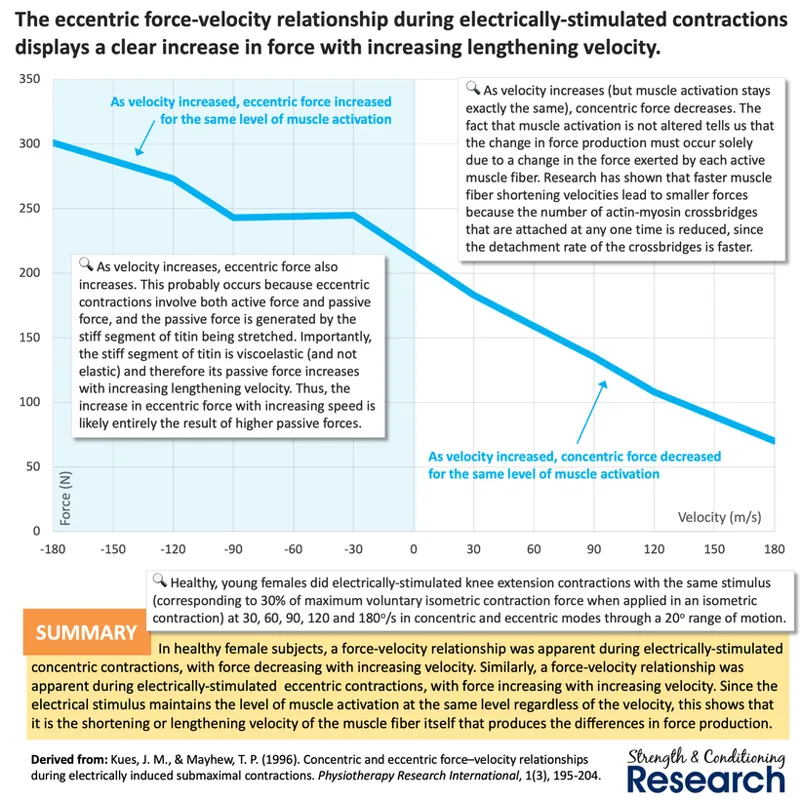
When activated by electrical stimulation, single muscle fibers display substantially higher eccentric forces at faster lengthening velocities compared to at slower lengthening velocities. Since the electrical stimulation eliminates the neural control of the muscle fibers, this phenomenon must arise due to muscle fiber properties.
.
The same phenomenon is observed when untrained, human subjects perform involuntary (electrically-stimulated) contractions at a relatively low level of force. Again, the electrical stimulation allows the level of muscle activation to be controlled and kept at the same level, such that the only factor influencing the force that is produced by the muscle is the properties of the individual, working muscle fibers.
.
#2. Why does force increase with increasing lengthening velocity?
It seems likely that force increases with increasing lengthening velocity because titin is viscoelastic. Titin is the element inside the muscle fiber that produces passive forces during the stretch of an activated muscle fiber. Since it is viscoelastic (rather than simply elastic), it generates a higher force in response to a faster stretch.
.
#3. What are the practical implications of this?
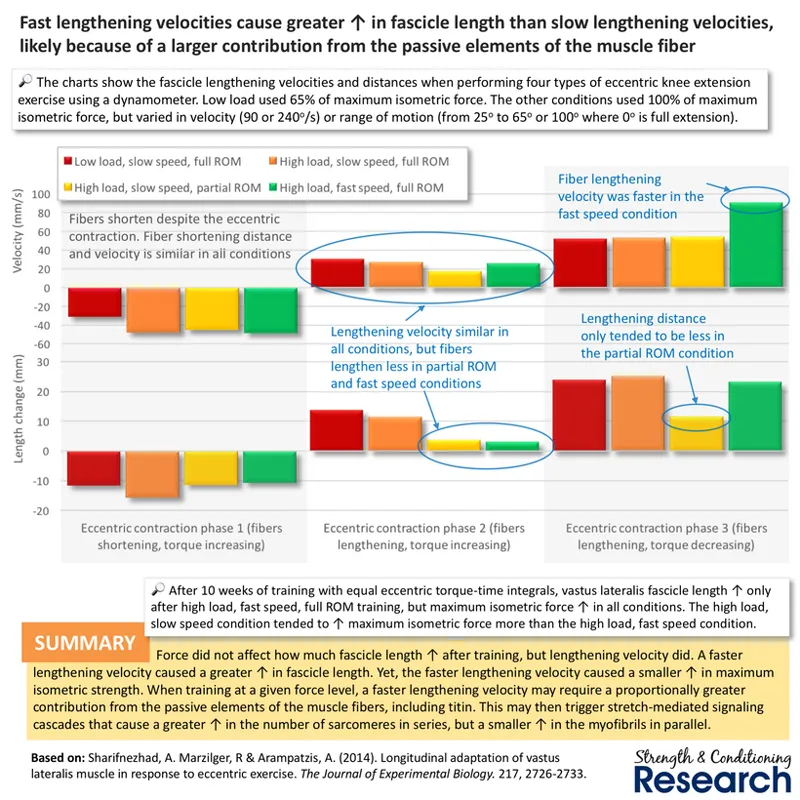
Since titin is both the producer of passive tension and also the element that detects the presence of passive tension and signals for longitudinal hypertrophy, faster eccentric contractions cause relatively more longitudinal hypertrophy than transverse hypertrophy.
.
#4. What is the voluntary eccentric force-velocity relationship in vivo?
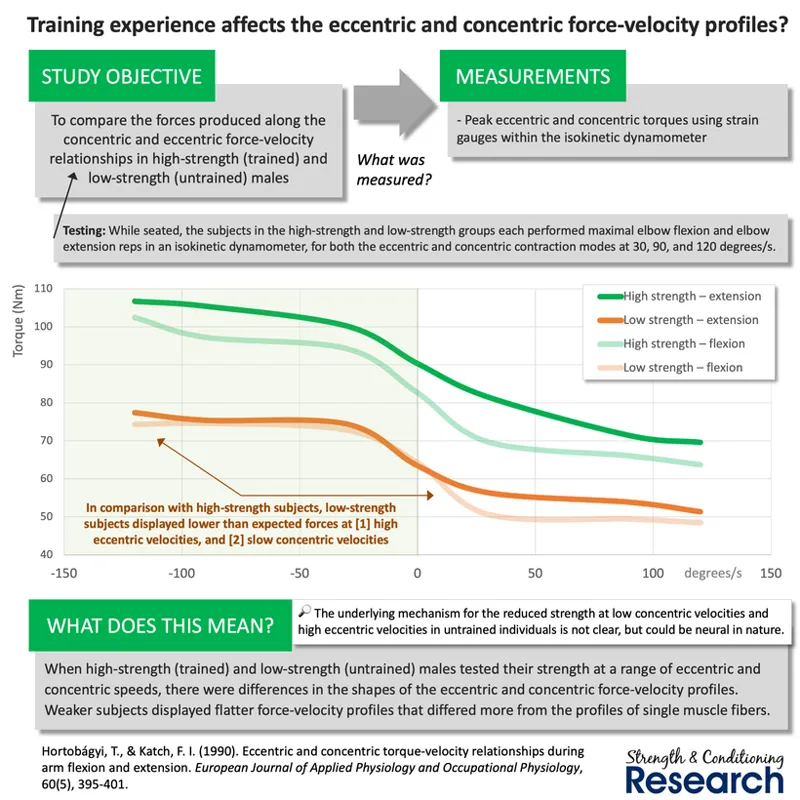
When measuring voluntary contractions, many studies have shown that the eccentric force-velocity relationship is flat. In other words, force does not vary with increasing lengthening velocity. Nevertheless, this behavior is only really apparent in untrained individuals. In trained lifters, eccentric force still increases with increasing velocity.
.
When we compare the voluntary and involuntary eccentric forces produced by trained and untrained subjects, we can see that trained athletes display increasing voluntary and involuntary eccentric force with increasing lengthening velocity, while untrained individuals display only increasing involuntary eccentric force. This deficit of eccentric strength at fast lengthening velocities has not yet been fully explained, and may involve a protective, neural mechanism.
.
#5. How does the voluntary eccentric force-velocity relationship change after eccentric training?
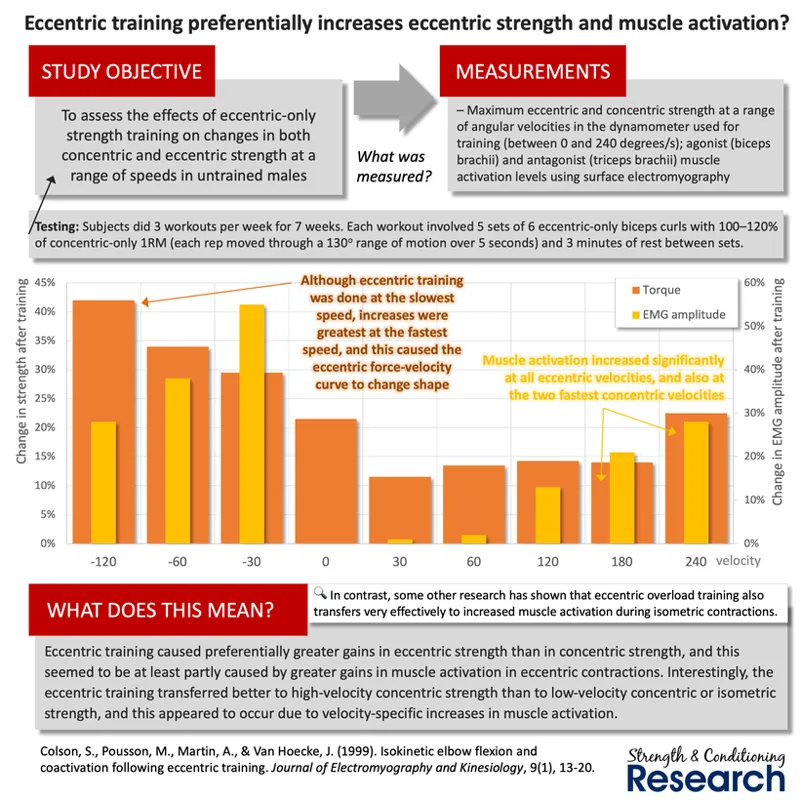
After strength training exercise (especially eccentric training exercise), the voluntary eccentric force-velocity relationship often corrects itself to become similar to the eccentric force-velocity relationship of single muscle fibers. In practice, this means that eccentric strength at fast velocities increases more than eccentric strength at slow velocities, even when the eccentric training was performed at a relatively slow speed.
.
Conclusions
When single muscle fibers are actively lengthened such that they produce eccentric contractions, they display higher forces at faster velocities. The same phenomenon can be seen during involuntary (electrically-stimulated) contractions involving whole muscles. This is the eccentric force-velocity relationship. Titin seems to be responsible for the higher forces that are produced at faster lengthening velocities. Titin is viscoelastic, and therefore it generates higher passive forces when it is stretched at faster speeds. Since titin is involved in the detection of passive forces and the subsequent signaling that produces sarcomerogenesis, the higher passive forces that are produced by faster lengthening velocities lead to greater longitudinal hypertrophy. Curiously, the eccentric force-velocity relationship is often not apparent during voluntary contractions performed by untrained individuals, such that force remains fairly constant with lengthening velocity. This deficit of force at fast speeds may be the result of a protective, neural mechanism that dissipates with training. Indeed, eccentric force at fast speeds often increases substantially after eccentric training, even when training does not involve performing eccentric contractions at fast speeds.
Comments (3)
Thank you Chris - you also pointed out that longitudinal hypertrophy is limited in comparison to transverse. What is your opinion on that ultimate ratio? So for example can I achieve a 50% increase in diameter and a 20% increase in length? What do you think?
Hello Chris - thank you - I'm confused - how does this relate to hypertrophy? It seems like the research shows the BEST muscle building pat of any repetition is a slow lowering of the weight. This made sense due to the equally high force of a fast lowering but a greater time under tension. Does the time under tension increase of the slow lowering surpass the benefit of the higher force from the fast lowering? Which is better for hypertrophy?
During normal strength training, the level of effort during the lowering phase is modified by the velocity. A faster velocity will mean a lower effort, and therefore fewer muscle fibers will be active. Consequently, fewer muscle fibers will be stimulated to grow. In contrast, during maximal effort eccentric training using a dynamometer or other similar machine, fast velocities can be achieved simultaneously with high efforts, such that many muscle fibers experience the fast eccentric contraction. During dynamometry training, a fast eccentric will cause more passive force due to the viscoelastic properties of titin, which causes more longitudinal hypertrophy to occur. This is impossible during normal strength training, because increasing velocity reduces motor unit recruitment.