




Effects of muscle length on fatigue
How muscle length affects fatigue mechanisms is important, because many workout routines aim to place less-fatiguing exercise variations earlier and more-fatiguing exercise variations later, so as to maximize the adaptations produced by all exercises across the entire workout.
.
#1. What is the effect of actin-myosin overlap?
The active length-tension relationship exists because all of the myosin molecules along the length of a myofibril do not always line up with the corresponding actin molecules. Thus, at very short or very long muscle fiber lengths, some myosins cannot bind with actin. For this reason, the active length-tension relationship forms a trapezoid shape with a plateau of peak force in the middle (called the optimum muscle length for force production). When more myosins bind with actin, more metabolite-related fatigue will occur due to the provision of ATP at a faster rate into the crossbridge cycle.
.
For this reason, we observe a more rapid development of fatigue immediately after strength training sets that are performed at optimal muscle lengths (which correspond to the plateau region of the active length-tension relationship) compared to at short muscle lengths.
.
#2. What is the effect of stretch-activated ion channels?
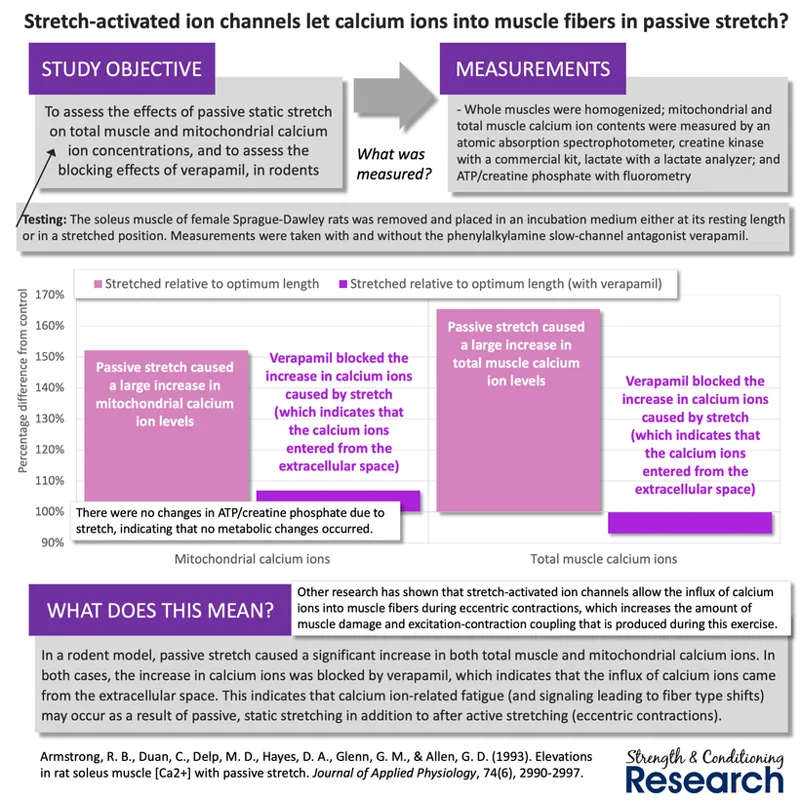
While metabolite-related fatigue is influenced by the active length-tension relationship, calcium ion-related fatigue mechanisms are influenced by the passive length-tension relationship. When muscle fibers are stretched, this allows calcium ions to flow into the cytoplasm from the extracellular space through stretch-activated ion channels. These calcium ions cause several fatigue mechanisms to occur, including excitation-contraction coupling failure.
.
For this reason, we observe the more rapid development of fatigue after strength training at long muscle lengths compared to at short muscle lengths. Training muscles at long muscle lengths involve stretching muscle fibers to the point where the stretch-activated ion channels are opened, which causes an influx of calcium ions and subsequently calcium ion-related fatigue mechanisms. This often causes greater total fatigue (and greater post-workout fatigue as well).
.
Importantly, calcium ion-related fatigue mechanisms include both excitation-contraction coupling failure and muscle damage, which are relatively long-lasting. Thus, they can impede performance (and therefore adaptations) produced by subsequent sets and exercises of a workout.
.
Although some other mechanisms have been explored (such as differences in voluntary activation levels between contractions at different muscle lengths and differences in muscle blood flow leading to differences in metabolite accumulation), these differences have been discounted. Thus, the only two factors that seem to make a difference are the active and passive length-tension relationships inside the muscle fibers, leading to differences in metabolite-related fatigue and calcium ion-related fatigue, respectively.
.
Conclusions
How muscle length affects fatigue mechanisms is important, since many workout routines aim to place less-fatiguing exercise variations earlier and more-fatiguing exercise variations later, so as to maximize the adaptations produced by all exercises across the entire workout. There are only two physiological mechanisms affecting the magnitude of fatigue and the type of fatigue mechanisms produced by strength training exercises performed at different muscle lengths. These are: [1] the amount of actin-myosin overlap, and [2] the extent to which the stretch-activated ion channels are opened. When actin-myosin overlap is greater (as occurs on the plateau of the active length-tension relationship, which most often tends to occur at moderate muscle lengths), this causes a faster rate of ATP usage and hence the development of more metabolite-related fatigue. In practice, this fatigue mechanism is not a problem as it does not reduce the magnitude of mechanical tension that stimulates hypertrophy. When the stretch-activated ion channel are opened (as occurs on the descending limb of the length-tension relationship, which tends to occur at long muscle lengths), this causes more calcium ion influx from the extracellular space and hence greater calcium ion-related fatigue. In practice, this fatigue mechanism is a problem because calcium ion-related fatigue impairs the mechanical tension that stimulates hypertrophy in any subsequent sets and exercises.
Comments (3)
Hey Chris just some brainstorming. Would you ever consider doing leg extensions prior to a hack squat for the potentiating effects (more voluntary activation of a muscle notorious for having little voluntary activation). Would high voluntary activation levels + less calcium ion related fatigue still outweigh the downside of having the quads trained to a 0rir in leg extension first?? Cheers
I don't think that potentiation works by increasing voluntary activation but rather by increasing local muscle fiber force, so IMO the net effect would be to reduce mechanical tension (calcium ions have a larger negative effect than the positive effect of phosphorylating the myosin regulatory light chains).
Thanks Chris - it seems like calcium ions are always the villain