




Mechanical tension
Mechanical tension is the primary stimulus for muscular hypertrophy. In fact, it is probably the only stimulus for hypertrophy.
.
#1. Why is mechanical tension a stimulus for hypertrophy?
There are two types of mechanical tension: active and passive. Each stimulates a different adaptation. Active mechanical tension (caused by muscular contractions) cause the addition of myofibrils leading to an increase in muscle fiber cross-sectional area. Passive mechanical tension (caused by stretch) causes the addition of sarcomeres in series leading to an increase in muscle fiber length (read more).
.
We know that passive mechanical tension can cause an increase in sarcomeres in series without any muscle activation because stretching denervated muscles causes them to grow. Denervated muscle fibers are not able to receive electrical signals from the brain and so cannot be activated. Additionally, they cannot experience any metabolite accumulation due to the supply of energy to the crossbridge cycle. Neither can they experience muscle damage due to the influx and accumulation of calcium ions. For this reason, mechanical tension is the only possible mechanism that can stimulate growth.
.
We cannot show that active mechanical tension is able to cause an increase in myofibrils in parallel without any muscle activation because muscle activation is necessary for active mechanical tension to be generated. Nevertheless, we can show that muscle fibers do not grow when they are activated but crossbridge cycling is blocked from happening.
.
#2. Why is muscle fiber activation NOT a stimulus for hypertrophy?
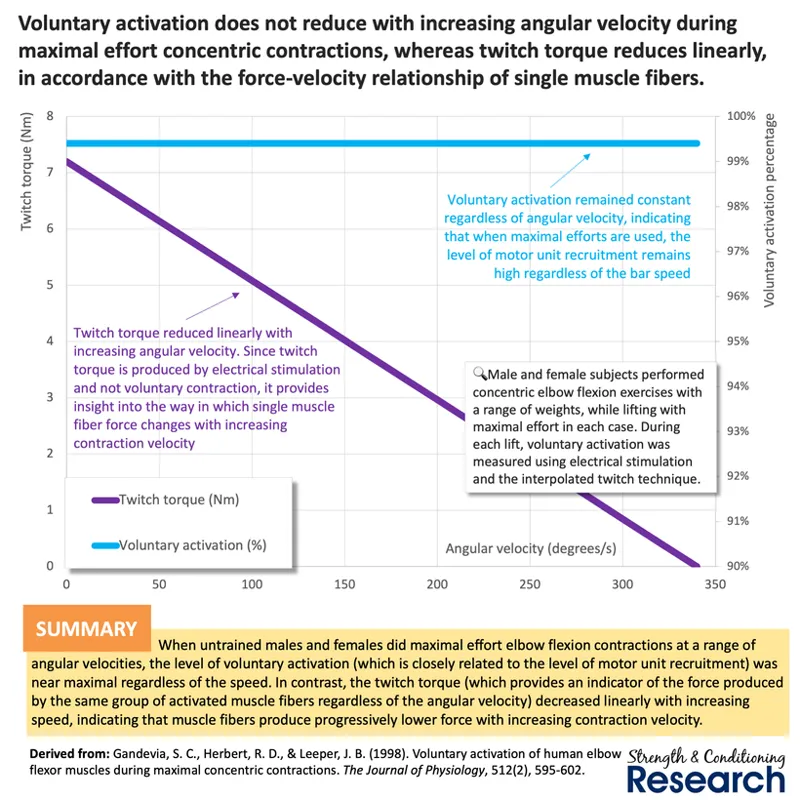
Some researchers and commentators have suggested that achieving a high level of motor unit recruitment can stimulate hypertrophy. However, this hypothesis can be dismissed easily, because very high levels of motor unit recruitment can be attained during high-velocity movements. Indeed, research has shown that maximal voluntary activation (the gold standard measurement for motor unit recruitment) is maximal whenever effort is maximal and is not affected by load or velocity.
.
Fast movement training programs do not produce hypertrophy. Yet, as shown above, when the fast movements are performed with maximal efforts, they involve high levels of motor unit recruitment. This tells us that high levels of motor unit recruitment cannot alone cause muscle growth.
.
Recently, this observation was tested directly. Researchers used a rodent model to assess the differences in hypertrophy caused by two different training programs that involved the exact same dosage of muscle activation but different levels of mechanical tension. The study showed that muscle activation alone was not sufficient to cause hypertrophy. Only muscle activation that occurred together with substantial mechanical tension was enough to bring about hypertrophy.
.
When muscle fibers shorten slowly, they produce very high forces due to the greater number of attached myosin motors. When muscle fibers shorten quickly, they produce very low forces due to the smaller number of attached myosin motors. The number of attached myosin motors is determined by the shortening velocity of the muscle fiber because the detachment rate of each myosin motor increases with increasing velocity. For this reason, each myosin remains attached to actin for a shorter period of time as shortening velocity increases.
.
#3. How does light load strength training produce hypertrophy?
Some researchers have argued that mechanical tension cannot be the sole mechanism that causes hypertrophy because light load strength training causes the same amount of muscle growth as more moderate loads. This objection fails to understand that muscle force is not the same as muscle fiber mechanical tension. As explained above, the active mechanical tension experienced by muscle fibers is largely determined by the force-velocity relationship and so is independent of load (read more).
.
#4. Why is muscle damage NOT a stimulus for hypertrophy?
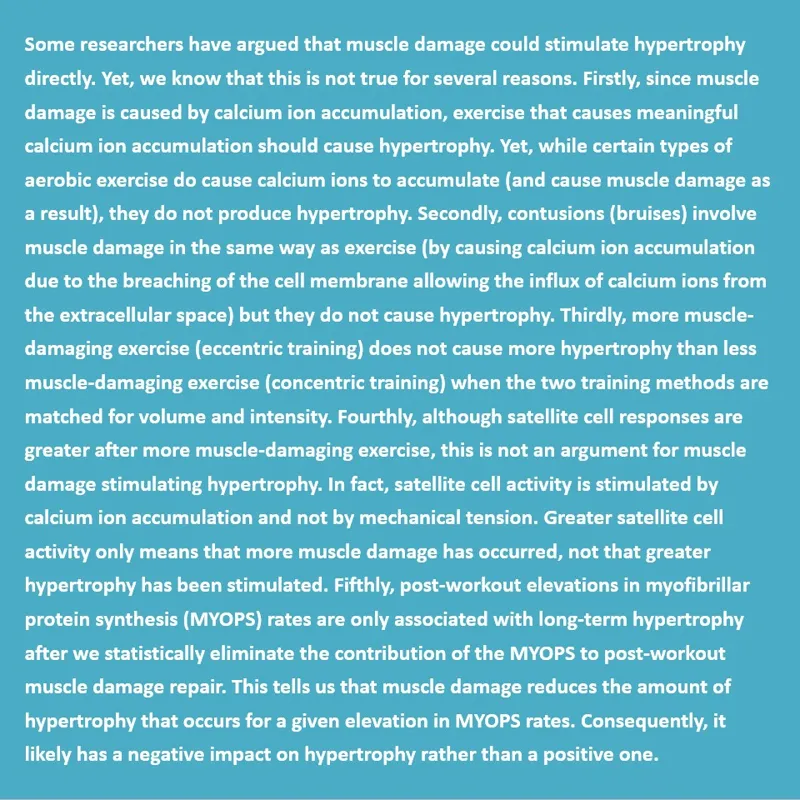
Some researchers have suggested that causing muscle damage can stimulate hypertrophy. Yet, this hypothesis has now largely been discarded (read more).
.
#5. Why is metabolic stress NOT a stimulus for hypertrophy?
Some researchers have suggested that metabolite accumulation can stimulate hypertrophy. Yet, this hypothesis has similarly been discarded (read more).
.
Conclusions
Mechanical tension is likely the only stimulus to cause muscle hypertrophy. There are two types of mechanical tension: active and passive. We know that passive mechanical tension causes the addition of sarcomeres in the absence of muscle activation because stretching denervated muscle fibers causes them to increase in length (albeit not in cross-sectional area). In contrast, it is more difficult to separate out the effects of active mechanical tension and muscle activation because activation is needed to form actin-myosin crossbridges. Even so, muscle fibers do not grow properly if they are activated while crossbridge formation is experimentally blocked. Since crossbridge formation is what produces active mechanical tension, this indicates that active mechanical tension and not muscle activation is what stimulates the addition of myofibrils leading to increases in muscle fiber cross-sectional area. Also, human and animal studies have shown that hypertrophy does not occur after training with high-velocity movements even when they involve maximum levels of motor unit recruitment and hence high levels of muscle activation. Since we know that the amount of crossbridge force (and therefore the amount of active mechanical tension)is determined by the force-velocity relationship, the fact that only slow movements can stimulate muscle growth also strongly implicates active mechanical tension as the driver of increases in muscle fiber size.



Comments (8)
Question related to mechanical tension/force-velocity relationship: Let's say I work up to a 10RM and lift each rep with maximum effort. I understand that muscle fibers produce more force at slow contraction velocities because of the force-velocity relationship. However, I can't seem to grasp why would muscle fibers produce more force in the last few reps of a 10RM (compared to the early reps that are lifted faster), because wouldn't lifting the same load faster mean that the muscle fibers have to produce more force, if F=ma? I have a rough idea of how cross bridging works and how that allows the muscle fibers to produce more force during slow contraction velocities. But in the context of using the same load, I don't understand why do muscle fibers produce more force at slower contraction velocities. So, I guess I'm confused why isn't the external force higher, while the muscle fibers produce more force? Hopefully this question makes sense, thank you!
F=ma can easily be used to describe the influence of whole muscle force on the external load. However, we cannot extrapolate from muscle force to muscle fiber force, and it is muscle fiber force (mechanical tension) that causes adaptations. Several fatigue mechanisms cause a reduction in the number of muscle fibers that are contributing fiber force to whole muscle force. For this reason, the remaining muscle fibers must then produce higher forces (and this increase in force is facilitated by the drop in muscle fiber shortening velocity).
Actually that is totally wrong about animal studies. They have terrible interval validity because of not being able to randomize as well, high risk of bias, do not simulate human events etc. Animal studies also have terrible exeternal validity because of blinding and species difference. Also because they lack the complexity of humans and have much different rates of aging and genomic difference in metabolic genomics. Why do you think so many studies showing an effect on animals dont show an effect in humans. The point is there really isnt a lot of research on the topic and most of the research on hypertropy is absolutley terribly done. I dont think they even have done a hypertrophy study where they controlled for food beyond simple self reported tracking. The samples sizes are small and so are rhe effect sizes. I love your site and been a subscriber for god knows how many years but it would be nice if you went into the inferential statistics of a study.A lot of things look good from a hypothetical standpoint but end up being proven wrong. I think you do the best job of desribing the mechanisms of what studies are researching but that is one component and the inferential statistics are there to determine if we are drawing the right conclusions. Im not just talking about a p value because its easy to p hack but at least mention things like mutliple comparisions, sample sizes, what type of studies and the weakness and strength of using certain studies over others. Statistical inference has proven that it does better than expert opinion.
Extrapolation of results from animals to humans (external validity) is always going to be a limitation of animal models, but I don't agree with the points you make about the extent to which the results recorded in animal studies reflect the truth about the studied population (which is internal validity). IMO, internal validity will always be superior in a population where we can completely control everything about the situation (sleep, food intake, effort level, etc.). Thus, confounding factors are always better controlled in animals than in humans. Considering internal validity further, I am not sure I follow why you think (1) the process of randomization is better in groups of humans than in groups of animals, and (2) the risk of bias is greater in animals than in humans. As regards the randomization, human studies are far, far more likely to use connected groups and/or convenience samples, which is a major risk for randomization failure. As regards risk of bias, that's a bigger area, but IMHO the presence of bias is much more apparent in human resistance training studies than in animal models (especially selection bias, study design flaws, and confounding factors). Finally, I would note that your point about animal models not simulating humans events is better described as an element of external validity and not internal validity (because it relates to extrapolation beyond the subject population).
Animal studies arent exactly the best. Exercise physiology studies maybe rhe worst next to mental health. Small sample sizes lack of control, tons of confounders, lots of multiple hypothesis testing, heterogeneity, usually no correction when they do multiple comparisons, very little replication and the list goes on. I think maybe you cant write off things so quickly without considering that exercise studies are pretty weak and simple deductive reasoning is not really good enough when your talking about something as multifactorial as the human body and human life. Love the articles but still dont think its a open a shut case with most exercise physiology studies
(1) I would argue that many animal studies of hypertrophy are in many ways better than human studies, because they involve far fewer confounding factors, much larger sample sizes relative to their statistical power, and the measurements are more extensive and accurate. (2) I believe that we can indeed write off the roles of metabolic stress and muscle damage relatively easily, since the evidence base on which they were initially proposed as hypothetical mechanisms was actually very weak.
Progressive overload with the last 1-2 reps at or near failure fighting for that rep. 👍
Thank you Chris - this explains why so many different training programs work and have worked for muscular development. From Arnold and Mike Mentzer (volume training versus HIT) in the 80s to the current debates you noted the only common denominator seems to be a load causing tension at the fiber level.