






Muscle damage (hypertrophy)
Muscle damage has been proposed as a mechanism by which hypertrophy is stimulated. However, this is not the case. In fact, muscle damage more likely detracts from the muscle growth that each workout is able to produce.
.
#1. Muscle damage is not caused by fibers being pulled apart
Although the fitness industry hive mind repeatedly states that muscle damage is caused by the fibers being torn apart during exercise, this is just not true. In fact, muscle damage is a biochemical effect that is caused by muscle fiber activation and not by mechanical tearing forces (read more).
.
Given that muscle damage is caused by calcium ion accumulation and not by mechanical tearing forces, if muscle damage is really a stimulus for hypertrophy, then any type of exercise that causes a meaningful amount of calcium ion accumulation (and therefore a degree of muscle damage) should also cause hypertrophy. Yet, aerobic exercise causes calcium ion accumulation and therefore also causes post-workout fatigue including excitation-contraction coupling failure and muscle damage (read more).
.
Nevertheless, aerobic exercise does not produce hypertrophy except in elderly, sedentary people (read more).
.
#2. Muscle damage caused by contusions NEVER causes hypertrophy
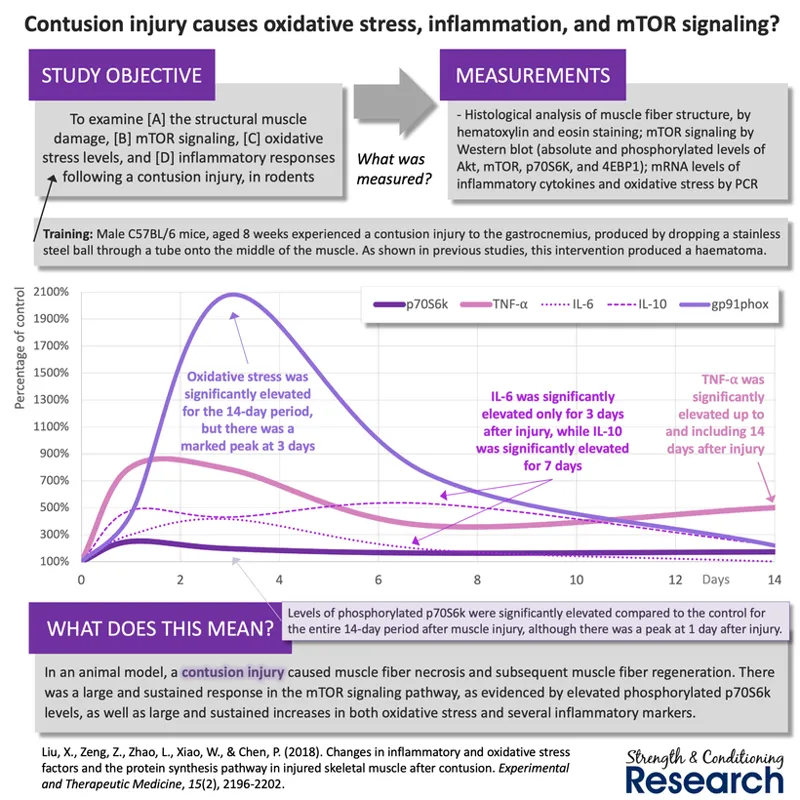
If damaging a muscle fiber stimulates it to grow in size, then muscle damage must cause hypertrophy regardless of how that muscle damage was caused. In other words, hypertrophy should occur after contusion injury. Evidently, this does not happen.
.
Interestingly, when muscle damage is caused by an impact, leading to contusion injury, the repair process still involves the same series of events as the repair process after eccentric contractions. The repair process involves oxidative stress and an inflammatory response, as well as anabolic signaling in the mTOR pathway. Clearly, this repair process can be fully activated without hypertrophy subsequently occurring. Therefore, it is perfectly possible to break down a muscle fiber and rebuild it without the muscle fiber growing larger than it was before the damage occurred.
.
#3. Muscle damaging exercise does not cause more hypertrophy
If damaging a muscle fiber stimulates it to grow in size, then more muscle-damaging exercise should always cause more hypertrophy than less muscle-damaging exercise. Evidently, this does not happen because muscle volume increases are typically quite similar after eccentric-only and concentric-only strength training programs that are matched for contraction mode-specific 1RM percentages.
#4. Satellite cell responses are NOT indicators of hypertrophy
Some researchers and fitness industry commentators have argued that the greater satellite cell responses after muscle-damaging exercise indicate that muscle-damaging exercise provides a greater stimulus for hypertrophy. This assumes that the satellite cell responses are always targeted at generating hypertrophy, which is laughable. The primary purpose of satellite cell responses and of the satellite cells themselves is to do muscle damage repair (read more).
.
#5. Post-workout MYOPS rate elevations are associated with hypertrophy only after removing the contribution to muscle damage
Long-term hypertrophy after a strength training program should be predictable from the post-workout elevation of myofibrillar protein synthesis after each workout in the program. However, this is only the case when the contribution of the myofibrillar protein synthesis rate elevation to muscle damage repair is removed (statistically). This tells us that muscle damage repair does not contribute to hypertrophy but actually withdraws resources away from the processes that are causing hypertrophy.
.
Indeed, this underlines the fact that we cannot use myofibrillar protein synthesis rate elevations as simple indicators of a hypertrophy stimulus. They can and do include an element of muscle damage repair. For example, when aerobic exercise studies report elevations in myofibrillar protein synthesis rates for 72 hours, this is absolutely not a hypertrophy effect. It is just muscle damage repair.
.
Conclusions
Some researchers have argued that muscle damage could stimulate hypertrophy directly. However, we know that this is not true for several reasons. Firstly, since muscle damage is caused by calcium ion accumulation, exercise that causes a meaningful calcium ion accumulation should cause hypertrophy. Yet, while certain types of aerobic exercise do cause calcium ions to accumulate (and cause post-workout muscle damage as a result), they do not produce hypertrophy. Secondly, contusions (bruises) involve muscle damage in the same way as exercise (by causing calcium ion accumulation due to the breaching of the cell membrane allowing the influx of calcium ions from the extracellular space) but they do not cause hypertrophy either. Thirdly, more muscle-damaging exercise (eccentric-only training) does not cause more hypertrophy than less muscle-damaging exercise (concentric-only training) when the two training methods are matched for volume and intensity. Fourthly, although satellite cell responses are greater after more muscle-damaging exercise, this is not an argument for muscle damage stimulating hypertrophy. In fact, satellite cell activity is stimulated by calcium ion accumulation and not by mechanical tension. Greater satellite cell activity only means that more muscle damage has occurred, not that greater hypertrophy has been stimulated. Fifthly, post-workout elevations in myofibrillar protein synthesis (MYOPS) rates are only associated with long-term hypertrophy after we statistically eliminate the contribution of the MYOPS to post-workout muscle damage repair. This tells us that muscle damage reduces the amount of hypertrophy that occurs for a given elevation in MYOPS rates. Consequently, it likely has a negative impact on hypertrophy rather than a positive one.


Comments (2)
Great article Chris - is muscle damage equivalent to soreness? DOMS? The biggest headache is hearing that the workout did not create soreness. Try as I might to explain that soreness is irrelevant, not the goal, and not a result many people view soreness as the definition of a good workout. So from this article obviously muscle damage is not necessary for hypertrophy. However how about soreness? Thanks!
We still don't actually know what causes muscle soreness, and we don't really know how soreness is connected to muscle damage. Historically, it has often been assumed that muscle damage and soreness are unrelated because the soreness is delayed, while the damage is not. However, we are now realizing that the damage is also delayed (albeit probably by not quite as long) given that it is caused by calcium ion accumulation and subsequent protease release rather than by mechanical tension. So unfortunately, there isn't a way to be sure about the relationship between muscle soreness and hypertrophy, but I would be very surprised if the two were connected.