



Concurrent training
Concurrent training refers to the performance of aerobic exercise workouts and strength training workouts within the same training week. Researchers have suggested that aerobic exercise creates an effect on the molecular signaling that occurs after strength training workouts. Yet, this hypothesis has now been largely rejected. Consequently, we can instead explain how post-workout fatigue can easily produce a similar interference effect.
.
#1. No signaling interference effects
Over many years, researchers developed the hypothesis that adenosine monophosphate kinase (AMPK) signaling (which is commonly stimulated by aerobic exercise) was able to interfere with mechanistic target of rapamycin (mTOR) signaling after strength training. AMPK is an energy sensor, and when energy levels are reduced (as is common after aerobic exercise), its signaling activities are increased. Nevertheless, when researchers tested the presence of increased AMPK levels during concurrent training, they did not find that it was associated with reduced muscle growth.
.
#2. Ranking of interference effects: speed > strength > size
One interesting observation made in concurrent training studies is that the interference effect is largest for measures of high-velocity strength and speed, next largest for measures of maximum strength, and smallest for hypertrophy. Therefore, it is common for high-velocity strength gains to be impaired during concurrent training, even when gains in maximum strength are not.
.
This observation cannot be explained by the molecular signaling model. In fact, the molecular signaling model would predict the opposite order, because it assumes that the performance impairments are caused by reduced hypertrophy, and hypertrophy does not improve speed. Indeed, when it increases the internal moment arm of the muscle, hypertrophy tends to reduce speed.
.
#3. Post-workout fatigue mechanisms can cause interference effects
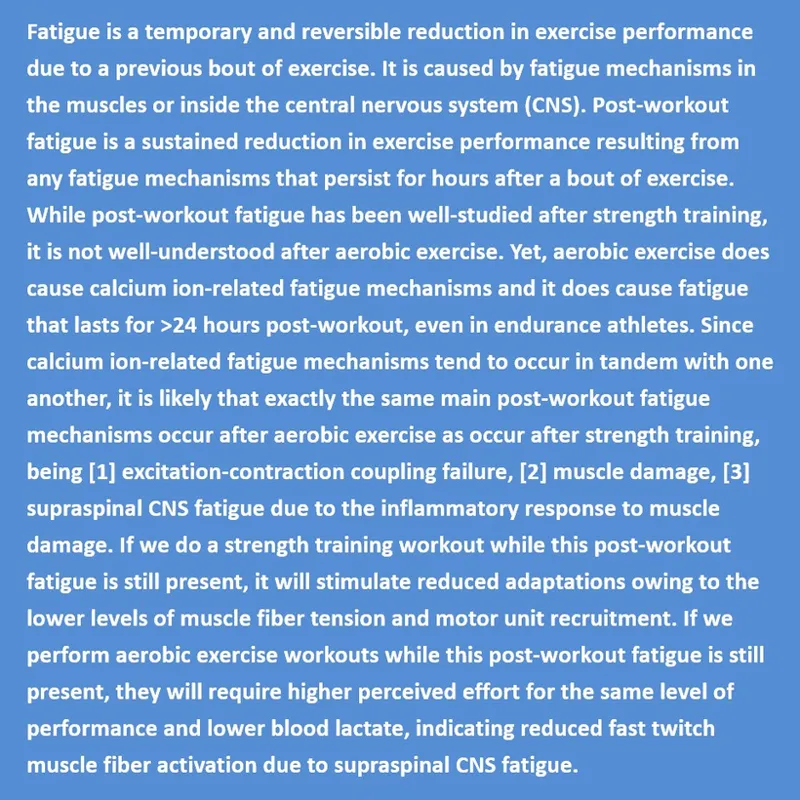
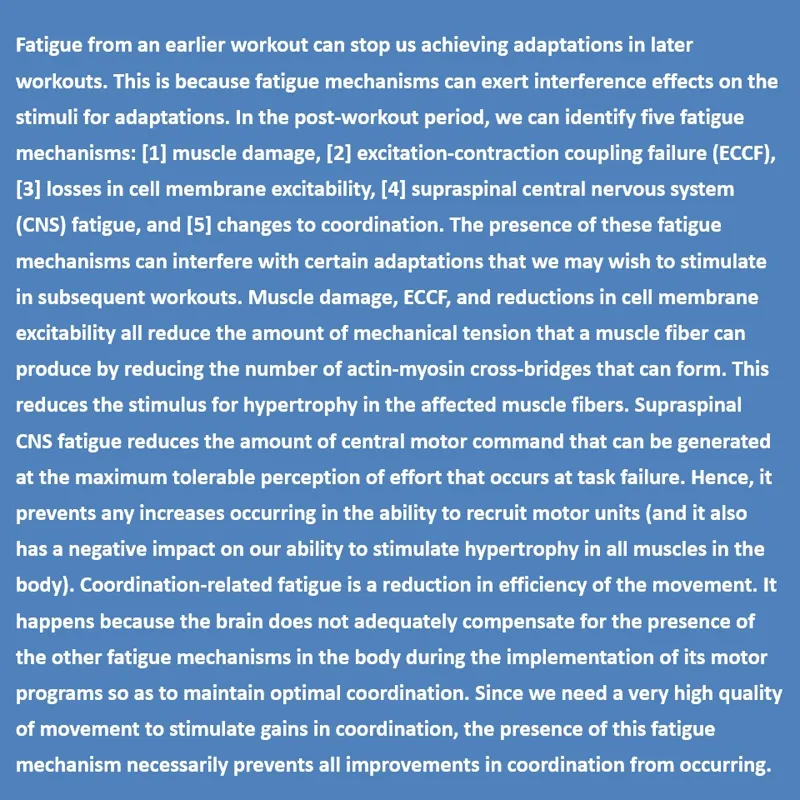
Fatigue mechanisms are able to interfere with the ability to stimulate a range of adaptations, especially neural ones that contribute to gains in speed and strength (read more).
.
#4. Aerobic exercise causes fatigue mechanisms immediately post-exercise
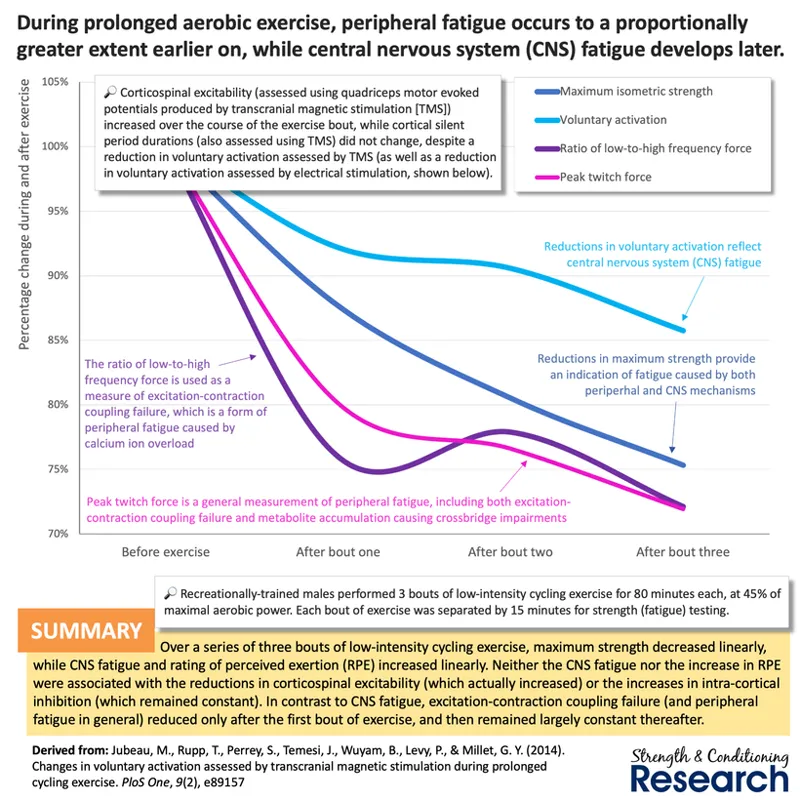
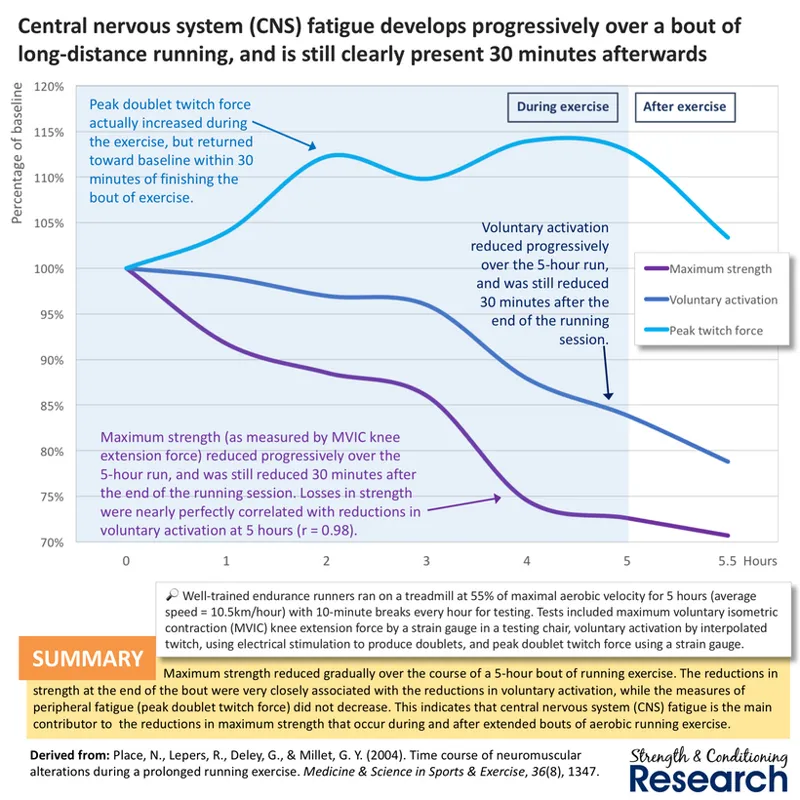
Research has shown that fatigue is caused by aerobic exercise workouts. The fatigue includes both local muscular mechanisms (that can impair single muscle fiber mechanical tension) as well as central nervous system (CNS) fatigue mechanisms (that can impair the level of motor unit recruitment).
.
Indeed, when substantially longer aerobic exercise bouts are performed, the CNS fatigue that is experienced during exercise is much more pronounced and lasts for even longer.
.
#5. Aerobic exercise can cause post-workout fatigue for days
While post-workout fatigue in the wider fitness industry is rarely associated with aerobic exercise, research has shown that it does occur and lasts for a couple of days (read more).
.
#6. Using block periodization to avoid the interference effect
Block periodization can be used to avoid the interference effect (where athletes need to develop both maximal aerobic capacity and maximum strength and/or speed). By employing blocks of training that are focused on one quality while maintaining the other quality with a reduced level of training volume, athletes can make better progress than if both qualities are targeted simultaneously.
.
Conclusions
Concurrent training refers to the performance of aerobic exercise workouts and strength training workouts in the same week. Concurrent training often produces reduced strength training adaptations (including reduced strength gains, speed gains, and hypertrophy) compared to a program that involves solely strength training workouts. Researchers have suggested that molecular signaling that occurs following aerobic exercise might interfere with the molecular signaling that occurs after strength training workouts, thereby reducing strength training adaptations. Yet, recent research has not supported this hypothesis. Moreover, the interference effect seems to be greatest for high-velocity strength (speed) and smallest for hypertrophy, suggesting that blunting of muscle growth is the least important effect of the underlying mechanism and not the most important. An alternative mechanism is that aerobic exercise sessions cause post-workout fatigue mechanisms that impair the ability to stimulate gains in speed, strength, and muscle size during strength training workouts. Indeed, studies have shown that calcium ion-related fatigue mechanisms (which reduce single muscle fiber mechanical tension) and central nervous system fatigue mechanisms (which reduce central motor command, motor unit recruitment, and motor unit firing rates) are apparent in the post-workout period after aerobic exercise bouts. This fatigue interference effect is a satisfactory model because it explains why concurrent training negatively affects speed gains more than strength gains and strength gains more than hypertrophy.

Comments (4)
Hi Chris, I am a Spanish coach. I did some sports related research in my youth (Mikel Izquierdo-Gabarren) Have you ever thought about translating your publications into Spanish? do you think we could collaborate on that?
When I first started making infographics, I worked with a couple of translators and many were translated into Spanish, German, Japanese and Chinese. That stopped after a while, because the work input is actually very considerable. Currently, some of my weekly patreon summaries (as shown by the text on the blue background above) are translated into Portugese, but that's about it. Happy to chat more if you think there is mileage, though.
Very interesting article. I remember reading your other article on how cardio might interfere with gains and thinking to myself "Does the mainstream fitness industry have anything right?". To me, I think this is the best argument I've seen for periodisation (even though that might not have been the goal of the article) for high level mixed quality/typically thought of as team sport athletes. Walking through it, it becomes apparent that high velocity strength adaptions will be minimised if a constant endurance stimulus is maintained year round. Whether or not high velocity strength adaptions are best developed with block periodisation or a more undulating periodisation I think remains an open question?
Yes, I think that there are some really good rationales for using block periodization in a range of situations, but the minimization of the concurrent training effect is probably the most important mechanism.