






Detraining of adaptations
Detraining describes a period of time in which adaptations are dissipating. Importantly, each adaptation dissipates when its unique stimulus is removed. This means that some adaptations can be increasing while others are simultaneously decreasing, depending on the type of training program.
.
#1. Detraining of neural adaptations
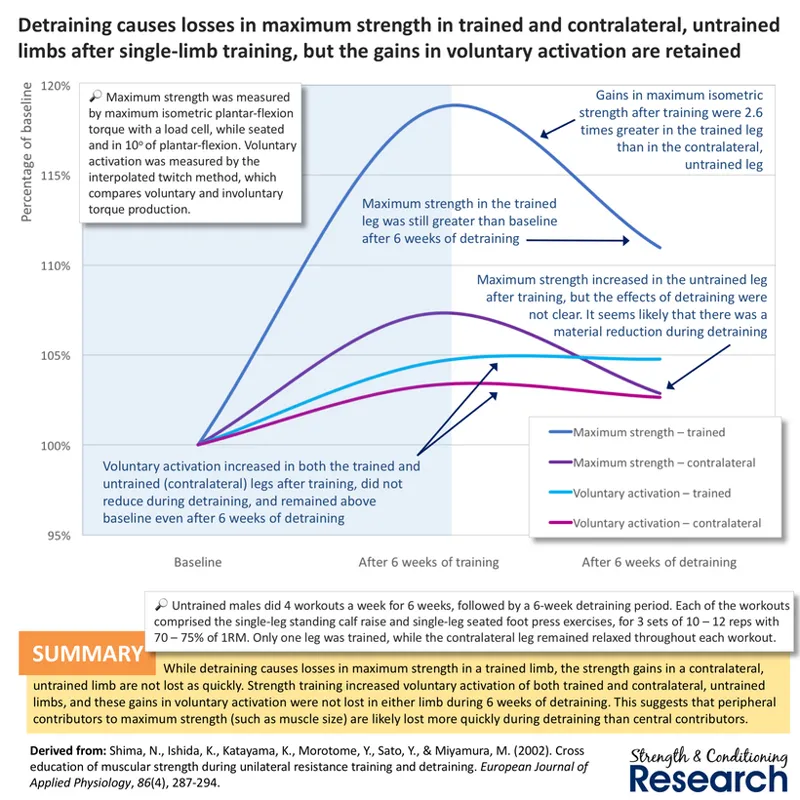
While it is often assumed that neural adaptations dissipate quickly during detraining, this is not the case. Coordination improvements are famous for lasting years (which is why we say "it's like riding a bike") and increases in motor unit recruitment levels both reduce very slowly during detraining.
.
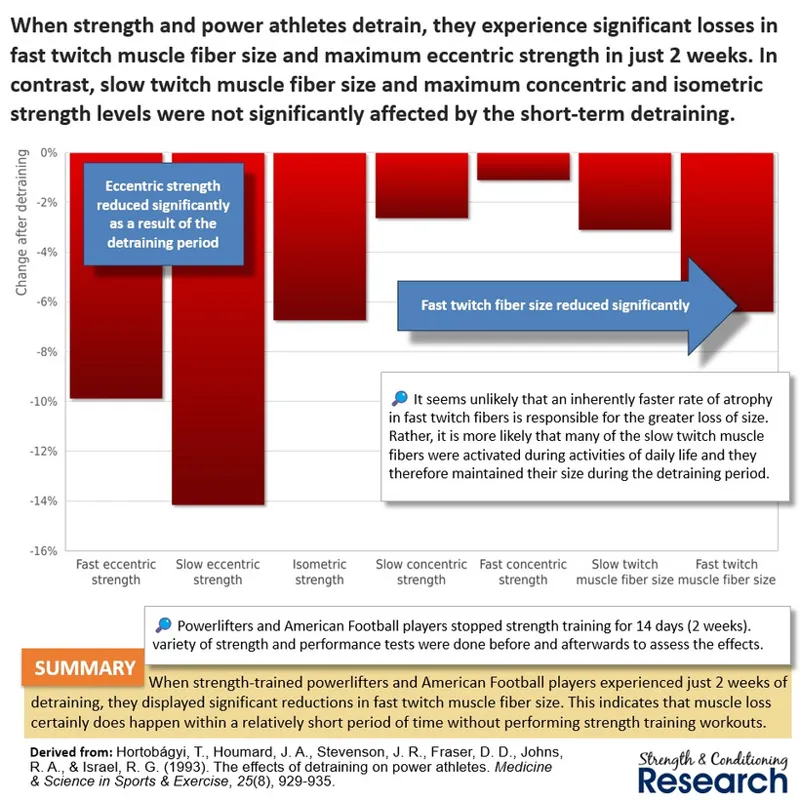
Incidentally, during a short detraining period, fast concentric strength dissipates far less than slow concentric strength or isometric strength. Fast concentric strength is heavily dependent upon neural adaptations, while slow concentric strength and (to an even greater extent) isometric strength are much more dependent upon peripheral adaptations.
.
#2. Detraining of peripheral adaptations
Strength training causes increases in muscle size and tendon stiffness. Detraining causes losses in muscle size and losses in tendon size and stiffness. However, while the muscle size reductions are fairly rapid during any period of detraining, the reductions in tendon stiffness occur more slowly, at perhaps half the speed. Even so, losses in muscle size and tendon stiffness both occur more quickly compared to changes in the ability to recruit high-threshold motor units.
.
While it is often claimed that muscle mass decreases very slowly during detraining periods. This is not the case. In fact, only a single week of detraining is enough to cause significant losses in muscle size.
.
Some research suggests that the rate of muscle loss after a period of hypertrophy is not linear, but in fact occurs more rapidly during the first few weeks of detraining compared to any subsequent weeks of detraining.
.
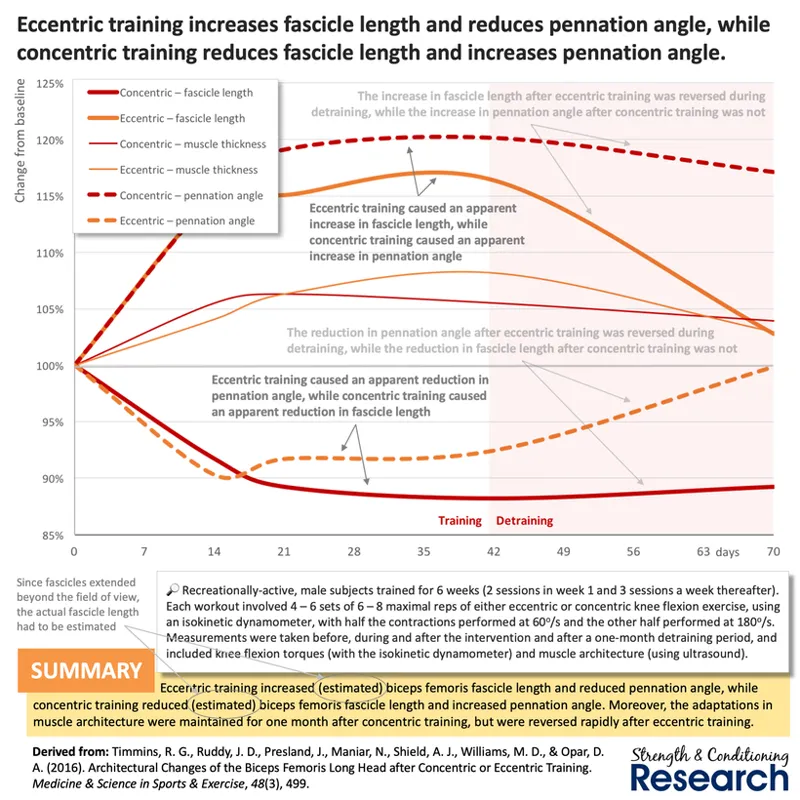
Additionally, it is likely that sarcomeres are lost more quickly than myofibrils, as indicated by the much more rapid loss of muscle fascicle length after stopping eccentric training compared to the rate of loss of muscle pennation angle after stopping concentric training.
.
#3. Detraining of flexibility
While flexibility is usually argued to be produced by a neural adaptation (an increase in stretch tolerance), it does not display the same pattern as other neural adaptations but instead dissipates relatively quickly (more in line with the expected reduction of sarcomeres in series). Exactly why this happens is currently unclear.
.
#4. Detraining by altering the type of training
Detraining is usually defined as an absence of training. Yet, it is more accurate to refer to detraining as the absence of a requisite stimulus. Therefore, it is possible to continue training and still experience detaining of an adaptation, while producing other adaptations. For example, a block of treadmill running does not maintain the hypertrophy created by a previous block of lower body strength training.
.
Similarly, the repeated bout effect is lost when we stop doing eccentric-only strength training and instead perform concentric-only strength training. The repeated bout effect is just a set of adaptations that provide resistance to calcium ion-related fatigue mechanisms.
.
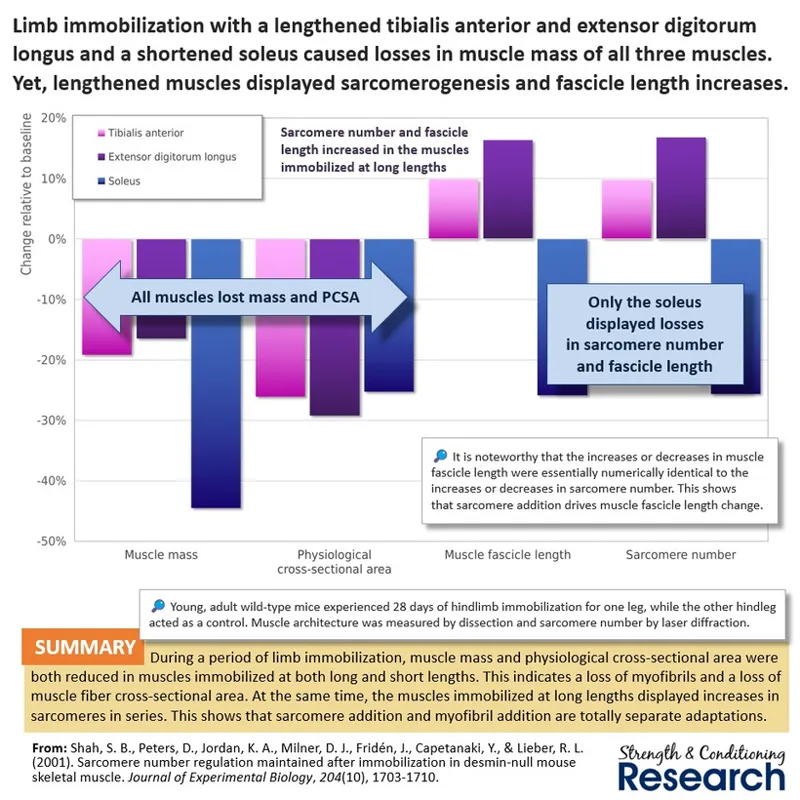
And, of course, we can experience atrophy due to immobilization of a muscle (due to the loss of myofibrils in parallel) even while sarcomeres are added because of the stretched position in which the muscle is immobilized, which provides a passive mechanical tension stimulus.
.
#5. Potentially negative effects of detraining
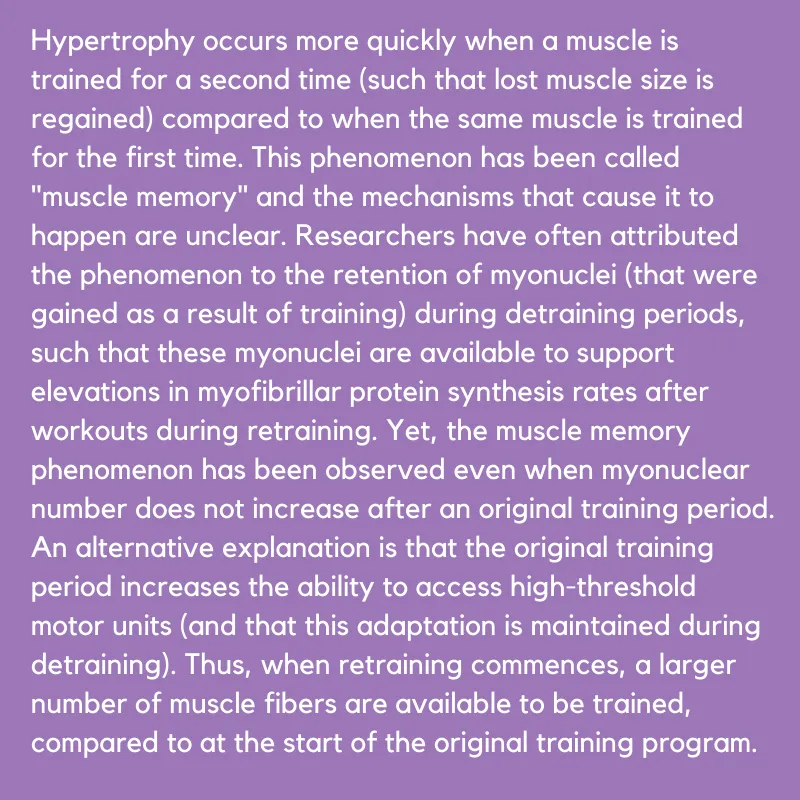
Detraining of muscle size is often regarded as a relatively easy problem to fix because lost muscle mass is known to be regained more quickly than it was gained in the first place. This retraining effect has been ascribed to "muscle memory", which probably occurs through more than one mechanism (read more).
.
Even so, allowing muscle size to dissipate could have negative implications owing to the potential for collagen deposition (read more).
.
Conclusions
Detraining describes a period of time in which adaptations are dissipating. Importantly, each adaptation dissipates when its unique stimulus is removed. This means that some adaptations can increase while others are simultaneously decreasing, depending on the training program. Also, the rate of dissipation of each adaptation is different. Generally, neural adaptations (such as improvements in coordination and increases in the ability to recruit motor units) dissipate slowly. Peripheral adaptations dissipate faster, but not necessarily at the same rate as one another. During detraining that still involves normal physical activity, stretch-mediated hypertrophy (caused by added sarcomeres) is lost fastest, followed by contraction-mediated hypertrophy (caused by added myofibrils), followed by tendon stiffness. During exercise training programs that involve the removal of a key stimulus for one or more particular adaptations, we also see detraining effects on some adaptations even while other adaptations are being generated. For example, when a strength training program is stopped and an aerobic exercise program is started, muscle size decreases (despite endurance-related adaptations likely occurring). Similarly, when an eccentric training program is stopped and a concentric training program is started, the repeated bout effect (which is a collection of adaptations providing resistance to calcium ion-related fatigue) goes away. Lastly, when a muscle is immobilized in a stretched position, it displays simultaneous decreases in muscle fiber cross-sectional area due to reduced activity levels and increases in muscle fiber length due to a stretch stimulus.


Comments (2)
Hi Chris! Great post as usual. What are the possible explanations for the increase in intramuscular collagen after periods of hypertrophy and atrophy?
It's not a particularly well-researched area as far as I can tell. I hope to make some more infographics soon, once I track down a few more relevant studies.