




Impaired muscle regrowth
Muscle is a very plastic and resilient tissue. Nevertheless, there are indications that both inactivity and severe muscle damage or injury can cause muscles to accumulate more connective tissue than they contained previously, causing a reduction in the strength-to-weight ratio.
.
#1. Muscle collagen increases after physical inactivity
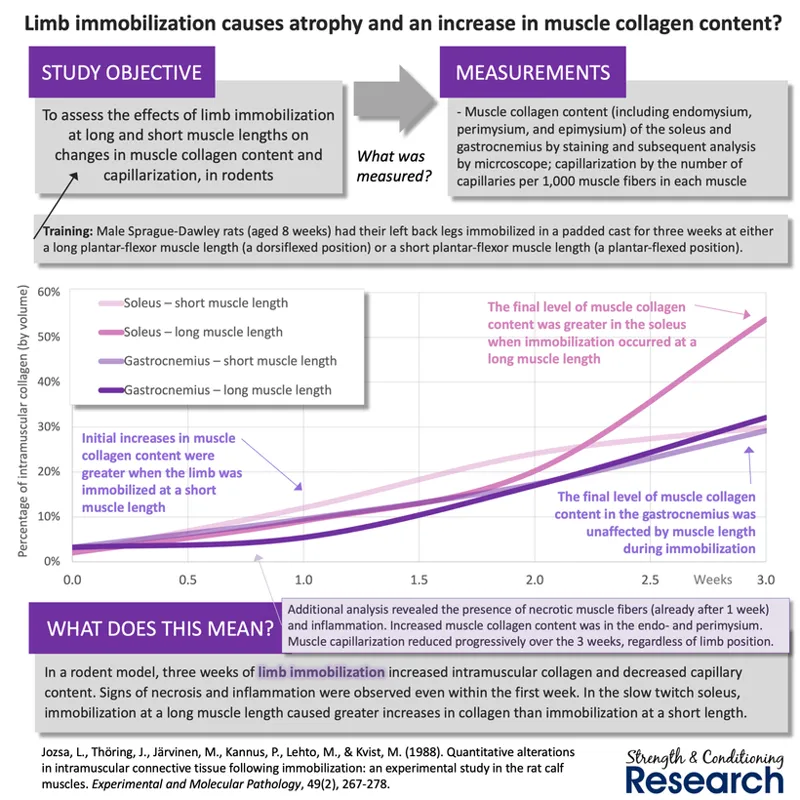
Many studies have shown that periods of inactivity lead to muscular atrophy, and that this atrophy is also accompanied by an increase in the amount of intramuscular collagen. This collagen seems to accumulate on the endomysium (the collagen that surrounds single muscle fibers) as well as the perimysium (the collagen that surrounds muscle fascicles). The accumulation of collagen occurs in tandem with signs of muscle fiber degeneration (necrosis) and inflammation.
.
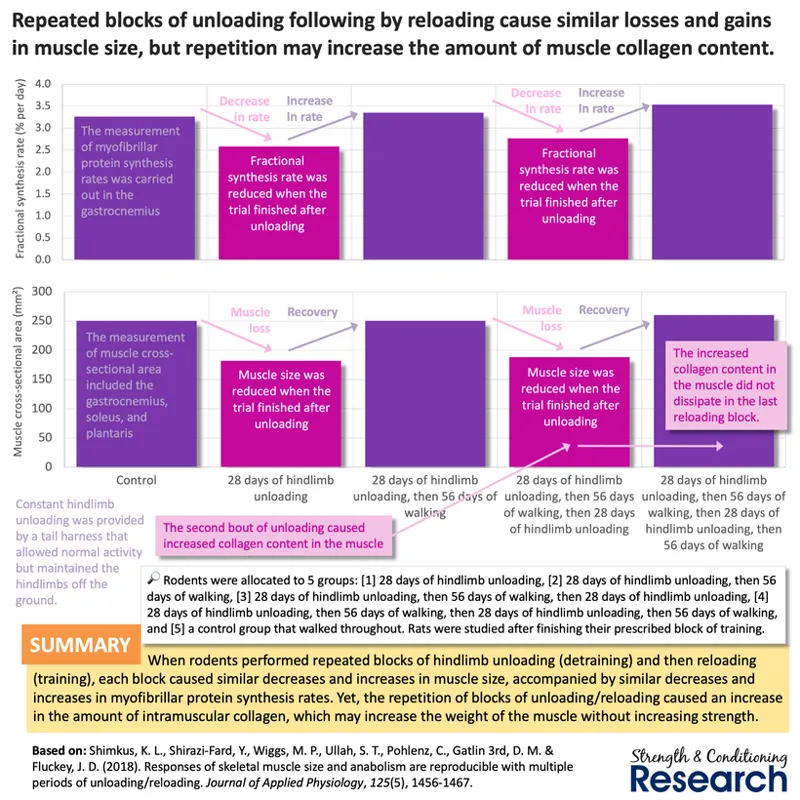
Unfortunately, this accumulation of collagen does not seem to disappear completely during subsequent blocks of training. Moreover, the maladaptation increases the mass of the muscle without simultaneously increasing its strength, which likely therefore impairs the strength-to-weight ratio and muscular function.
.
#2. Muscle collagen content increases after severe muscle damage
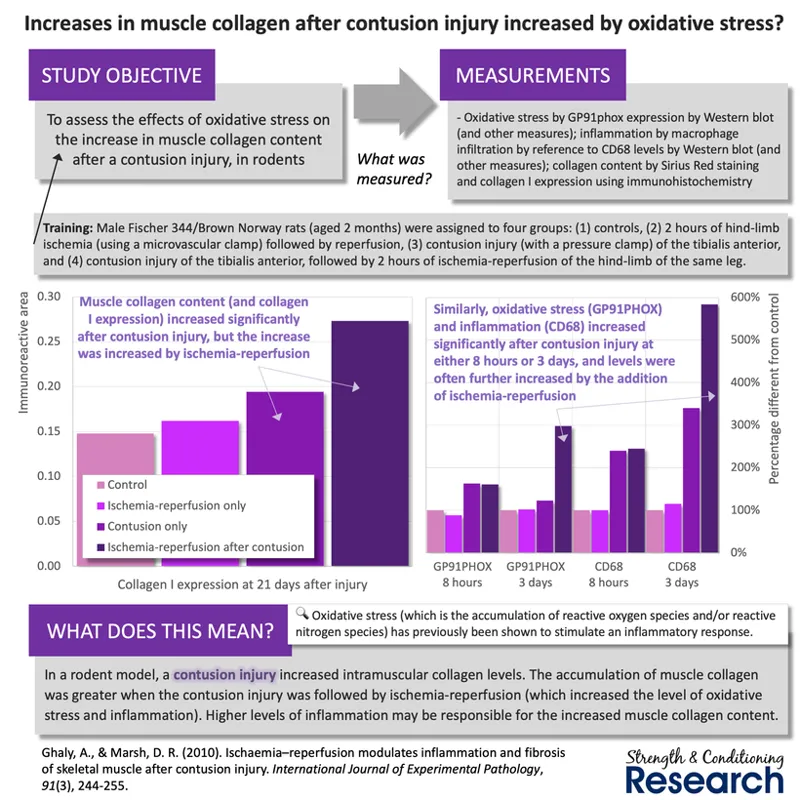
Many studies have also shown that muscle damage or injury can also lead to an increase in the amount of intramuscular collagen. The amount of intramuscular collagen that is deposited is increased when the level of oxidative stress is increased, which in turn increases the inflammatory response.
.
Again, this accumulation of collagen does not seem to disappear entirely as a result of subsequent recovery periods. Indeed, there is a sustained increase in the mass of the muscle that occurs without a simultaneous increase in strength, which impairs the strength-to-weight ratio and muscular function.
.
#3. What causes collagen deposits after muscle-damaging exercise?
After strenuous exercise, there is often an inflammatory response. This inflammatory response is a key part of the muscle damage repair process. The greater the muscle damage that is caused by the exercise bout, the greater the inflammatory response.
.
Indeed, although the inflammatory response is a key element of the muscle damage repair process, it also causes more muscle damage in the days after the workout, possibly by increasing the levels of oxidative stress inside the muscle.
.
Importantly, while this inflammatory response is essential for repairing the muscle damage caused by exercise, when the level of inflammation is excessive, it seems to increase the amount of muscle collagen that is deposited inside the muscle.
.
#4. Why might overreaching and/or overtraining increase muscle collagen content?
Overreaching and overtraining has often been observed to occur in tandem with increased levels of oxidative stress, which is a key factor that increases the inflammatory response after exercise. Therefore, it is possible that athletes are at a greater risk of experiencing an increase in muscle collagen content (and therefore a reduction in the strength-to-weight ratio) when they are engaged in very high volume or very high frequency training blocks that are intended to produce overreaching.
.
Conclusions
Muscle is an extremely plastic and resilient tissue. Muscles can readily regain losses in size following inactivity and can also repair themselves following damage and injury. Nevertheless, both prolonged physical inactivity and severe muscle damage or injury can cause an increase in intramuscular collagen content, which does not always dissipate during subsequent periods of reloading or training. This increased intramuscular collagen content reduces the ratio of maximum strength to muscle size (although it does not seem to reduce muscle size). After periods of physical inactivity and severe muscle damage or injury, the trigger for excess collagen to be deposited inside a muscle seems to be a high level of oxidative stress, and the subsequently elevated inflammatory response. Since overreaching and overtraining have been associated with increased levels of oxidative stress, it is quite possible that complete physical inactivity immediately following overreaching or overtraining blocks, as well as severe muscle damage or injury sustained during overreaching or overtraining blocks, could bring about an increase intramuscular collagen content such that the ratio of maximum strength to muscle size is reduced. This is yet another reason to avoid high-volume blocks of training that are intended to produce an overreaching state.
Comments (3)
Thank you!
Chris, I know you mentioned that you still do not have a clear opinion on muscle soreness (DOMS), but if muscle damage could be related to DOMS and muscle damage is the thing we should try to avoid after training while increasing the mechanical tension, can we also assume that if we experience DOMS especially more painful ones, then the training session for that body part was too hard/too much volume/training too close to failure? Thanks! 🙏
I suspect that there is some kind of relationship between DOMS and muscle damage (although we don't yet really know how and why) so really excessive DOMS probably is an indicator that a workout may have involved too much volume or intensity, especially if the exercises are familiar to us.