




Motor unit recruitment
Motor unit recruitment is a key principle that governs our ability to achieve muscular hypertrophy since it is what allows muscle fibers to be activated and thereby to produce (and experience) the mechanical tension that stimulates them to grow.
.
#1. What is motor unit recruitment?
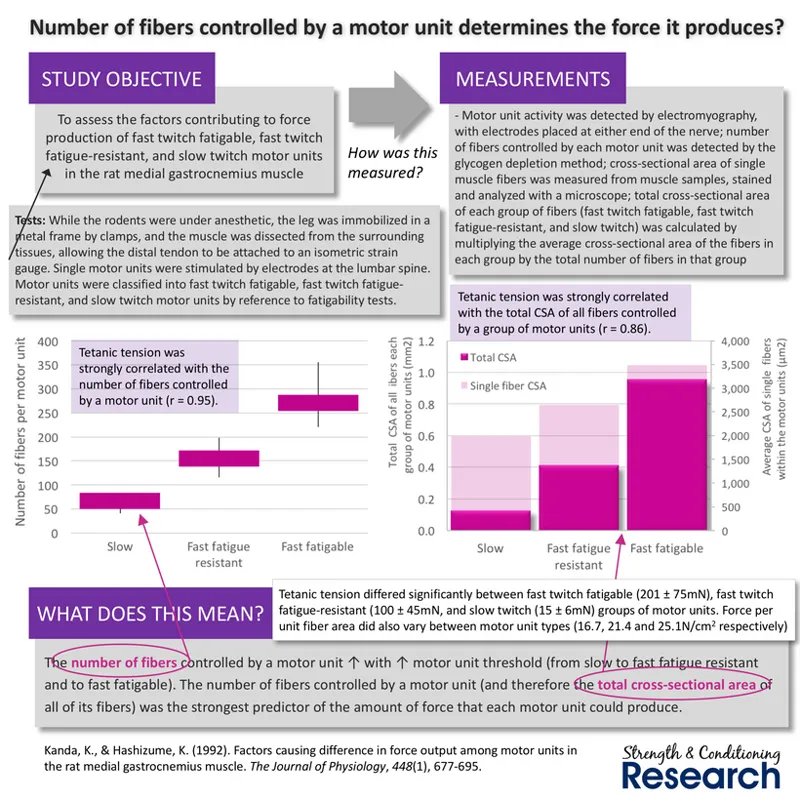
The level of motor unit recruitment during a muscular contraction is simply the number of motor units that are recruited or switched on. Motor units are comprised of motor neurons and the muscle fibers that they innervate. There are usually a couple of hundred motor units inside a muscle, and each of them contain between a dozen and a few thousand muscle fibers. Motor units are switched on in a specific order (in accordance with Henneman's Size Principle), and those that are recruited earlier are linked to small numbers of slow twitch muscle fibers, while those that are recruited later are linked to larger numbers of fast twitch muscle fibers.
.
#2. What is central motor command?
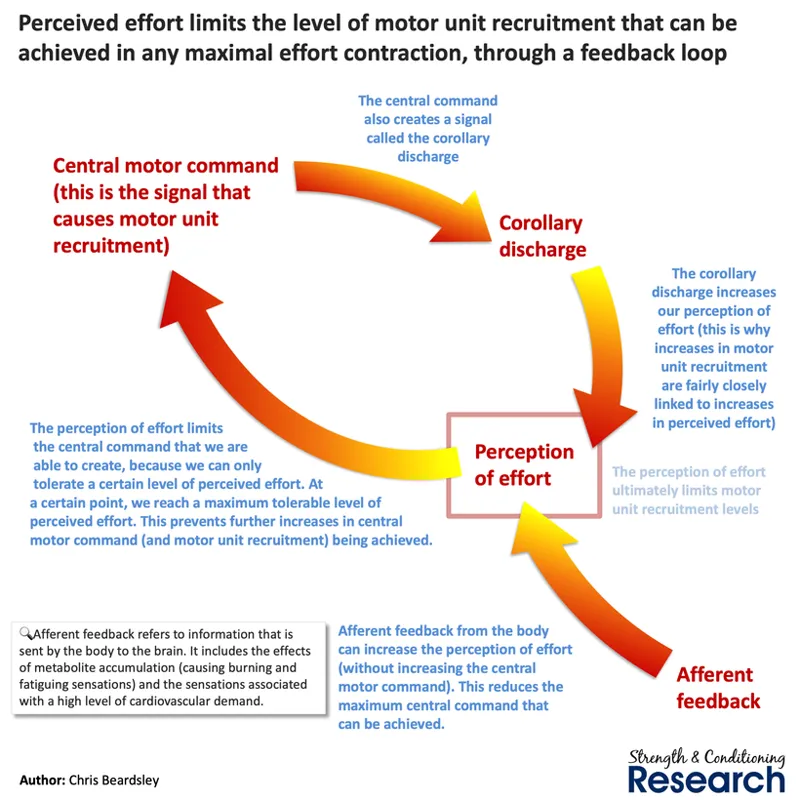
Motor units are recruited in response to a signal that is sent from the brain, which is called the central motor command. The larger the signal, the more motor units are recruited. This central motor command also sends a secondary signal (called the corollary discharge) to a part of the brain that detects effort. This means that as the central motor command increases, so does our perception of effort. In practice, this means that the level of motor unit recruitment during a contraction is often very closely related to our perceived level of effort.
.
Indeed, there is a relatively large body of data showing how motor unit recruitment is related to effort perception through the sensation of innervation.
.
In practice, the link between motor unit recruitment and effort perception can be broken if other sources of effort perception are added into the mix, such as afferent feedback from the muscles or cardiovascular sensations from the heart and lungs.
.
#3. How is motor unit recruitment related to muscle force?
The central motor command that we send to the muscle is a voluntary signal. We can choose exactly how large to make this signal (up to a point). Therefore, the level of motor unit recruitment is similarly under voluntary control. Essentially, we can choose how many motor units are recruited (and therefore how many muscle fibers are active). In an unfatigued muscle, this obviously affects force production, because the number of activated muscle fibers is closely related to the amount of isometric force that can be exerted by a muscle. Ultimately, the higher the level of motor unit recruitment, the higher the level of muscle force (all other things being equal).
.
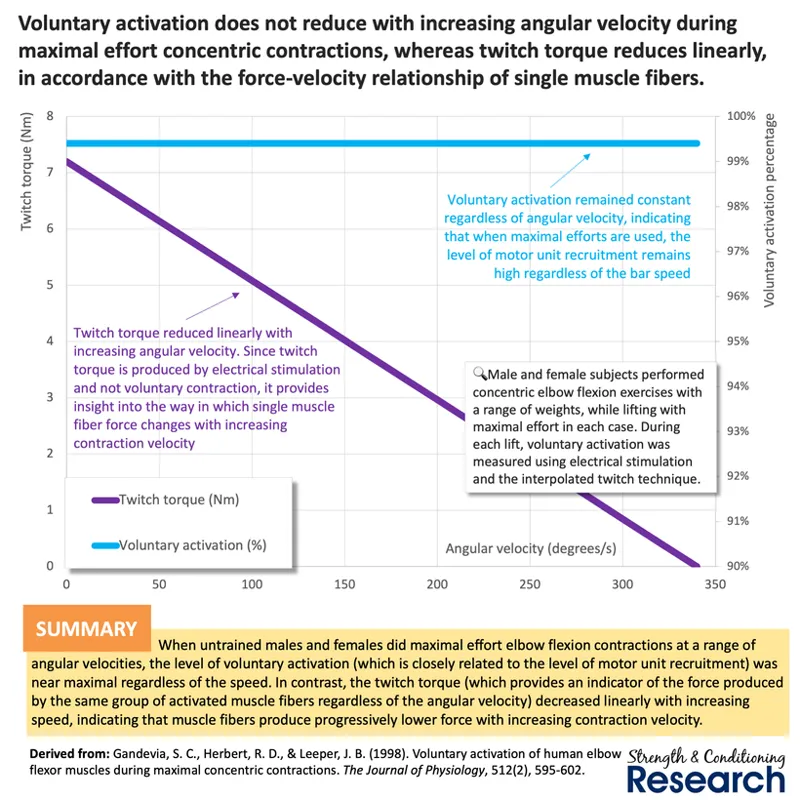
Nevertheless, muscle force can vary greatly when maximal effort (and therefore maximal motor unit recruitment) is used to perform lifts with different weights, and therefore at different velocities. When light weights are lifted with maximal effort (and therefore maximal motor unit recruitment), the force output is relatively low. When heavy weights are lifted with maximal effort (and therefore maximal motor unit recruitment), the force output is relatively high. This is because of the force-velocity relationship of single muscle fibers. When single muscle fibers are allowed to shorten quickly, they produce small forces. When single muscle fibers are compelled to shorten slowly, they produce large forces. This is because the number of actin-myosin crossbridges that can form at slow speeds is greater than the number of actin-myosin crossbridges that can form at fast speeds, and the number of actin-myosin crossbridges is what determines force output.
.
#4. How is motor unit recruitment related to muscle fiber mechanical tension?
Although motor unit recruitment is related to whole muscle force, it is not related to single muscle fiber mechanical tension. An increase in motor unit recruitment simply switches on more muscle fibers, it does not increase the mechanical tension that is experienced by a single muscle fiber (which is largely dependent upon the force-velocity relationship).
.
#5. Does fatigue increase motor unit recruitment?
Several studies have shown that the whole muscle force threshold at which motor units are recruited reduces when fatigue mechanisms are present. This does not mean that the presence of fatigue itself increases motor unit recruitment. Rather, we voluntarily increase our effort levels in order to increase the level of motor unit recruitment so that we can achieve the desired level of whole muscle force.
.
#6. Can we recruit all of our motor units?
Untrained individuals typically have a fairly limited ability to recruit motor units. Thus, many of their high-threshold motor units are not recruited even when they exert a maximal effort. Even so, this does vary between muscles. Larger muscles tend to display lower levels of motor unit recruitment than the smaller muscles (measured by the gold standard interpolated twitch method for voluntary activation).
.
More well-trained individuals tend to display higher levels of motor unit recruitment, although it is still unlikely that they are able to recruit every single muscle fiber in the larger muscles.
.
#7. Can we increase the number of motor units that we can recruit?
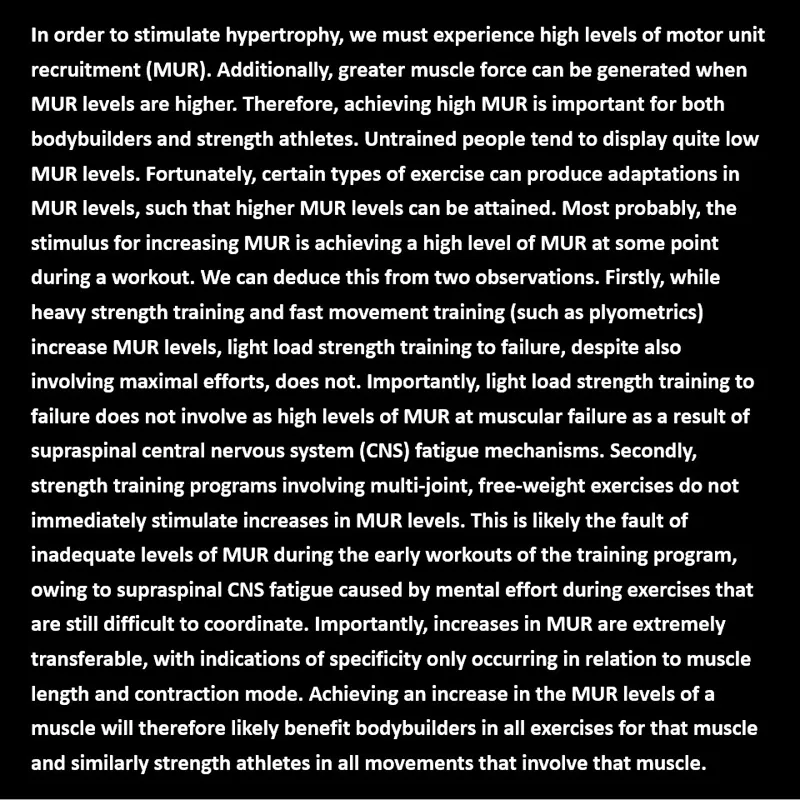
Yes, we can increase the number of motor units that we are able to recruit (read more).
.
Conclusions
Motor units are comprised of single motor neurons and the muscle fibers that are attached to them. Motor units are switched on in a specific order (following Henneman's Size Principle). Those recruited earlier are linked to small numbers of slow twitch muscle fibers. Those recruited later are linked to larger numbers of fast twitch muscle fibers. Motor units are recruited in response to a signal sent by the brain, called the central motor command. The larger the signal, the more motor units are recruited. The central motor command also sends a secondary signal (the corollary discharge) to a part of the brain that detects effort. Thus, as central motor command increases, so does perception of effort. In practice, this means that the level of motor unit recruitment in a muscular contraction is often closely related to our perceived level of effort. In addition, since the level of motor unit recruitment determines the number of activated muscle fibers, motor unit recruitment levels are also closely related to whole muscle force, at least when we are in an unfatigued state. When we experience fatigue, the level of whole muscle force that corresponds to a given level of motor unit recruitment decreases because the working muscle fibers are not able to exert as much force. To maintain whole muscle force levels as we fatigue, we must voluntarily increase motor unit recruitment. Importantly, untrained people are not able to access all of their motor units voluntarily. Strength training can produce increases in this ability, which increases [1] strength, and [2] the ability to produce muscle growth by permitting access to muscle fibers at the top of the high-threshold motor unit pool.
Comments (6)
Hi, Chris. Quick question please. How sensitive is motor unit recruitment to time off from training?
Like other neural adaptations, increases in motor unit recruitment are very persistent. There are minimal losses after 1–2 months and only very small losses after 6+ months. The infographics in this post provide some visualizations of the changes: https://www.patreon.com/posts/detraining-of-54927458
Hi Chris. Is high velocity training as effective at increasing MU recruitment as heavy strength training? I know it improves it. I’m wondering if the research says the magnitude is similar. Many thanks.
To my knowledge, there is no long-term training study that has compared the effects of fast movement training and heavy strength training on voluntary activation (gold standard). Given that the stimulus is likely the achievement of a high level of central motor command, I would expect the effects of the two types of training to be similar, since both minimize CNS fatigue.
Hey Chris, I have a question about voluntary activation and the ability to recruit HTMU. In general, if we move a load heavier than 85% of MVC, all of our motor units are activated. As you say all of the motor units that we are voluntary capable of activating. So my question is, if there are HTMU which especially untrained people are not able to recruit, why do these fibres not experience atrophy. In general, if a human fibre does not experience tension they experience atrophy, so why would that not be the case for these fibres. I mean a higher EMG- amplitude could be explainable due to a higher frequency of action potentials, right? And just higher torque measurements have other co- factors, like coactivation. And if we look at a normal recruitment- pattern (at lets say medium intensity) HTMU are recruited the last and with the lowest frequency, therefore they would be able to create much more tension. I mean I guess in a complex movement I would understand if someone is not capable to recruit all relevant fibres, but not being able to recruit them in any situation seems weird. I am a little confused about that…
The muscle fibers of inaccessible motor units that are not recruited are certainly not well-developed and are essentially atrophied compared to the muscle fibers of accessible, regularly-recruited motor units. It's exactly right that muscle fibers need to experience regular mechanical tension in order to remain a certain size.