



Muscle damage threshold effect
Muscle damage is a key mechanism of post-workout fatigue. The amount of muscle damage that occurs after a strength training workout is increased by using higher training volumes and also by training closer to failure. Yet, these training variables are not linearly related to the amount of muscle damage that occurs, for interesting physiological reasons.
.
#1. What are post-workout fatigue and muscle damage?
Fatigue is a temporary and reversible reduction in exercise performance that occurs as a result of a previous bout of exercise. Post-workout fatigue is just fatigue that can be measured in the recovery period. Muscle damage or myofibrillar damage is one fatigue mechanisms that occurs during this recovery period (read more).
.
#2. How does muscle damage respond to increasing volume?
Increasing training volume increases post-workout fatigue. This occurs as a result of greater muscle damage being experienced. It is often assumed that the amount of muscle damage that occurs is linearly related to the amount of training volume performed. Yet, this does not seem to be the case. Instead, muscle fiber damage seems to be much lower than expected at low volumes and much higher than expected at high volumes. This suggests that there is a threshold effect, whereby muscle fibers are very resilient up to a certain volume. After that level of volume, they become much more susceptible to the biochemical processes that cause damage.
.
In this respect, it is very interesting that this threshold effect occurs after the muscle fibers have already been fatigued by the workout. This is a very important observation, because it means that the increase in the amount of muscle damage due to higher volumes happens while the muscle fibers are producing a relatively low level of muscle fiber force during the workout. In the traditional model of muscle damage, which assumes that damage is caused by mechanical tension, this makes literally no sense, because the dramatic increases in muscle damage with increasing volume occur while fibers are producing the lowest forces. In contrast, it makes good sense if we use the biochemical model of muscle damage, which assumes that damage is caused by the progressive accumulation of calcium ions, and that there is a tipping point at which the level of calcium ions is too much for the mitochondria of the muscle cells to handle.
.
#3. How does muscle damage respond to proximity to failure?
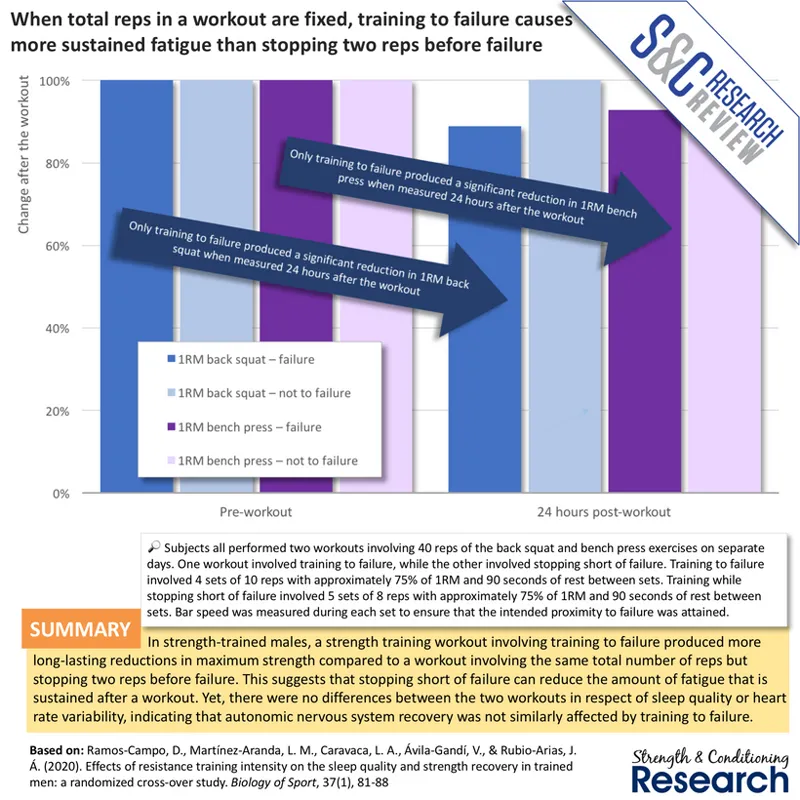
Increasing proximity to failure also increases the amount of sustained fatigue that occurs after a workout. Interestingly, recent research showed that stopping just two reps before failure completely removes the sustained fatigue that occurs after a workout. This suggests that there is similarly a threshold effect, such a dramatic increases in muscle damage occur once a certain proximity to failure is reached, but little muscle damage is produced prior to that point.
.
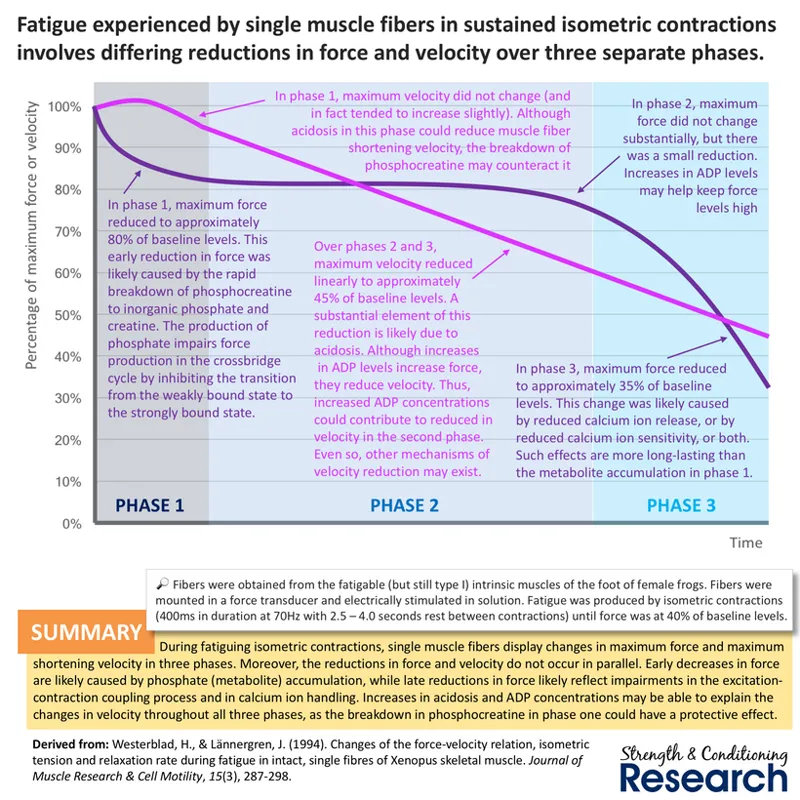
The reason for this sudden increase in sustained fatigue has previously been identified by careful studies using single muscle fibers. When muscle fibers experience fatiguing isometric contractions (which are very similar to the dynamic contractions used in normal strength training), they pass through three phases, which involve different mechanisms of fatigue. The initial two phases involve metabolite-related processes, which do not cause sustained fatigue. However, the third phase involves excitation-contraction coupling failure, which is caused by the same calcium ion-related processes as muscle damage. So, we can see that only the last part of the isometric contraction causes muscle damage. Similarly, it is likely that only the last two reps of a set performed to failure cause muscle damage.
.
Indeed, it is interesting that the involuntary bar speeds of the final two reps of a set are much slower than the preceding reps. This likely occurs due to the sudden switch from only metabolite-related fatigue being present to both metabolite-related fatigue and excitation-contraction coupling fatigue being present, such that the overall fatigue increases suddenly and dramatically.
.
Conclusions
Muscle damage is the most important post-workout fatigue mechanism. The amount of muscle damage (and therefore also the amount of post-workout fatigue) is increased by [A] the training volume performed in the workout, and [B] the proximity to failure implemented on the sets performed. However, increasing training volume and training closer to failure does not increase muscle damage linearly. Rather, there seems to be a threshold effect. Low training volumes and stopping a few reps before failure cause virtually no muscle damage whatsoever. In contrast, once a certain threshold of volume or a certain proximity to failure is reached, increasing training volume or training closer to failure start to cause progressively more and more muscle damage. This threshold likely reflects the sudden appearance of excess calcium ions inside the muscle fiber, since this is what causes muscle damage. Indeed, excitation-contraction coupling failure (which is also caused by the presence of excess calcium ions inside the muscle fiber) has been documented to occur quite late in fatiguing contractions, after metabolite-related fatigue has already been present for some time.

Comments (2)
Great article, thanks. I am wondering do you think it’s possible to build up resistance to excitation contraction coupling failure? For instance a distance runner as opposed to a cyclist does a large volume of eccentrics. Would resistance to excitation contraction coupling explain some of the specificity of performance?
Yes, we can actually view excitation-contraction coupling failure as a subset of muscle damage. It's basically caused by the same process, starting with calcium ions and involving calpains. So anything that increases resistance to calcium ions will reduce both fatigue mechanisms. I have an article and a couple of infographics planned for the repeated bout effect that will explain how that works in some more detail.