




PAP and PAPE effects
Athletes often perform potentiation exercises as part of their warm-ups. Potentiation can be defined as a temporary increase in exercise performance as a result of a previous bout of exercise (which is usually called a "conditioning contraction"). It is the opposite of fatigue. There are two potentiation effects that have different time courses and different underlying mechanisms: [1] the post-activation potentiation (PAP) effect, and [2] the post-activation performance enhancement (PAPE) effect.
.
#1. What is the post-activation potentiation (PAP) effect?
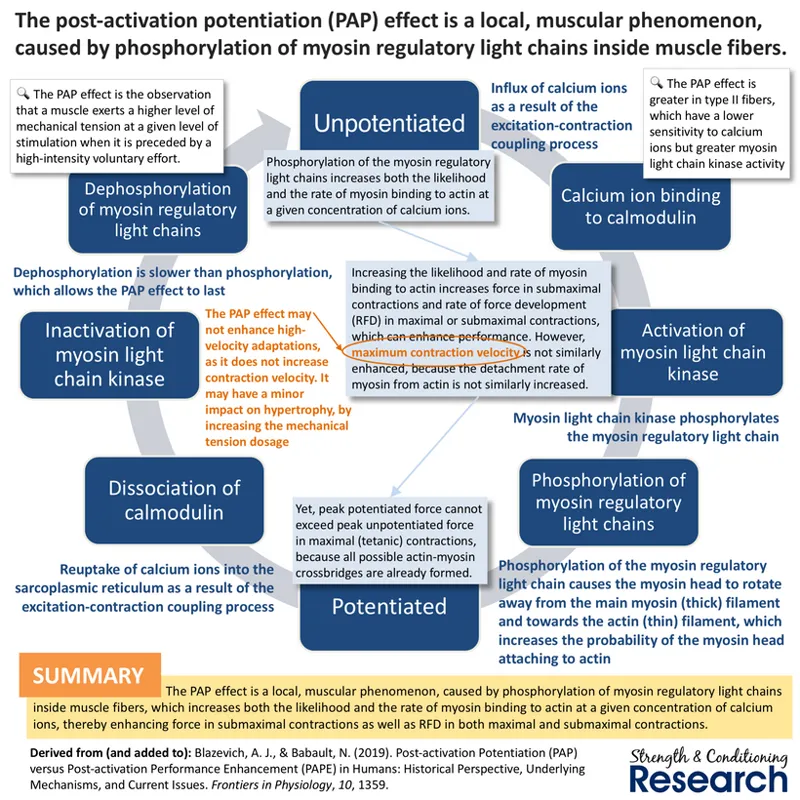
For decades, researchers have studied what is known as the post-activation potentiation (PAP) effect. This effect involves a short-lived increase in muscle fiber force as a result of prior bout of exercise. It can be observed in isolated muscles and muscle fibers (which guarantees that it does not involve the central nervous system) and appears to be the result of a shift in the position of the myosin heads inside the muscle fibers.
.
Interestingly, the magnitude of the PAP effect seems to be greater (albeit more short-lived) inside fast twitch muscle fibers than inside slow twitch muscle fibers.
.
#2. What is the post-activation performance enhancement effect?
Although researchers who have studied the existence of potentiation in athletes after strength training have often referred to such potentiation as being caused by the PAP effect, this terminology has recently been changed, as it has become clear that potentiation effects that last for longer than 5 minutes almost certainly cannot be caused by the PAP effect mechanism. Thus, researchers have now suggested that when potentiation effects occur that are not clearly attributable to the phosphorylation of myosin regulatory light chains and the subsequent shift of myosin heads inside the muscle fibers, the term "post-activation performance enhancement (PAPE)" effect should be used instead. The exact mechanisms underpinning the PAPE effect are not known.
.
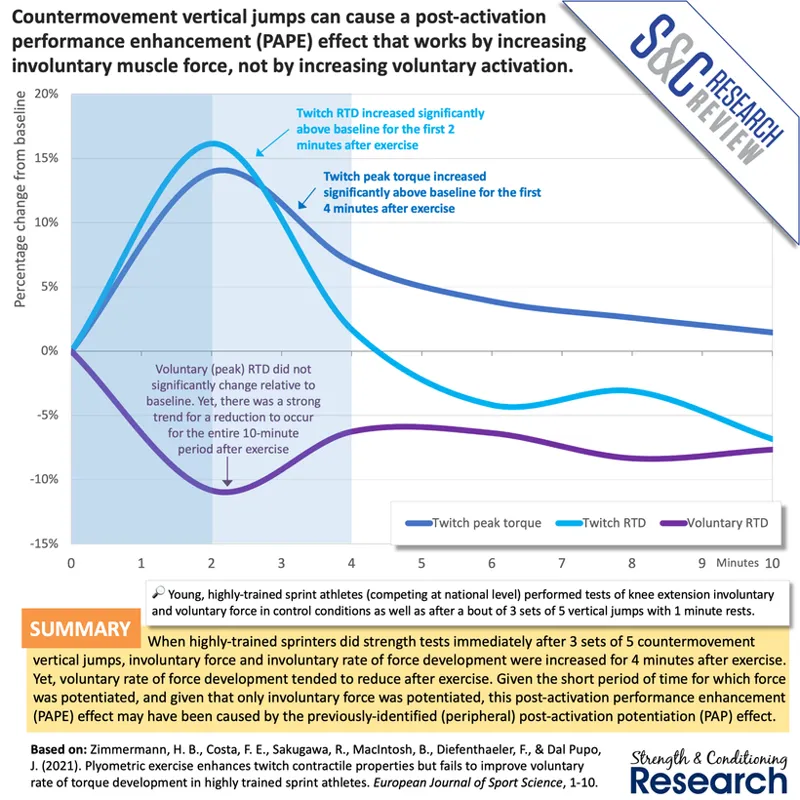
Importantly, even though potentiation is often claimed to be produced by stimulating the central nervous system, this idea has little support in the research literature. Indeed, voluntary activation is often reduced after brief bouts of exercise and not increased, which implies that the potentiation effect occurs despite a small amount of central nervous system fatigue being present, and not due to any increase in the ability to recruit motor units.
.
#3. Could the PAP effect contribute to potentiation in humans?
Importantly, even though the sustained potentiation effect that is now referred to as a PAPE effect cannot be entirely explained by the PAP effect, this does not rule out the possibility that the PAP effect could contribute to a potentiation phenomenon in humans. Indeed, a very short-duration potentiation effect has been observed that increases involuntary force after high-velocity exercise.
.
Other research has shown that this temporary increase in muscle force after high-velocity strength training probably dissipates within the 5 minute limit. Therefore, it fits all of the criteria for being classified as a PAP effect and not a PAPE effect.
.
Importantly, although much of the strength and conditioning community tends to think of PAP (or PAPE) effects as being produced by heavy strength training exercises, they can easily be generated by high-velocity movements like jumps and throws. For example, medicine ball throws are very effective at increasing bench press 1RM performance when performed just 30 seconds beforehand, which would be most likely due to a PAP effect. Similar results have been recorded for back squat 1RM after jumping.
.
Conclusions
Athletes often perform potentiation exercises as part of their warm-ups. Potentiation can be defined as a temporary increase in exercise performance as a result of a previous bout of exercise (which is usually called a "conditioning contraction"). There are two potentiation effects that have different time courses and different underlying mechanisms: [1] the post-activation potentiation (PAP) effect, and [2] the post-activation performance enhancement (PAPE) effect. The PAP effect is well-described and occurs for up to five minutes after a conditioning contraction. It is caused by the phosphorylation of myosin regulatory light chains inside the activated and working muscle fibers, such that myosin is brought closer to actin, allowing a faster rate of crossbridge formation and higher active mechanical tension across the whole force-velocity profile. It very likely creates the potentiation effect that is observed immediately after high-effort, high-velocity exercises in humans. The PAPE effect peaks 6-10 minutes after a conditioning contraction and lasts for 15 minutes. While neural mechanisms are often proposed as an explanation for the PAPE effect, studies have shown that voluntary activation is quite often suppressed despite the presence of a PAPE effect following appropriate conditioning contractions.
Comments (4)
Is it relevant to try to apply this to rest periods? For example cluster cluster sets with 25+ sec intra-set rest to allow for potentiation of various type II fibers? Inter-set rest between heavy sets less than 5 minutes (4 minutes?) so the potentiation effect doesn't dissipate? Or is it not applicable in that way?
It's applicable, but most types of strength training will produce the same effect. The difference between the strength training types is the amount of fatigue that is experienced, rather than the amount of potentiation. That's where cluster sets become interesting. I have an article and a couple of infographics planned to cover this topic.
Hello! I was trying to find some information on how to use this in practice. What are your thoughts on this theory for strength athletes who are performing one rep max, for example, in squats or deadlifts? Can we use drop jumps to increase strength in squats? Thank you! 🙏
We can certainly use jumps to increase maximum strength temporarily for squats. I tend to program several vertical jumps in a warm-up for athletes who will be performing a heavy back squat workout, starting with submaximal jumps and working up to a couple of maximal effort jumps. That typically creates a post-activation potentiation effect.