






Repeated bout effect
The repeated bout effect is the observation that a single strength training workout reduces the amount of sustained fatigue (and muscle soreness) that is produced by a subsequent, similar strength training workout for the same muscle group.
.
#1. What is the repeated bout effect?
The repeated bout effect is the observation that a single strength training workout reduces the amount of post-workout fatigue that is produced by a subsequent, similar strength training workout for the same muscle group.
.
#2. What is NOT the repeated bout effect?
The repeated bout effect refers to the effect produced by a single workout. Therefore, anyone who has completed a single workout has experienced the repeated bout effect. It is total nonsense to state that more well-trained lifters have a greater repeated bout effect than less well-trained lifters. If they both have done a single workout, they both have the same repeated bout effect. And we know that doing a single workout is certainly not enough to stop post-workout fatigue from happening.
.
#3. Which post-workout fatigue mechanisms underpin the repeated bout effect?
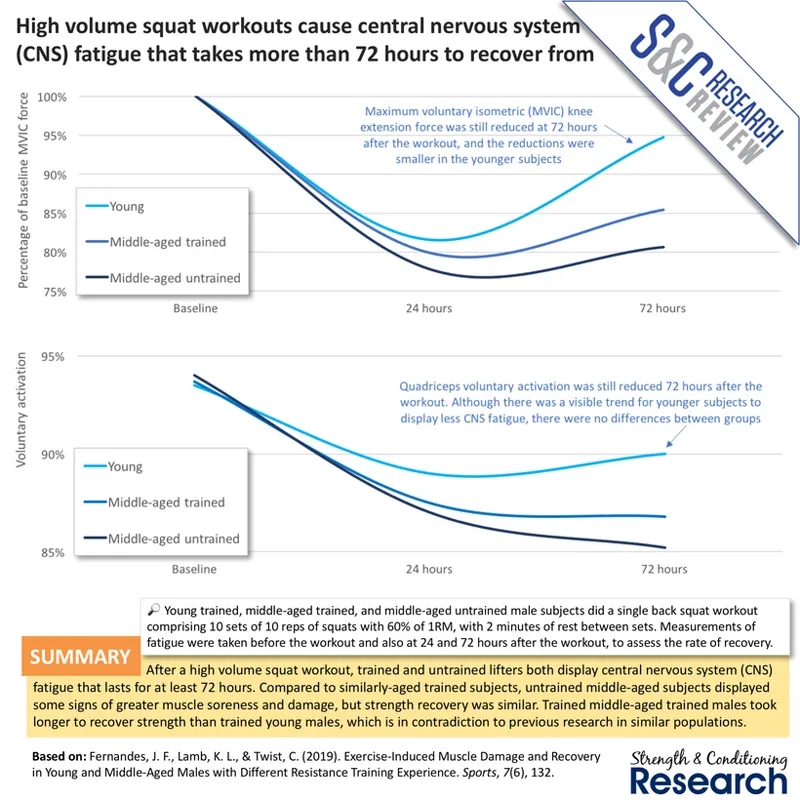
Post-workout fatigue comprises: [1] muscle damage, [2] excitation-contraction coupling failure, and [3] central nervous system (CNS) fatigue. Interestingly, CNS fatigue after a strength training workout does not seem to be much lower in trained individuals compared to in untrained individuals.
.
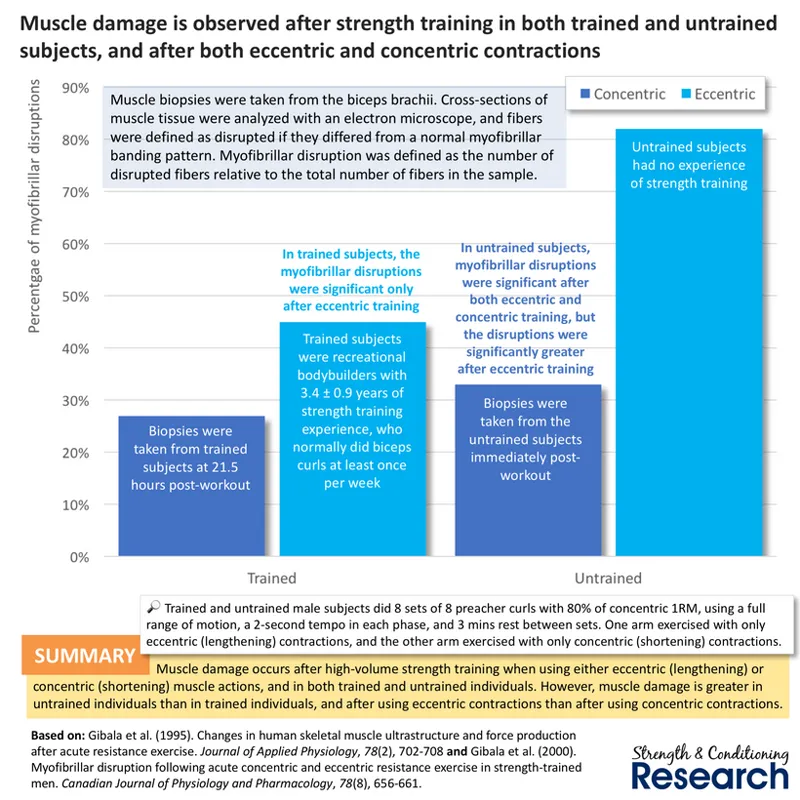
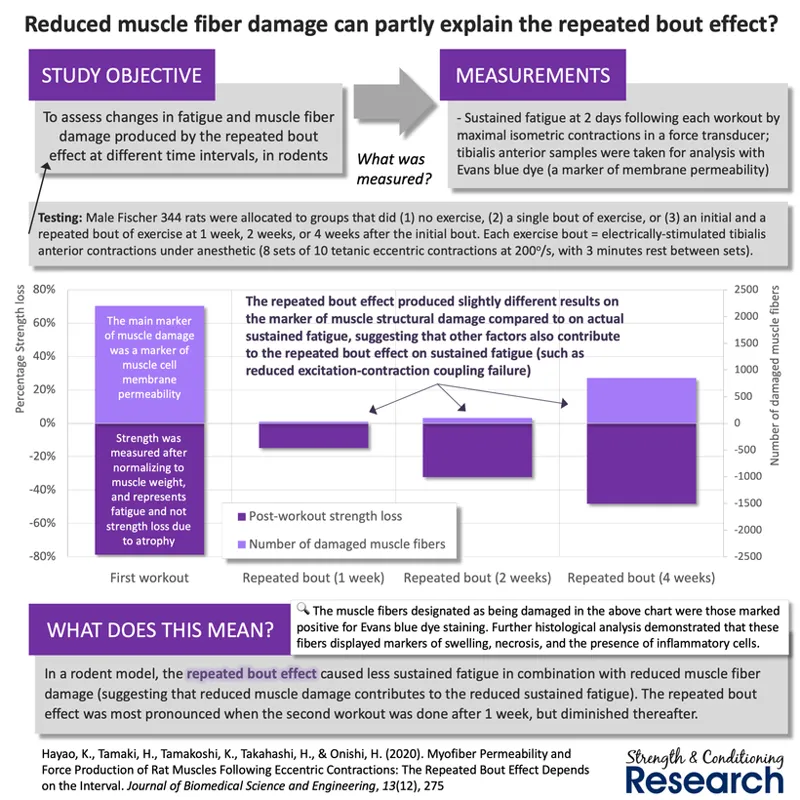
Post-workout CNS fatigue is caused by the inflammatory response to muscle damage. Therefore, this implies either that [A] the amount of muscle damage experienced by untrained and trained individuals is similar, or that [B] the inflammatory response per unit of muscle damage that is experienced after a strength training workout is greater in trained individuals than in untrained individuals. Fortunately, this question is relatively easy to answer, since researchers have shown that structural damage is greater in untrained individuals than in trained individuals after a strength training workout.
.
In line with this, rodent studies have shown that reductions in the amount of muscle damage after a workout are reduced in tandem with the repeated bout effect.
.
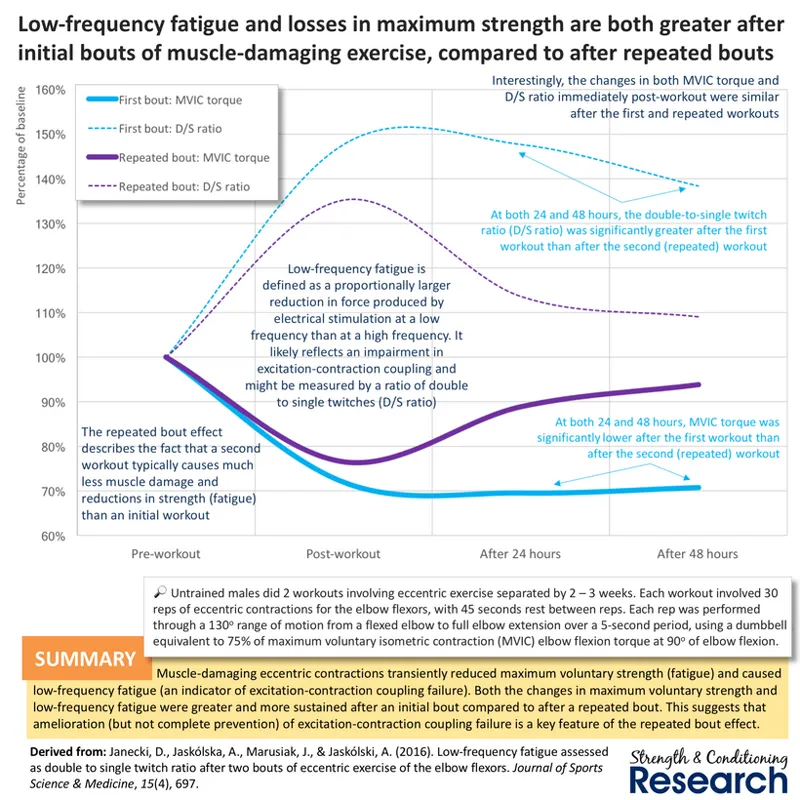
Furthermore, the inflammatory response after a strength training workout is greater after a repeated bout of exercise compared to after an initial bout. This explains why CNS fatigue is similar in trained and untrained lifters despite untrained lifters experiencing more muscle damage.
.
Finally, we also have studies confirming that excitation-contraction coupling failure is reduced as a result of the repeated bout effect. This means that the repeated bout effect involves a reduction in both local muscular fatigue mechanisms but no change in CNS fatigue.
.
Additionally, it is noteworthy that high-intensity exercise can damage the sarcoplasmic reticulum, which is likely what causes the excitation-contraction coupling failure to produce a fatiguing effect.
.
Moreover, this sarcoplasmic reticulum damage does not happen after repeated workouts and has been linked to improvements in fatigue resistance.
.
#4. How do changes in calcium ion-related fatigue occur?
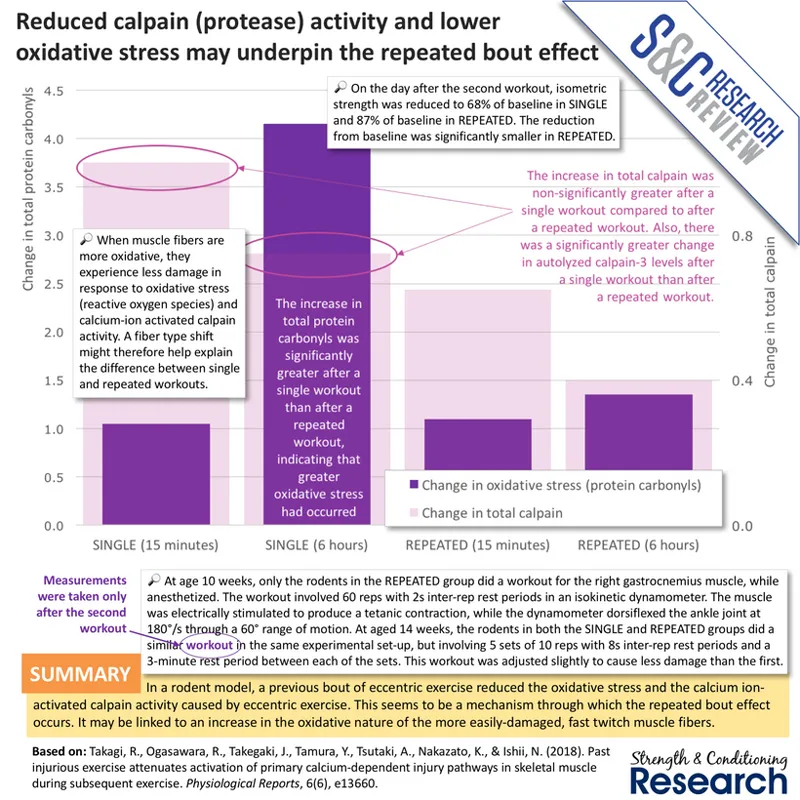
In the previous section, we saw how the repeated bout effect involves a reduction in both of the local muscular fatigue mechanisms (being excitation-contraction coupling failure and muscle damage) but no change in CNS fatigue. The two muscular fatigue mechanisms are both caused by the accumulation of calcium ions inside the muscle fiber. Therefore, anything that reduces the accumulation of calcium ions will produce a repeated bout effect.
.
#5. What mechanisms reduce calcium ion accumulation?
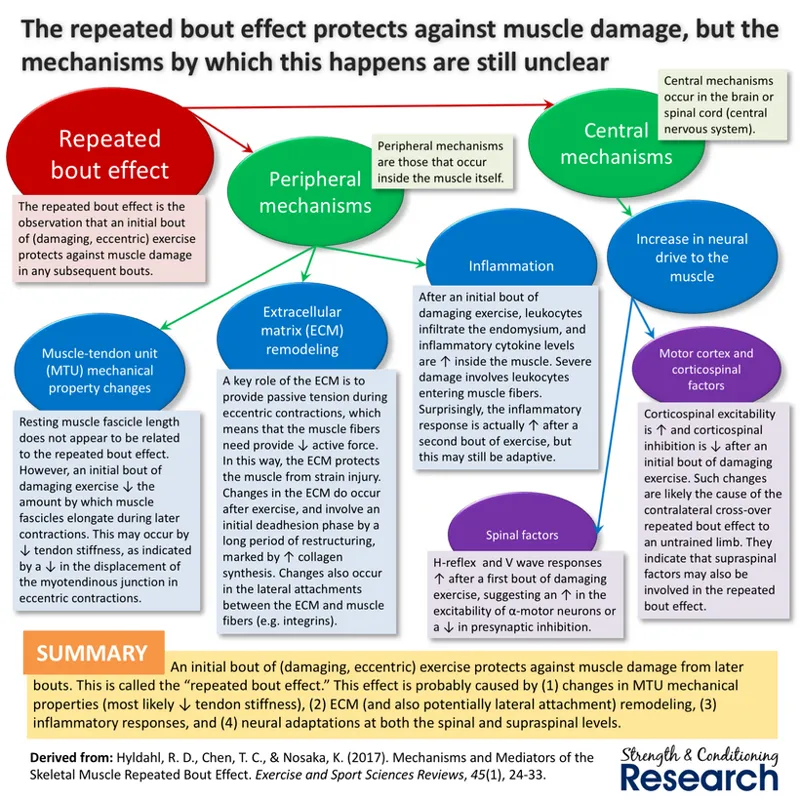
Some research has shown that the repeated bout effect involves a reduction in the amount of muscle fiber stretch. This would reduce the amount of calcium ions released into the cytoplasm in eccentric contractions through stretch-activated ion channels.
.
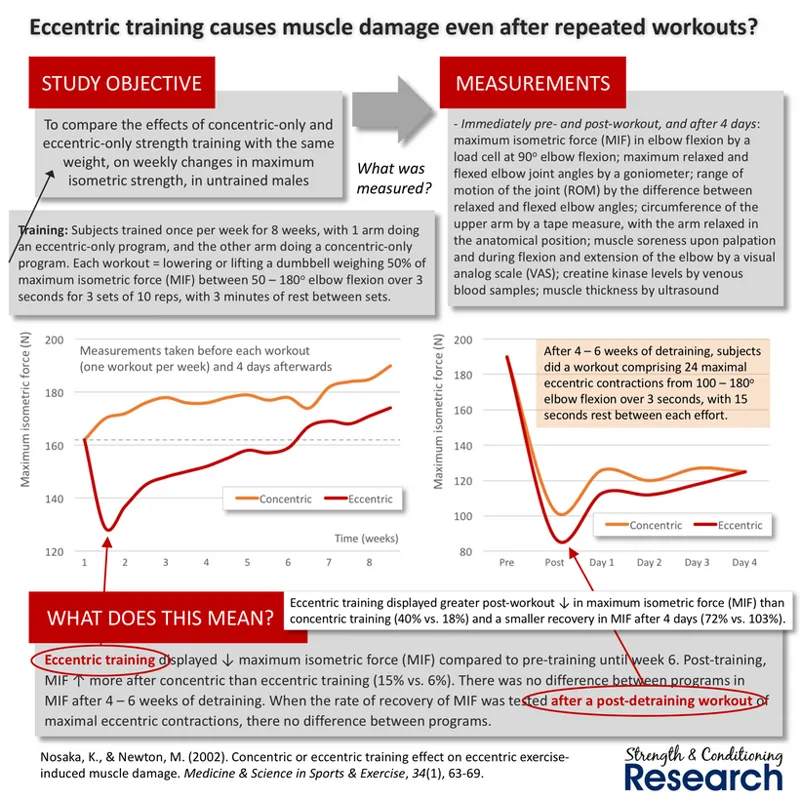
Sarcomerogenesis might cause the same effect by causing less lengthening of individual sarcomeres. In this respect, it is interesting that while eccentric training causes a repeated bout effect for eccentric workouts, a sustained block of concentric training removes this effect.
.
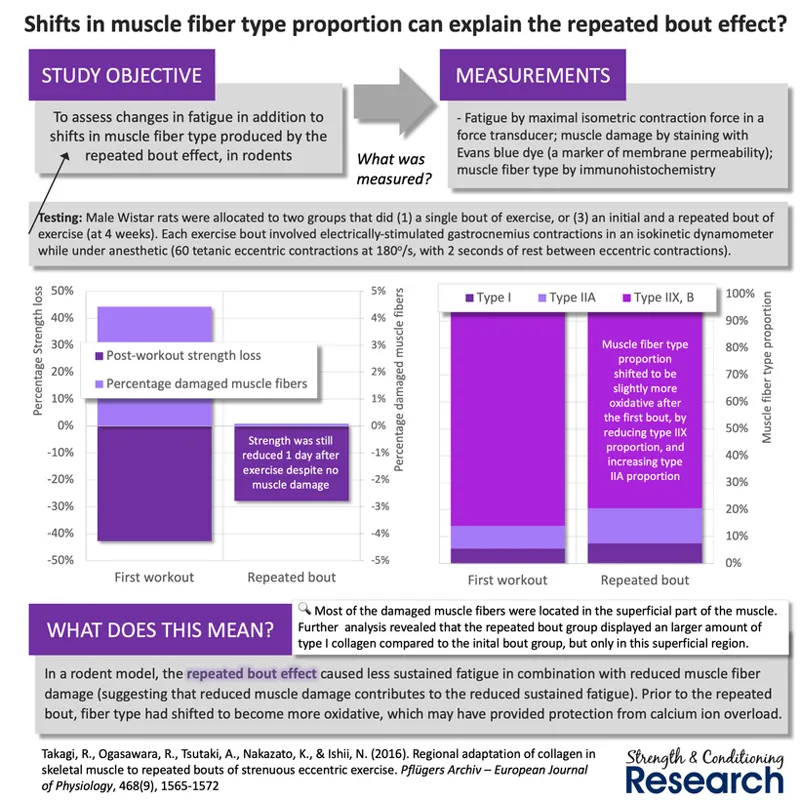
Similarly, the repeated bout effect could involve an increase in the amount of calcium ions that are removed from the cytoplasm by the mitochondria, because this could easily occur through small shifts in muscle fiber type from the highly glycolytic type IIX muscle fibers to the less glycolytic and more oxidative type IIA muscle fibers. Indeed, research has shown that type IIX muscle fibers are directed to start changing type immediately after even a single strength training workout.
.
Indeed, researchers have identified that muscle fibers do display a shift in muscle fiber type (such that the oxidative capacity of the muscle fiber is increased) in tandem with the repeated bout effect.
.
Conclusions
The repeated bout effect (RBE) is the observation that a single strength training workout reduces the amount of post-workout fatigue (and muscle soreness) caused by a subsequent workout for the same muscle. Post-workout fatigue comprises: [1] muscle damage, [2] excitation-contraction coupling failure (ECCF), and [3] central nervous system (CNS) fatigue. While muscle damage and ECCF after a workout are greater in untrained than in trained lifters, CNS fatigue is not (because the inflammatory response that produces CNS fatigue is greater for a given level of muscle damage in trained lifters). This suggests that the RBE is caused by reductions in ECCF and muscle damage, which are caused by the accumulation of calcium ions during exercise leading to protease production that damages the triadic junction and the rest of the muscle fiber, respectively. Therefore, the RBE could arise by means of [1] a reduction of calcium ions entering the muscle fiber during exercise (likely by a reduction in the extent to which muscle fibers lengthen [either by temporary changes in tendon stiffness or the addition of sarcomeres in series], because this would reduce the influx of calcium ions through stretch-activated ion channels), or by means of [2] an increase in the amount of calcium ions taken out of the cytoplasm during exercise (this could easily occur through an increase in the mitochondrial content of the muscle fiber, though a rapid fiber type shift).
Comments (6)
Chris, as always, thank you for your answers! They are really insightful. When we talk about strength improvements (either via increases in reps or weight) we talk about improvements in different exercises? For example, if I am doing squats only once per week, I should gauge my progress on that exercise?
Yes, absolutely. Strength is very exercise-specific, because coordination improvements are a key mechanism by which strength (in an exercise) increases.
Great article! Chris, I wanted to ask you about so called "bro-splits" where people train a muscle group only once per week. I know that training frequency is different between different muscle groups, but would you recommend training a muscle at least twice per week? When should people start splitting volume into more than one session? Thank you! 🙏
So there are two key questions here that can be answered by reference to the literature: (1) at what point is workout volume (per muscle) likely to cease being productive? and (2) how often can a muscle be trained?
Interesting article. So if I am understanding no. 3 correctly, the increased muscle fiber length that comes with eccentric training reduces fatigue during the workout by reducing muscle lengthening during the workout?
Yes, although some researchers have suggested that the reduced muscle lengthening could also occur through other mechanisms, such as increased tendon lengthening relative to muscle lengthening, as well.