




Crossover effects
Crossover effects occur when either immediate or long-term changes occur in one muscle after a bout of exercise (usually strength training) involving a completely different muscle. There are several known crossover effects, including [1] the transfer of strength gains from one limb to another, [2] the transfer of fatigue from one muscle to another during a workout, and [3] the transfer of the repeated bout effect from one muscle to another. In each case, the amount of strength gains, fatigue, or protection that is transferred to the untrained limb is smaller than the amount that is achieved by the trained limb.
.
#1. Cross-education happens after single-limb strength training
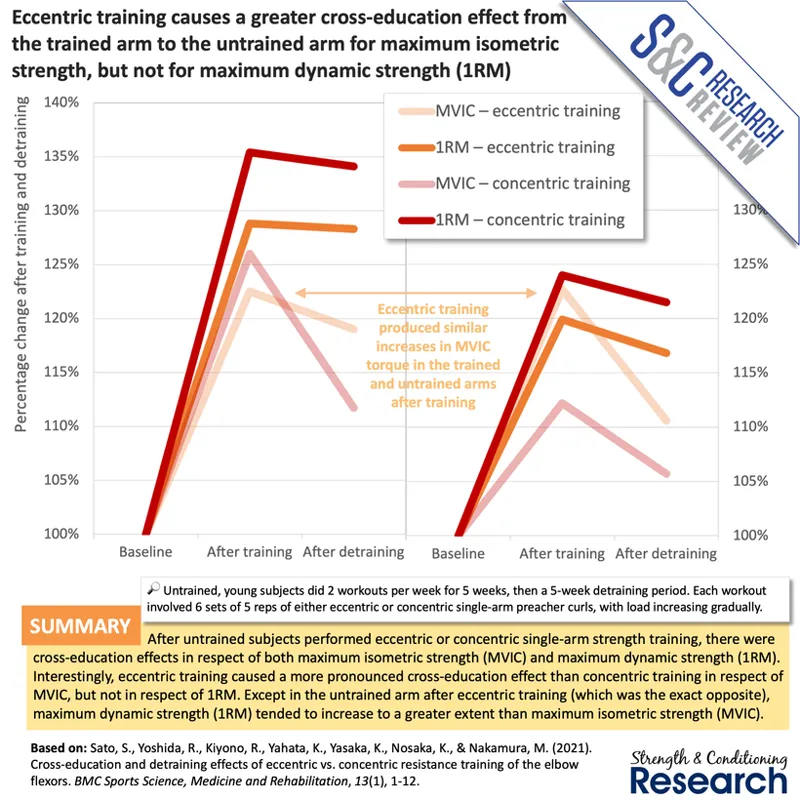
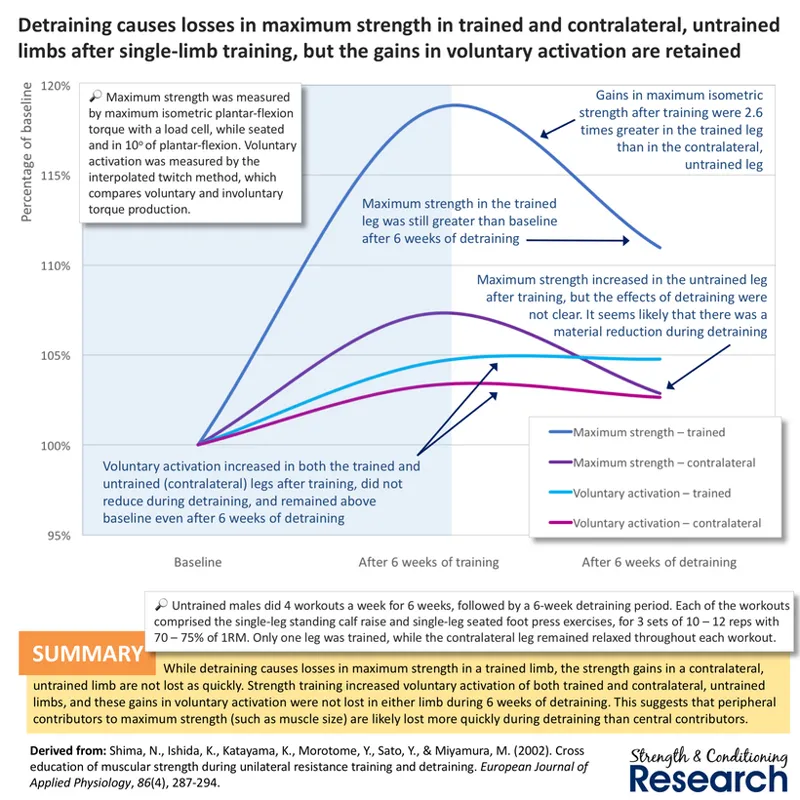
After strength training with a single arm or a single leg, there are strength gains in the trained limb as well as smaller strength gains in the untrained limb. There are many features of this crossover effect, including the fact that eccentric contractions produce a greater transfer of strength from the trained limb to the untrained limb than other contraction modes, albeit only for certain types of strength.
.
What mechanisms cause the strength gains in the untrained limb to occur is not known. However, it is often assumed that improvements in coordination are a key factor. Even so, increases in the ability to recruit high-threshold motor units have also been observed in the untrained limb.
.
Importantly, strength gains can also occur in more remote muscle groups, as well as in the directly opposite limb from the trained limb. For example, upper body strength gains have been observed after single-leg, lower body strength training. Exactly what mechanism contributes to these strength gains is still unknown. Since coordination is unlikely to be a contributory factor, given the totally unrelated movement patterns that are involved, it is possible that the strength gains are produced by an increase in the ability to recruit high-threshold motor units.
.
#2. Crossover fatigue occurs after single-limb strength training workouts
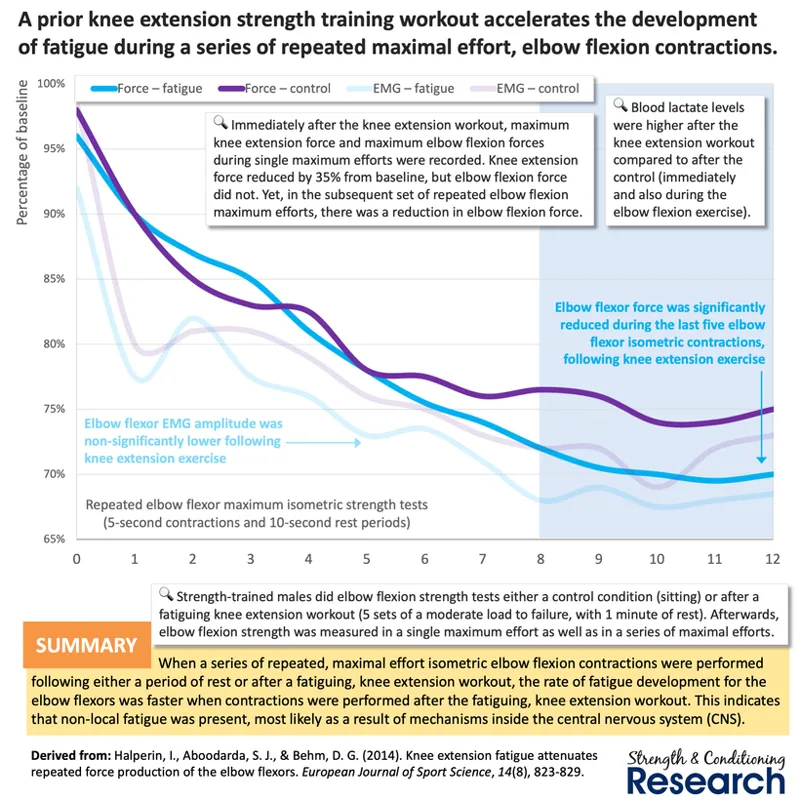
Crossover effects have been reported in relation to fatigue. When a muscle of a single limb is exercised, there is local fatigue in the muscles of that limb, as well as fatigue in the muscles of the opposite limb. This non-local fatigue is greater in the directly corresponding muscle of the opposite limb, but is also noticeable in other muscles of the opposite limb.
.
It seems likely that this non-local fatigue arises due to a variety of mechanisms, most of which are probably mediated through supraspinal central nervous system (CNS). Indeed, CNS fatigue has also been directly measured within totally different muscles of the body after strength training for one muscle. This seems to occur due to afferent feedback as a result of metabolite accumulation.
.
It is important to note that this non-local fatigue effect does occur in muscles in completely different parts of the body, and not just in the muscles of the opposite limb. When researchers have explored this phenomenon, they have noted that it is more apparent in repetitive, fatiguing tasks than in single, maximal efforts. This indicates that the fatigue mechanism involved is definitely supraspinal CNS fatigue induced by an increased perception of effort.
.
#3. Crossover repeated bout effect
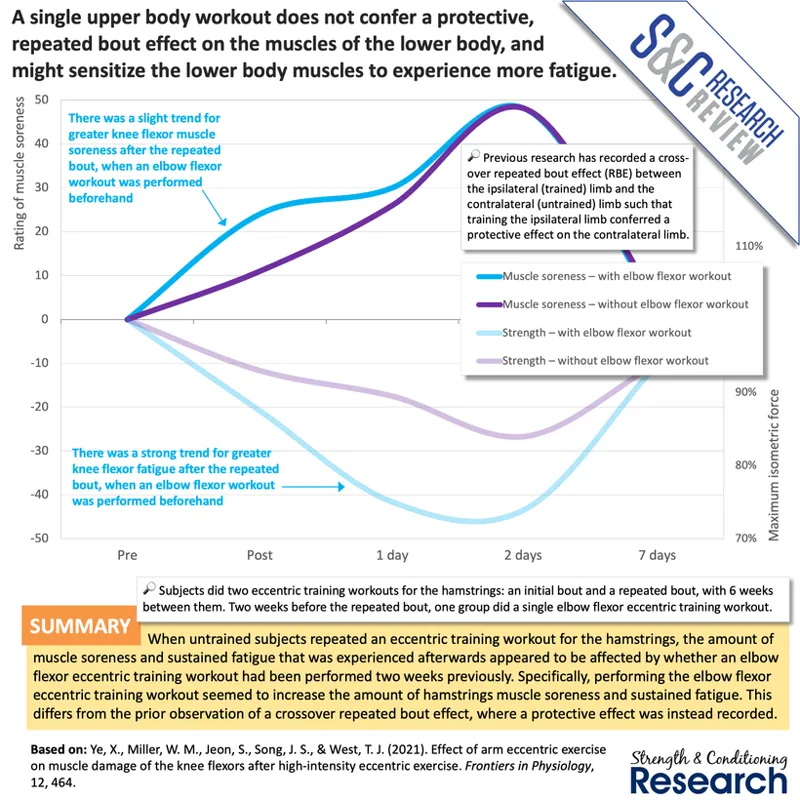
In addition to the crossover effect of strength gains and a cross-over effect of fatigue, there is also a crossover effect in relation to the repeated bout effect. When a strength training workout is done for a single arm or for a single leg, this confers a protective (repeated bout) effect on the trained muscle during a subsequent workout. In other words, the subsequent workout causes a smaller amount of sustained fatigue and muscle soreness in comparison with the earlier workout. None-the-less, this initial workout also confers a protective (repeated bout) effect on the directly corresponding, albeit untrained muscle of the opposite limb.
.
Interestingly, despite the fact that the other cross-over effects apply to directly corresponding muscles of the opposite limb as well as to more remote muscles of the body, the cross-over repeated bout effect does not. There is no cross-over repeated bout effect to more remote muscles. If anything, the opposite effect is produced, such that more remote muscles are actually sensitized to fatigue after a workout involving another muscle group.
.
Conclusions
Crossover effects occur when exercise performed by one muscle causes changes in another muscle. Crossover effects include: [1] the transfer of strength gains from one limb to another after long-term strength training (partly due to improvements in coordination and partly due to increases in the ability to recruit high-threshold motor units), [2] the transfer of fatigue from one muscle to another during a strength training workout (likely due to supraspinal central nervous system fatigue caused by afferent feedback), and [3] the transfer of the repeated bout effect from one muscle to another (through as-yet entirely unknown mechanisms). While crossover effects are usually recorded in the corresponding muscle of the opposite limb, more remote crossover effects do occur, such as between trained muscles of the lower body and untrained muscles of the upper body. These more remote crossover effects only occur in relation to [1] strength gains after training, and [2] fatigue after exercise. The crossover effect that occurs in relation to the repeated bout effect is limited to the corresponding muscle of the opposite limb. More remote muscle groups actually seem to be sensitized to experience more sustained fatigue (perhaps because of rapid strength gains caused by increases in the ability to recruit high-threshold motor units allowing more fast twitch muscle fibers to be damaged by exercise).