



Volume load
Volume load is not the same thing as volume. In the hypertrophy literature, volume refers to the number of sets performed to failure. Volume load is instead calculated as the number of reps multiplied by the weight on the bar. While volume is a fairly good predictor of hypertrophy (up to a point), volume load has absolutely no relationship with hypertrophy whatsoever, as can be seen from the various areas of research outlined in this article.
.
#1. Hypertrophy can be altered without any changes being necessary in volume load (just by altering proximity to failure)
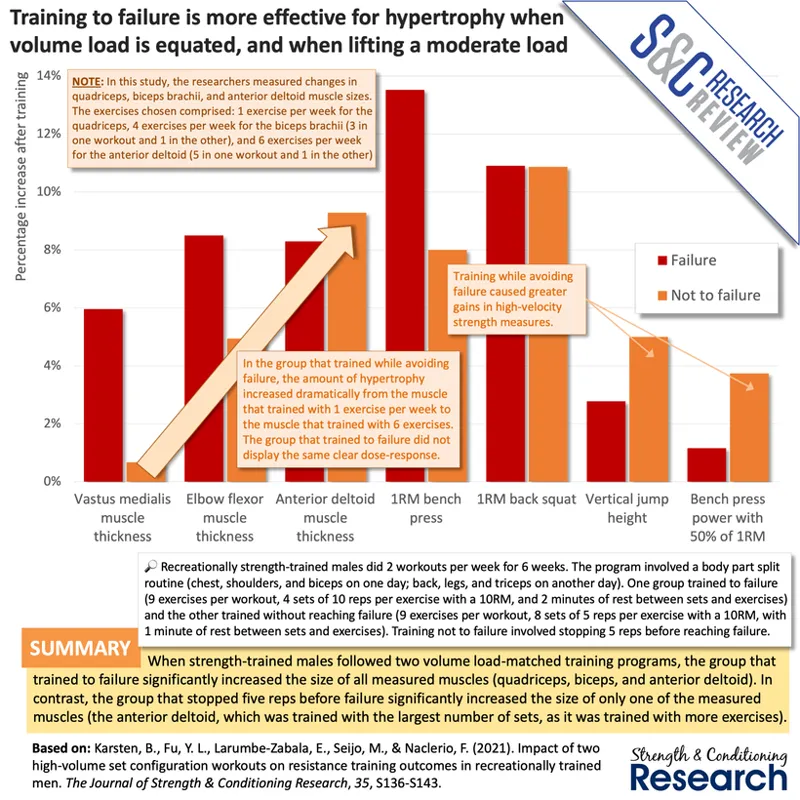
When volume load (sets x reps x weight) is kept constant, changing proximity to failure greatly alters the amount of hypertrophy that is achieved after strength training. For example, when comparing heavy and light load strength training with the same volume load where the heavy load group involves training closer to failure, the heavy load group achieves more muscle growth.
.
Similarly, when training with the same volume load, training to failure produces more muscle growth than training while avoiding failure by using intra-set rest periods.
.
#2. Volume load can be altered without affecting hypertrophy (by changing the load on the bar but keeping proximity to failure the same)
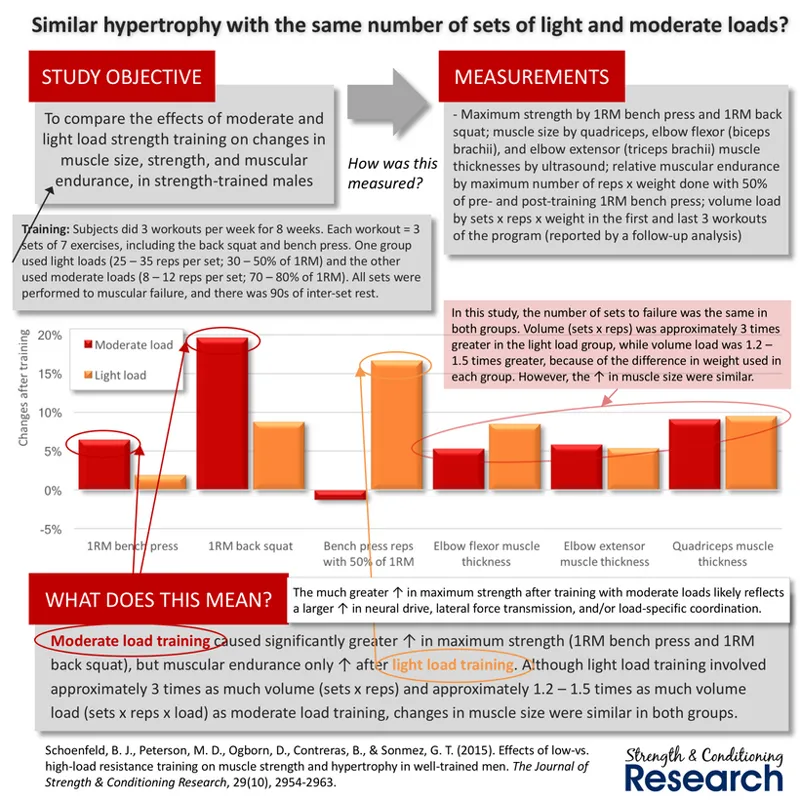
When training to failure, performing the same number of sets with a range of loads (between 5 and 30RM) tends to produce the same muscle growth. Most studies have reported this finding, and it is now fairly widely-accepted as a general principle (although there are a couple of exceptions). Nevertheless, training with lighter loads involves higher volume loads (sets x reps x weight) than training with heavier loads.
.
#3. Volume load can be altered without affecting hypertrophy (by applying blood flow restriction cuffs during light load strength training to failure)
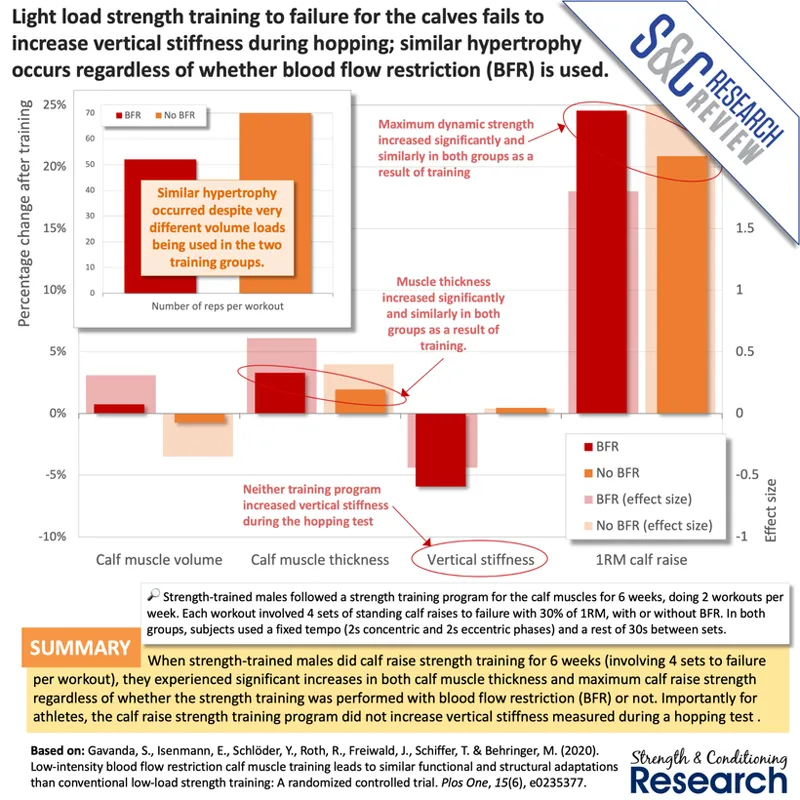
When applying blood flow restriction to a limb, the number of reps that can be achieved in a set with a light load when training to failure is substantially reduced. Therefore, the volume load is similarly dramatically reduced. Nevertheless, the amount of hypertrophy that is produced during light load strength training to failure is not affected by the application of blood flow restriction.
.
#3. Hypertrophy can be altered without any changes being necessary in volume load (just by altering range of motion)
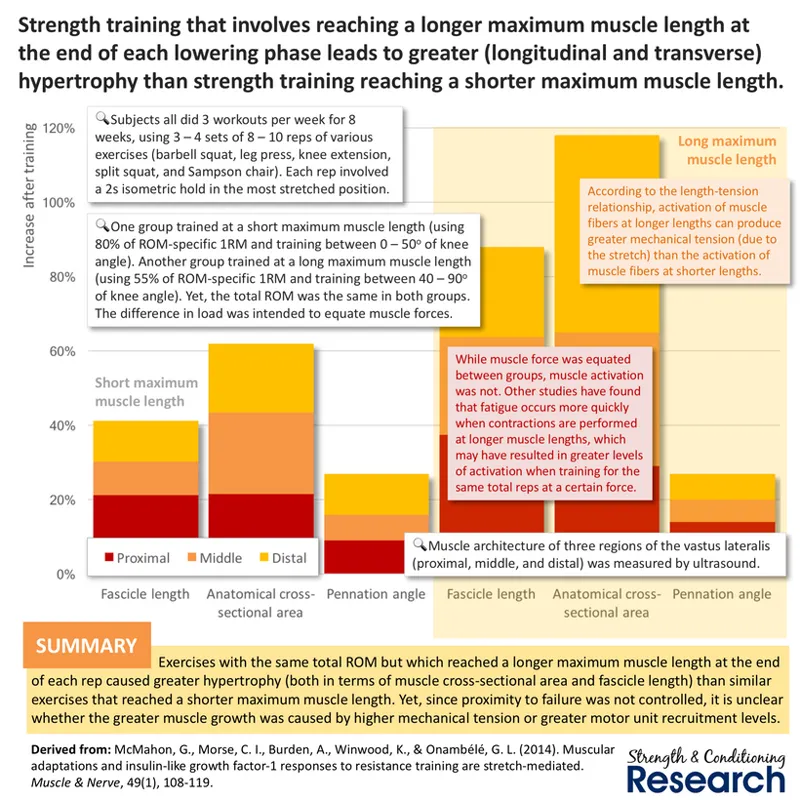
When training through exactly the same range of motion (in terms of the number of degrees), using a range of motion that finishes the lowering phase at a longer maximum muscle length (in a more stretched position) causes more muscle growth than using a range of motion that finishes the lowering phase at a shorter maximum muscle length (in a less stretched position). This happens even when muscle forces are equalized such that the volume load used when training to a longer maximum muscle length is actually smaller.
.
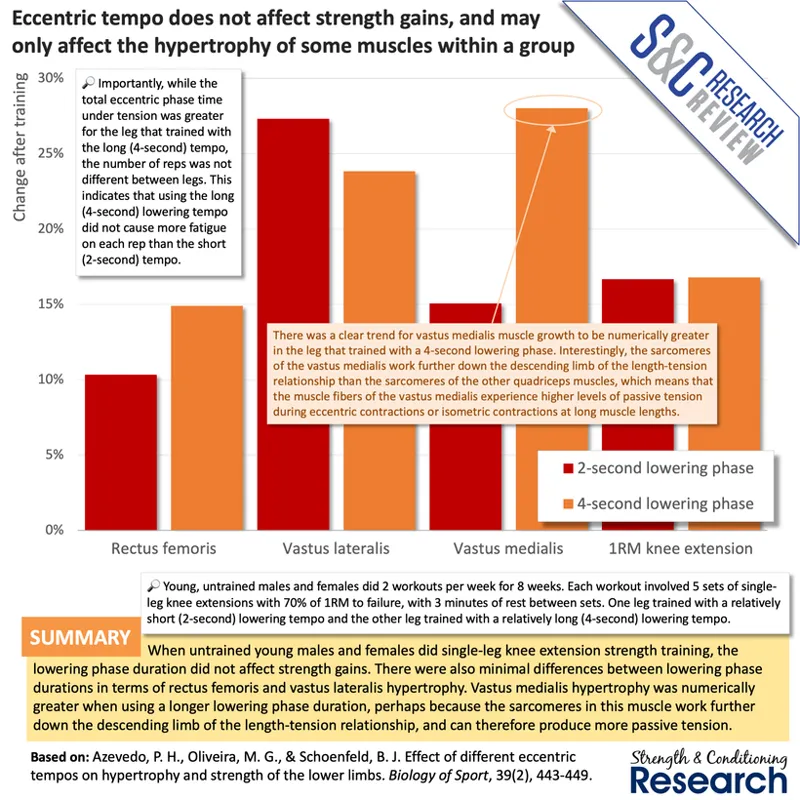
#5. Hypertrophy can be altered without any changes being necessary in volume load (just by altering the eccentric tempo)
Some research has shown that using a slower lowering tempo may enhance hypertrophy. Importantly, this happens without affecting the volume load (because eccentric fatigue is different from concentric fatigue, and the limiting factor is still fatigue in the concentric phase).
.
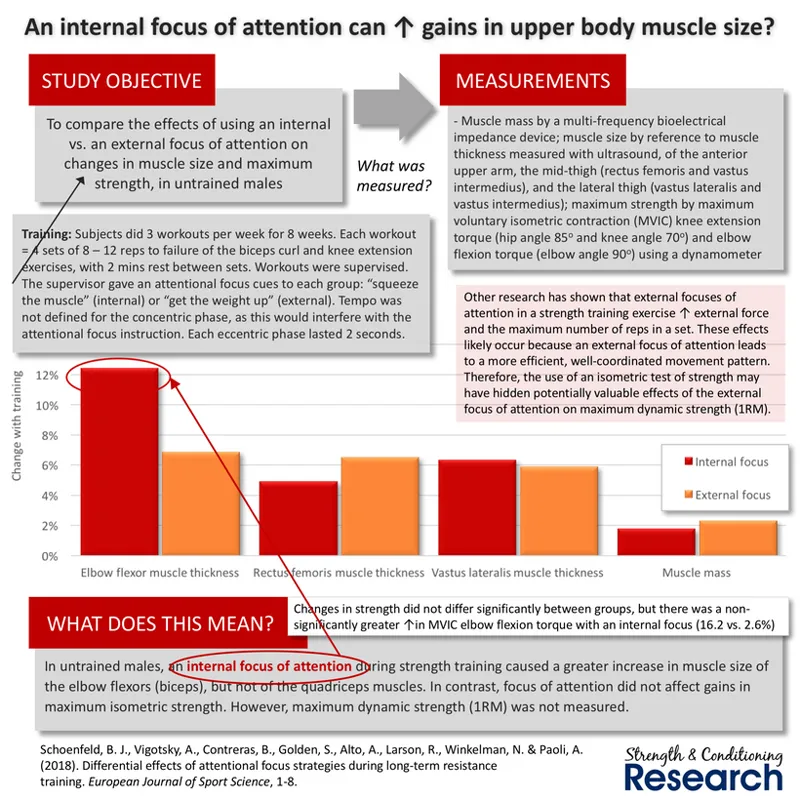
#6. Hypertrophy can be increased while volume load is decreased (just by implementing an internal focus of attention)
When performing a strength training set to muscular failure, the focus of attention affects how many reps can be achieved in a set, and therefore affects the volume load (sets x reps x weight). Using an internal focus of attention reduces the number of reps, while using an external focus of attention increases the number of reps.
.
Nevertheless, using an internal focus of attention (and a smaller number of reps and therefore a smaller volume load) causes more hypertrophy.
.
Conclusions
Volume load (the number of sets multiplied by the number of reps multiplied by the weight on the bar) is often stated to be a key determinant of the amount of hypertrophy that is caused by a strength training workout. This is not true. Indeed, there are a number of obvious examples that break the link between the volume load performed and the hypertrophy that results. [1] When training with the same volume load, training further from failure reduces hypertrophy. This happens whether proximity to failure is altered by changing the weight, sets, and reps, or whether proximity to failure is altered by implementing intra-set rest periods. [2] When training with the same volume load, reaching a longer maximum muscle length and training with a slower lowering tempo on each rep both increase hypertrophy. [3] When performing sets to failure, moderate loads and light loads produce the same hypertrophy but sets of moderate loads involve less volume load. Similarly, sets of light loads with and without blood flow restriction (BFR) produce the same hypertrophy but sets of light loads with BFR involve less volume load. [4] When performing sets to failure, using an internal focus of attention causes more hypertrophy to be produced compared to an external focus of attention even though using an external focus of attention permits a greater volume load to be achieved.
Comments (2)
Amazing job Chris as usual - congratulations as a study pub ahead of print in JSCR today cited "stimulating repetitions". Are you prepared for copycats and jealous peers? One question about muscle length as how does this comport with gluteus maximus?hip thrust? The largest muscle in the human body developed at the fully contracted position. So are internal moment arm lengths the deciding factor and is it really more an issue of optimal muscle length? Thanks!
Internal moment arm lengths (MALs) are very important when there are multiple muscles that can all perform the same joint action. For example, the adductor magnus, gluteus maximus, and hamstrings can all perform hip extension. Therefore, the MALs of each of these muscles is the key to determining which muscle is actually trained by an exercise. In contrast, if only one muscle is present at a joint, then the MAL is actually totally irrelevant, because there is no other muscle to be activated in its place.