






What causes muscle damage?
The internet widely believes that muscle damage is caused by internal tearing forces. Even so, it is actually caused by biochemical effects that are instigated by the presence of calcium ions. Here are the reasons why we know that tearing forces do not cause muscle damage under normal conditions.
.
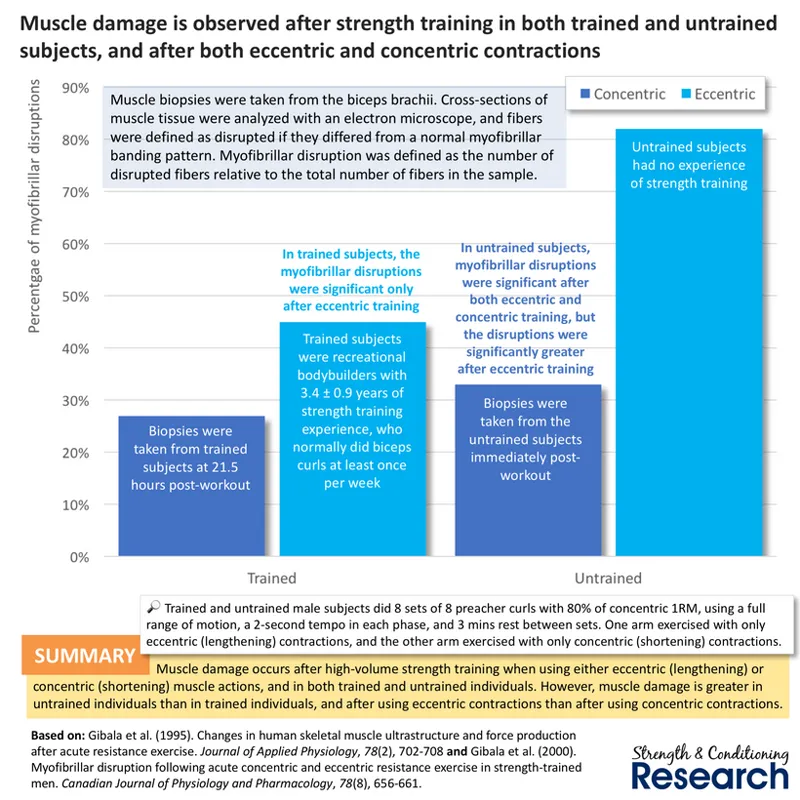
#1. Muscle damage can happen after concentric contractions
Concentric contractions do not involve any muscle lengthening so they cannot tear muscle fibers. Therefore, if concentric contractions cause muscle damage (as measured directly and not just by reference to post-workout fatigue), then there MUST be a physiological mechanism that causes damage to muscle fibers that does not rely upon tearing forces.
.
#2. Muscle damage can be generated even when muscle force is minimal
For tearing forces to create damage inside the muscle, there must be sufficient levels of muscle force. If muscle force is minimal when muscle damage is created, it MUST be caused by another mechanism that does not rely upon force being above a certain threshold.
.
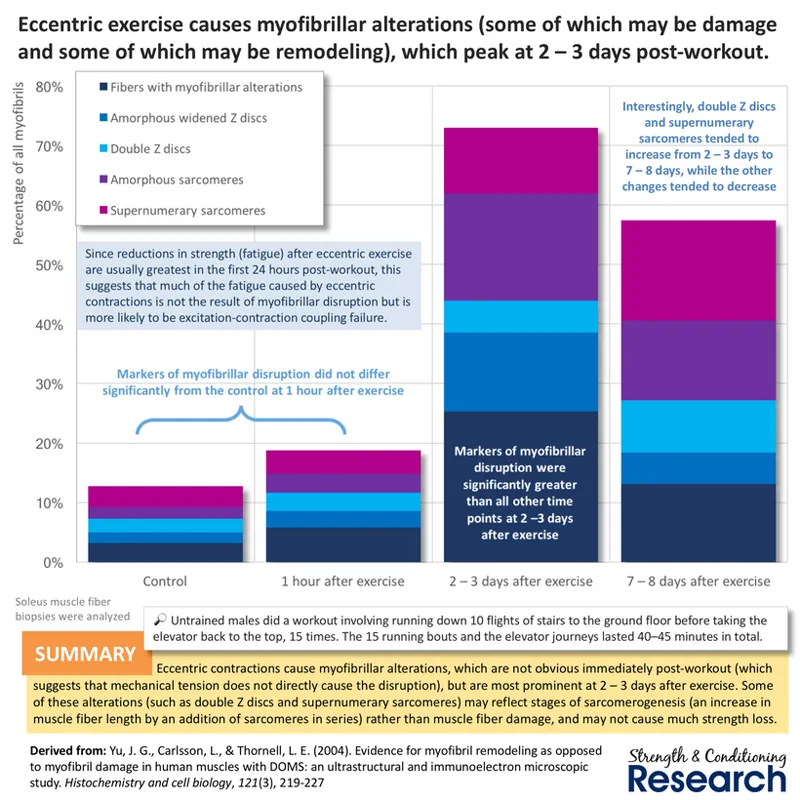
#3. Muscle damage is not present immediately after exercise
Tearing forces MUST produce damage that is visible immediately after exercise. If muscle damage appears several hours or even days after the workout that instigated the damage, then it cannot be caused by tearing forces and must be the result of some other physiological processes.
.
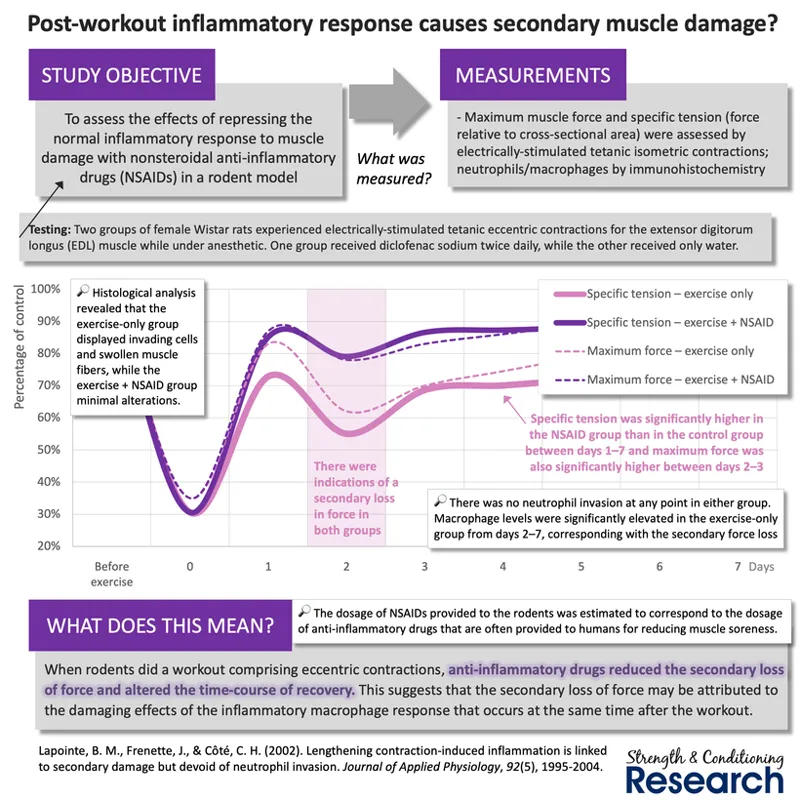
#4. Muscle damage is caused by post-workout inflammation
Post-workout inflammation has been shown to cause muscle damage during the post-workout period itself, when muscle forces are not being generated. Obviously, this muscle damage cannot be counted as being produced by tearing forces.
.
A great many studies have shown essentially identical results with the result that researchers have even coined the term "secondary muscle damage" as a physiological phenomenon.
.
#5. There is a very obvious alternative mechanism
Often, when I point out that muscle damage is not caused by mechanical tension, I am met with the "well what does cause muscle damage then?" question, as if this were somehow a difficult point to address. There is a gigantic body of literature demonstrating that muscle damage is caused by the influx and retention of calcium ions within the muscle fiber.
.
Indeed, researchers have shown that there is a pronounced increase in calpain levels immediately after a bout of muscle-damaging exercise, which is related to the post-workout fatigue that is experienced.
.
#6. Calcium ion accumulation explains why fast twitch fibers are more easily damaged
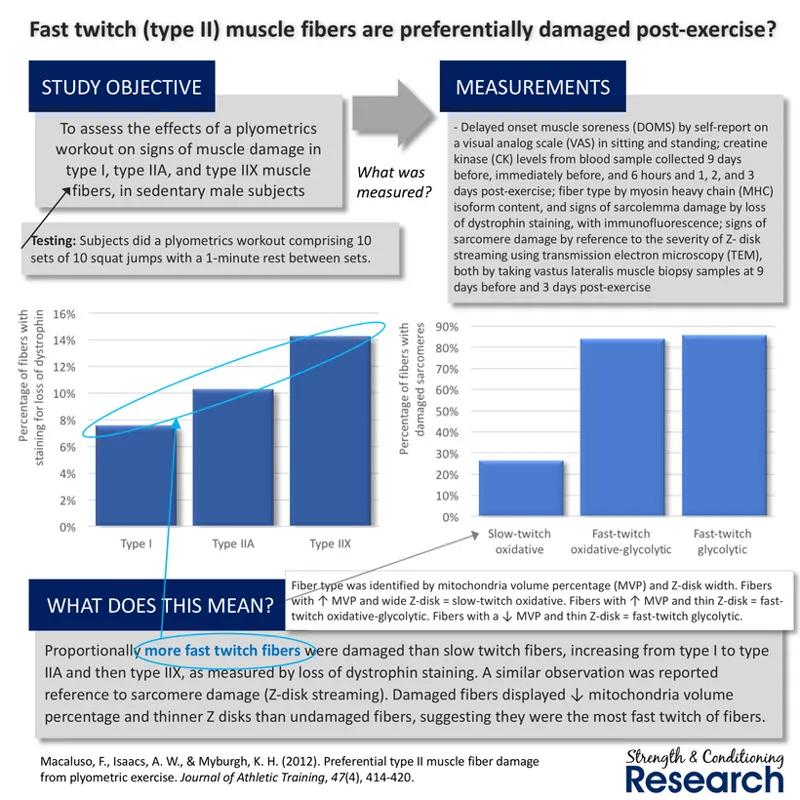
It is well-known that fast twitch muscle fibers (and muscles that contain more fast twitch muscle fibers) are more easily-damaged after exercise. In animal models, increased myofibrillar damage has been directly observed. In humans, we have to date observed only increased sustained fatigue after the workout. In an attempt to fit this information with the idea that muscle damage is caused by mechanical tension, researchers have focused on the differences in structure between type I and type II muscle fibers, suggesting that they might be more susceptible to damage by virtue of being thinner and more fragile. Even so, there are far more plausible explanations.
.
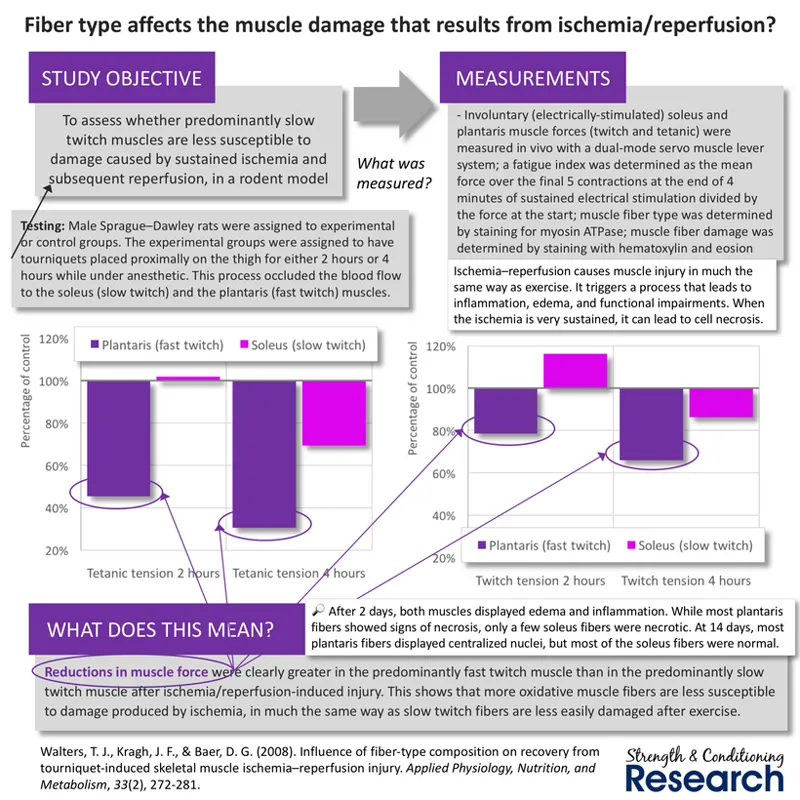
Indeed, research has shown that fast twitch muscle fibers are more easily damaged than slow twitch muscle fibers even when the damage is caused by ischemia, which involves no mechanical tension whatsoever. This increased susceptibility to damage must therefore be caused by biochemical factors. Indeed, the calcium ions model of muscle damage explains this situation very easily, since fast twitch muscle fibers have fewer mitochondria and are therefore less able to protect themselves from the presence of calcium ions.
.
Also, there is further evidence supporting this model, because fast twitch muscle fibers display more oxidative stress (reactive oxygen species) during ischemic exercise. Reactive oxygen species are a key signaling element in the calcium ions model of muscle damage. Therefore, an increase in oxidative stress is clear evidence that an excess of calcium ions is responsible for increased muscle damage in fast twitch muscle fibers during ischemia.
.
Indeed, the fact that the presence of reactive oxygen species is linked to the presence of muscle damage is another key factor supporting the idea that muscle damage is caused by an excess of calcium ions and not by mechanical tension.
.
#7. So why do eccentric contractions cause more muscle damage?
One argument that is often set forward by the proponents of the idea that mechanical tension causes muscle damage is that eccentric contractions cause more muscle damage than other contraction modes, and since eccentric contractions involve stretching a muscle fiber while it is activated, it must be the stretching that causes the damage. While that is technically true, the stretching does not cause damage in the way that they imagine. In fact, the stretching of an activated muscle fiber is well-known to cause additional calcium ions to enter into a muscle fiber, and this additional influx of calcium ions wreaks havoc on the inner structure of the cell, by triggering the release of proteases that degrade it. Thus, it is not mechanical tension that causes damage, but biochemistry.
.
#8. The alternative mechanism can explain why muscle damage after exercise is similar to muscle damage after other injuries (such as contusions or lacerations)
One large advantage of the calcium ions mechanism of muscle damage is that it explains why all types of injury to muscles (including contusions from impacts, lacerations, and even ischemia) all lead to similar damage-related processes and subsequent repair-related processes. Ultimately, in each case there is an influx of calcium ions into the muscle fiber, which leads to proteases being released.
.
Conclusions
Muscle fibers are not damaged by tearing forces during exercise. We can prove this by reference to four observations: [1] directly-measured muscle damage has been recorded after workouts involving concentric-only contractions, in which there are no tearing forces; [2] substantial post-workout fatigue can be produced in fatiguing contractions when muscle forces are very low (and therefore tearing forces are absent); [3] directly-measured muscle damage is very often not visible immediately after exercise, but rather appears after hours or even days (so cannot be caused by tearing forces); and [4] post-workout inflammatory processes have been shown to produce additional post-workout fatigue as well as direct markers of muscle damage. This again indicates that the muscle damage is often produced without the need for tearing forces. In replacement for the idea that muscle damage is produced by pulling muscle fibers apart, we can use a well-established model based on calcium ion accumulation. When calcium ions accumulate in the cytoplasm of a muscle fiber due to muscle fiber activation and/or stretch, they trigger the release of proteases that damage the inside of the muscle fiber. Post-workout inflammation clears away this damage, causing losses of myofibrils. This model explains all of the above observations as well as why fast twitch fibers are more easily-damaged (they have fewer mitochondria that can remove calcium ions), why eccentric contractions cause the most damage (they involve activation at the same time as stretch), and why all types of muscle injury cause similar damage and repair processes (they all involve calcium ion influx).
Comments (10)
amazing work as usual chris
Thank you, Chris. It gets clearer now!
Hello! So we should not go beyond failure because that does not increase mechanical tension and only increase fatigue? But what about partial reps after failure is reached in the long muscle lengths? For example, doing one arm dumbbell rows to failure and then few more reps at the bottom, stretched position? Thank you, Chris. I am new patron, so sorry if I am asking the wrong question
During the last two reps of a set, the amount of excitation-contraction coupling failure inside the muscle fibers of the high-threshold motor units increases dramatically (which reduces the mechanical tension that the muscle fibers can produce) and the level of CNS fatigue also increases (which reduces the number of high-threshold motor units that are active. This means that extending a set beyond failure will have relatively small benefits for hypertrophy. It can be done (such as with rest pause) but the stimulating effect of each additional rep is maybe a third or a quarter of what it would be in a normal set.
Thanks Chris for the feedback - I guess my point is that in the gym where I literally see trainers pushing clients BEYOND failure (the give me one more as opposed to leave a few in the tank which is so prevalent) - yes I maintain your recommendations would be taken generally to be easy or certainly moderate exertion training. Or am I off base again? And this is important because I agree however I have experienced clients being disappointed over not having a hard workout.
Oh sure, absolutely. When additional reps are performed beyond failure then those reps are essentially the same as what professional cyclists call "junk miles" since they involve more excitation-contraction coupling failure but no real stimulus for adaptation.
Tempting to suggest short intra-rep rest to modulate the calcium ion accumulation - if that's even possible. I remember a training protocol proposed a few years ago called Max Stimulation, later adopted as the German PITT-force training. Basically 5-10RM loads with a few seconds (3-5, max 20 sec) of rest between reps, shorter than typical cluster training, then slightly longer rest as rep speed slowed down. Theory being that this allowed slightly more reps but with a better stimulus-fatigue ratio.
Yes, that's an interesting idea. The concept of modulating rest periods to reflect what is actually happening is something I have been thinking about for a while. To me, the idea of fixing rest periods as 3 minutes irrespective of the level of fatigue is nonsensical, in the same way as trying to relate external volume load to hypertrophy without controlling for effort or fatigue. So increasing rest period duration over time makes a lot of sense, because the earlier rest periods don't need to be as long as the later rest periods.
Thanks Chris - from your writings it seems like both fatigue and muscle damage are not necessary for strength and muscular development. It's almost like the workout should be program should be characterized as progressive but relatively easy.
This is a really interesting point that strikes at the heart of how we define things as difficult and easy. Technically, if we are referring to RPE, then I would argue that optimal training program for athletes would always involve a high RPE on every rep, but each set would stop with a couple of RIR, before reaching failure. Certainly, I would see low volumes being better than high volumes for long-term progress, but how can we define that in terms of difficult and easy? Our terminology is not ideal for expressing these concepts.