



Repetition strength
We often use increases in repetition strength as a means of tracking progress during strength training. Yet, increases in repetition strength are not perfectly associated with increases in muscle size, since muscular-endurance-related mechanisms can increase the ability to perform reps with a given weight, in addition to increases in muscle fiber size.
.
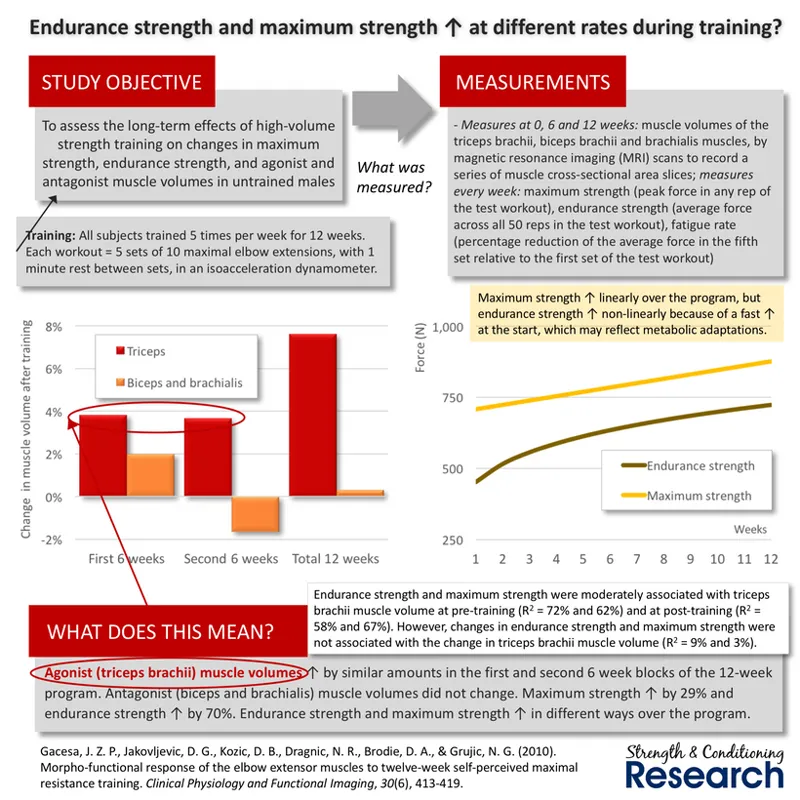
#1. Changes in maximum strength and repetition strength are not always closely related
When we test gains in maximum strength and repetition strength during a strength training program, they do not increase at the same rate. This is likely due to different adaptations occurring at different rates. Some adaptations benefit maximum strength to a greater degree than repetition strength, while other adaptations benefit repetition strength to a greater degree than maximum strength.
.
#2. Type of external resistance affects relative increases in maximum strength and repetition strength
Muscle growth tends to be the same whether we are training with accommodating resistance or with weights. Yet, increases in repetition strength are greater after training with accommodating resistance. This demonstrates that accommodating resistance is better at causing muscular-endurance-related adaptations despite producing similar hypertrophy.
.
#3. Repetition range affects relative increases in maximum strength and repetition strength
While muscle growth is not affected by repetition range, increases in repetition strength are greater after training with light loads. This tells us that lighter loads are better at causing muscular-endurance-related adaptations despite producing similar hypertrophy.
.
#4. Repetition strength can be increased by increasing resistance to any relevant fatigue mechanism that occurs during strength training
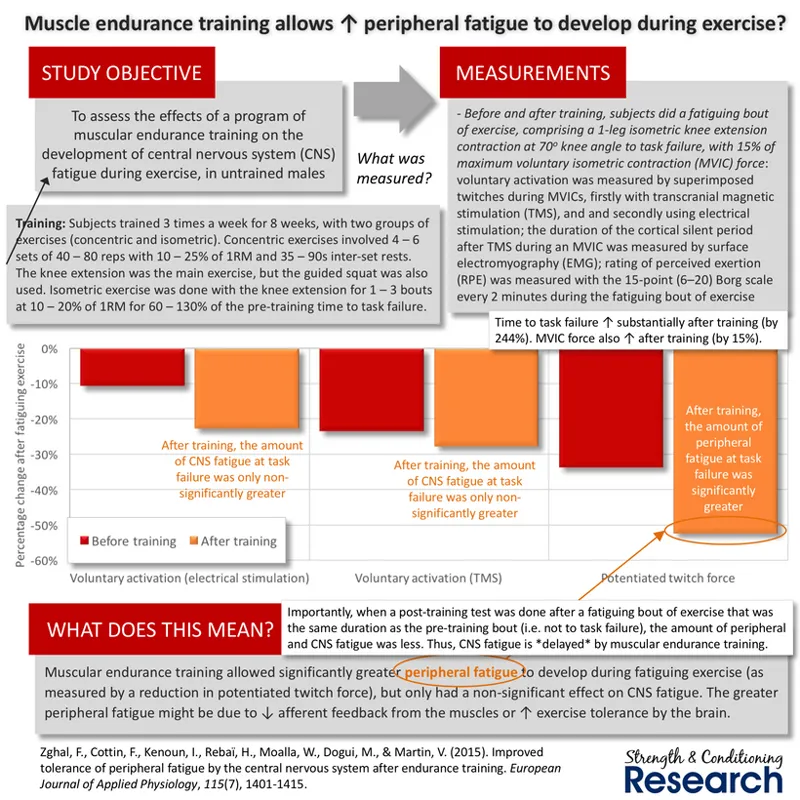
Increases in repetition strength that are independent from increases in maximum strength must be generated by improvements in fatigue resistance. Improvements in fatigue resistance must be caused by increases in the ability to withstand specific fatigue mechanisms. Various fatigue mechanisms occur during strength training sets (read more).
.
There are two obvious categories of fatigue mechanism that can be increased by strength training. Firstly, there is of course the reductions in calcium ion-related fatigue. We can see this happening by reference to the repeated bout effect and the multiple repeated bout effect because any change in calcium ion-related fatigue must necessarily cause a change in post-workout fatigue (read more).
.
Secondly, there are changes in the extent to which metabolite-related fatigue occurs. While an increase in buffering capacity (which delays the onset of metabolite accumulation) is often cited as a key mechanism, it is also likely that an increase in the tolerance to the afferent feedback occurs, since we can see that the total amount of peripheral fatigue at muscular failure increases after training.
.
Conclusions
We often use increases in repetition strength as a means of tracking progress during strength training. Yet, increases in repetition strength are not perfectly associated with increases in maximum strength nor are they perfectly associated with changes in muscle size. We can see this when looking at the effects of both external resistance type and repetition range. Muscle growth tends to be the same whether we are training with accommodating resistance or with weight. Similarly, hypertrophy is the same when we train with either light or moderate loads to failure. Yet, increases in repetition strength are greater after training with accommodating resistance (compared to when training with weight) and are greater after training with lighter loads (compared to when training with moderate loads). Thus, accommodating resistance and lighter loads must be better at creating fatigue resistance adaptations. Improvements in fatigue resistance must be caused by increases in the ability to withstand specific fatigue mechanisms. Various fatigue mechanisms occur during strength training sets. Nevertheless, we know that changes in calcium ion-related fatigue mechanisms are very limited (as indicated by the repeated bout effect). Increases in resistance to metabolite-related fatigue are often ascribed to an improvement in buffering capacity. Yet, there are indications that we can also develop tolerance to the metabolite-induced afferent feedback that causes supraspinal central nervous system (CNS) fatigue. This suggests that fatigue resistance during strength training occurs by means of improvements in the ability to resist metabolite-related fatigue and supraspinal CNS fatigue.

