




Muscle loss
Most discussions of how to write the best strength training program for bodybuilding focus on how to optimize the amount of hypertrophy that occurs. Rarely do such discussions consider the factors that can lead to muscle loss, even though research has shown that this can happen.
.
#1. Excessively muscle-damaging workouts
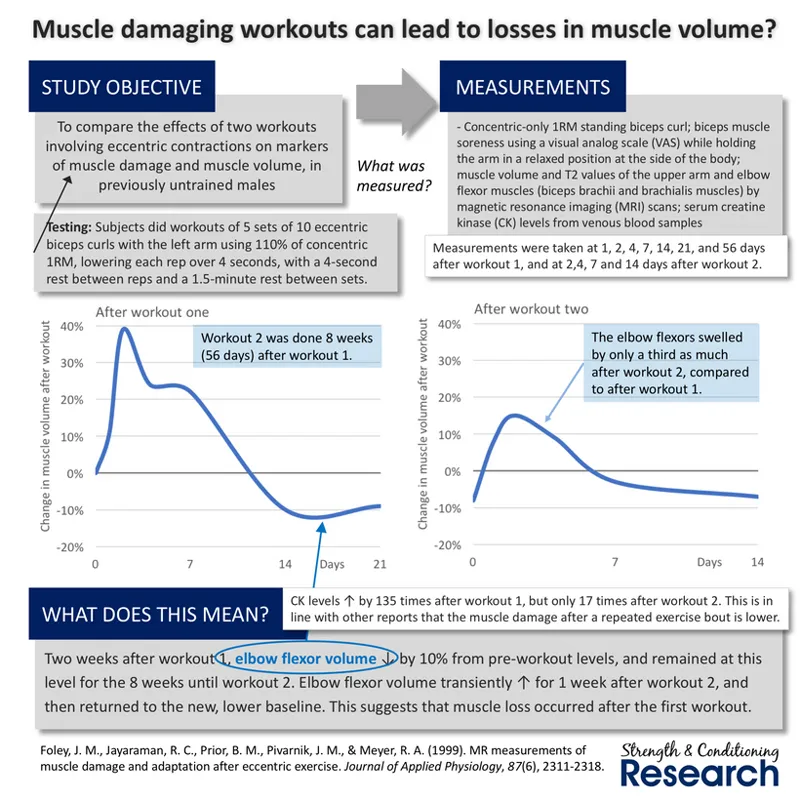
Although muscle damage has been championed by some researchers as a method of causing hypertrophy, we have known for a long time that excessive muscle damage in a single workout can cause muscle loss. Moreover, the loss of muscle mass does not appear to be a temporary phenomenon, at least in the absence of strength training.
.
To understand why this might occur, it is important to understand the difference between muscle fiber repair and muscle fiber regeneration. These terms are often used interchangeably in the wider fitness industry, but they actually have completely different meanings. Muscle fiber repair refers to the replacement of small parts of muscle fibers (ranging from segments of small structures within the cytoskeleton to small segments of the fiber itself). Muscle fiber regeneration refers to a complete replacement of the old, damaged muscle fiber by the growth of an new one inside the old cell membrane, after the old, damaged muscle fiber has been removed through necrosis.
.
Researchers often make use of a number of different models for investigating muscle fiber repair and regeneration. Very often, exercise models are used to create muscle fiber damage, which necessitates muscle fiber repair. In contrast, a number of injury models are generally used to create muscle fiber necrosis, which necessitates muscle fiber regeneration. That is not to say that exercise cannot cause muscle fiber necrosis (it can), but it is much more difficult to induce and is less predictable in its occurrence. Two common injury models are ischemia/reperfusion and muscle toxin administration. In many ways, ischemia/reperfusion is an extreme version of what causes muscle damage during exercise, making it an interesting model to examine. Some research has shown that while all types of muscle injury leading to muscle fiber regeneration cause muscle loss for several weeks, ischemia/reperfusion causes what appears to be a permanent loss of muscle fibers, with the original muscle weight being replaced by non-functional connective tissue.
.
#2. High-velocity eccentric contractions
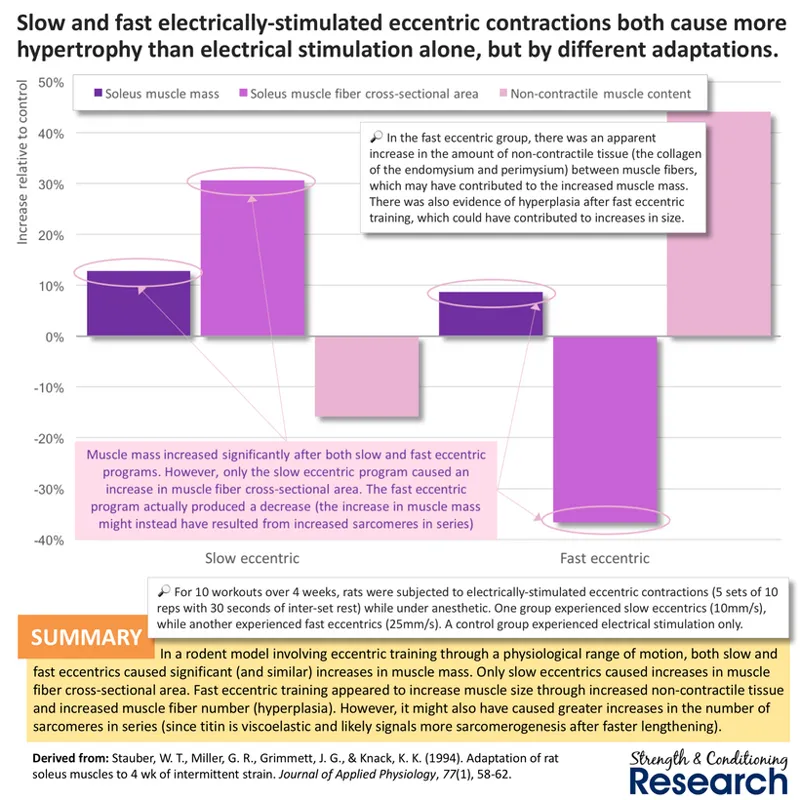
High-velocity eccentric contractions can cause muscle loss. Exactly why this happens is not clear.
.
Some research has identified that high-velocity eccentric contractions could cause nerve damage by means of the high compressive forces generated (indeed, high-velocity eccentrics involve higher forces than low-velocity eccentrics, due to the eccentric-force velocity relationship tending to increase slightly with increasing velocity). This nerve damage could then lead to losses in muscle fiber diameter in much the same way as denervation.
.
While some research has found no signs of additional muscle damage following the use of high-velocity eccentrics compared to low-velocity eccentrics, there are indications that more fibrosis (the depositing of collagen) could occur.
.
#3. Overreaching and overtraining
Although very high volumes are a popular way of strength training for bodybuilding, there is a risk of overreaching and even overtraining when volume exceeds a certain threshold. Importantly, overreaching and overtraining have been associated with muscle loss in a number of studies. While high volume workouts could individually cause muscle loss by being excessively muscle-damaging, overreaching and overtraining might additionally cause muscle loss through systemic mechanisms involving increased catabolism.
.
#4. Sleep loss
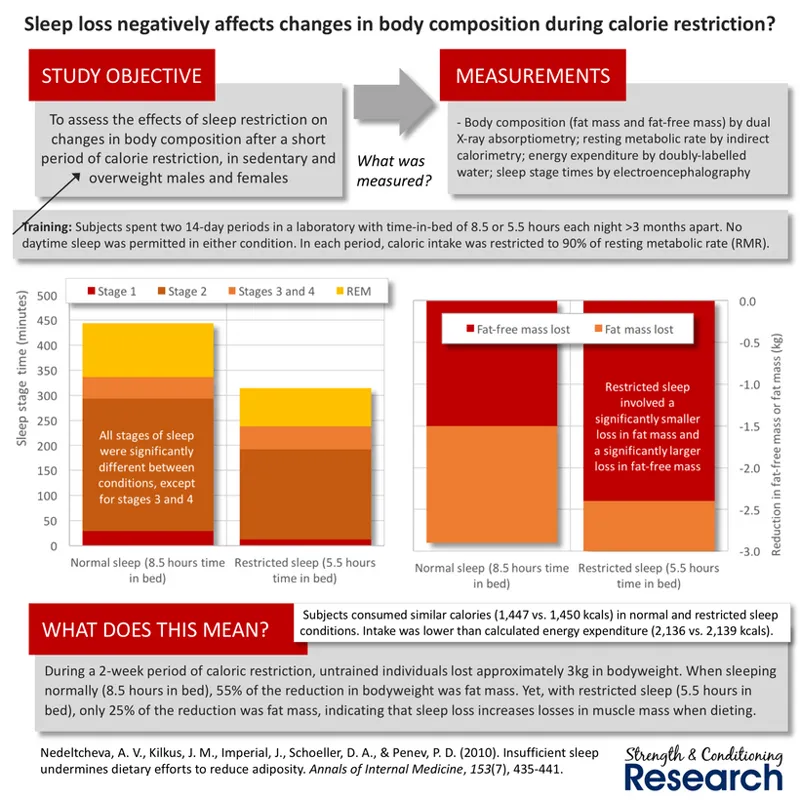
Sleep is widely-accepted to be important for recovering from exercise. Yet, it seems to be even more important than was previously realized. Indeed, research has shown that a lack of sleep can cause muscle loss in untrained people during periods of calorie restriction.
.
Moreover, more detailed research in rodents suggests that the negative effects of sleep on muscle mass can occur irrespective of [1] whether the subject is in caloric restriction or not, and [2] whether the muscle has been exercised (and damaged) or not. This suggests that sleep loss directly causes muscular atrophy, likely through a systemic mechanism involving increased catabolic activity.
.
Conclusions
Excessively muscle-damaging workouts can cause persistent or even permanent muscle loss. When muscle fibers are severely damaged, they become necrotic and must be regenerated (which is different from being repaired). Repair involves the replacement of small structures inside individual muscle fibers. In contrast, regeneration is a process that involves the complete removal of the original muscle fiber and its replacement by the growth of a new one inside the old cell membrane. If this process succeeds, then the new muscle fiber merges with the old cell membrane. If this process fails, the muscle fiber may not be replaced, leading to reduced muscle size. Additionally, fibrosis can occur, which reduces specific tension (strength relative to size). Research has shown that workouts involving fast eccentric contractions can also cause muscle loss. Since this happens without indications of muscle damage, it might be the result of compression-induced nerve damage, subsequently leading to impaired muscle fiber stimulation during muscle activation. Research has also shown that both overreaching and overtraining, as well as sleep restriction, can cause muscle loss. While overreaching and overtraining programs could easily produce muscle loss through the effects of single workouts (if such workouts are sufficiently muscle-damaging), they might also exert some systemic effects, perhaps through similar catabolic mechanisms as sleep loss.
Comments (3)
Thank you for the comment and noted - great point about the rodents and anesthetic - however speed is speed and velocity is velocity - in Muscles and Movements McConnell stated all ballistic movements are inherently dangerous. I always have linked that to the absorption of kinetic energy on the stops or transition from eccentric to concentric when training. So the joint stress. I had never thought about the nervous system being damaged.
Thanks Chris - the part about nerve damage from fast eccentrics got my attention. So this means speed training is risky for neuropathy?
It also caught my attention. Though I greatly appreciate the work of Chris, I might have some reserve on that particular point, because the rodents were under anesthetic. Therefore, a whole lot of mecanisms supposed to "counteract" such contractions might happen "on the field" (pain, for example).