




Fatigue after aerobic exercise
Fatigue is a temporary and reversible reduction in exercise performance due to a previous bout of exercise. Fatigue is caused by specific physiological mechanisms that interfere with the usual processes of muscle force production, either in the muscles or in the central nervous system.
.
#1. What is post-workout fatigue?
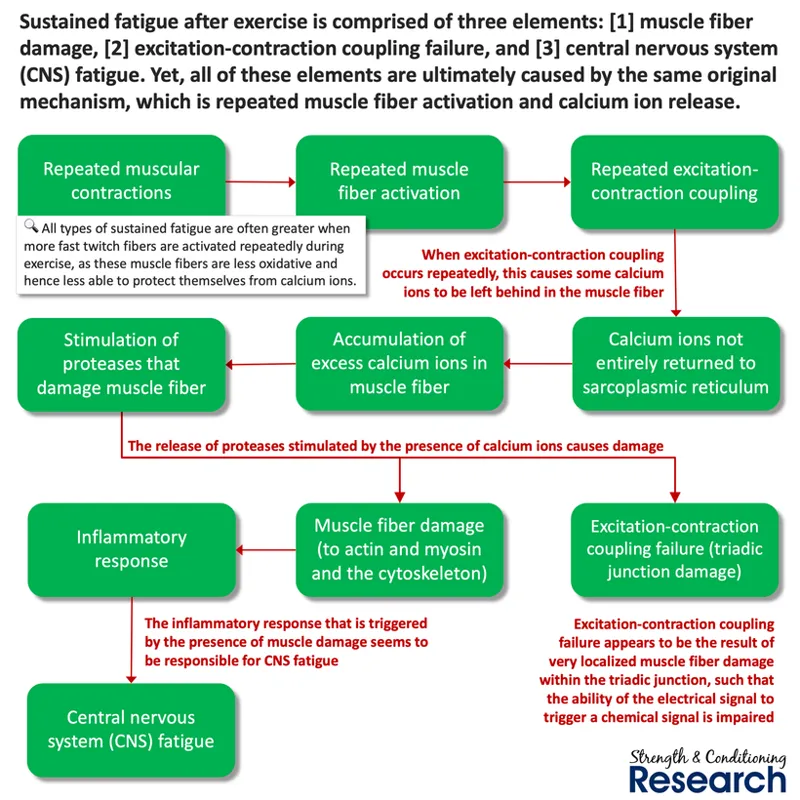
Post-workout fatigue is produced by calcium ion accumulation in the working muscle fibers during exercise as a result of repeated muscle fiber activation. Calcium ion accumulation leads to all post-workout fatigue mechanisms, including excitation-contraction coupling failure, muscle damage, and supraspinal CNS fatigue due to the inflammatory response to muscle damage.
.
#2. Does aerobic exercise cause calcium ion accumulation?
Even well-trained endurance athletes display signs of calcium ion-related fatigue after aerobic exercise. We can identify the presence of these effects by identifying reductions in the specific tension of isolated muscle fibers as well as reduced calcium ion sensitivity of fast twitch fibers.
.
While untrained individuals clearly display damage to the sarcoplasmic reticulum, liking impairing the release of calcium ions through excitation-contraction coupling failure, it is not clear if this occurs in endurance athletes. Yet, given the tendency of calcium ion-related fatigue mechanisms to occur in tandem with one another, it is likely that if reductions in calcium ion sensitivity have occurred, then excitation-contraction coupling failure and muscle damage have also occurred.
.
Moreover, animal models that have been designed to reflect human aerobic exercise workouts similarly display strong indications of calcium ion-related fatigue mechanisms, although there is some uncertainty about exactly which mechanisms are present and when.
.
One key feature of calcium ion accumulation (and therefore calcium ion-related fatigue) is that it affects fast twitch muscle fibers more than slow twitch muscle fibers (because of the different amount of mitochondria that they possess). Therefore, it is noteworthy that post-workout fatigue after aerobic exercise in rodent models is greater when the exercise is higher in intensity (and therefore involves higher levels of fast twitch muscle fiber activation).
.
#3. Does aerobic exercise cause muscle damage?
If we assume that the same post-workout fatigue model applies to all types of exercise and is caused by calcium ion accumulation leading to calcium ion-related fatigue, then we should expect there to be muscle damage after aerobic exercise workouts. While this has not been measured directly, we do have indications pointing in that direction. Myofibrillar protein synthesis rates are elevated post-exercise, which can either indicate that hypertrophy has been stimulated or that muscle damage has occurred and is being repaired. It's probably not hypertrophy.
.
#4. Does aerobic exercise cause central nervous system fatigue?
If we assume that the same post-workout fatigue model applies to all types of exercise and is caused by calcium ion accumulation leading to calcium ion-related fatigue, then we should expect there to be supraspinal CNS fatigue after aerobic exercise workouts. This does happen.
.
#4. What is the practical effect of doing strength training workouts when some post-workout fatigue is still present?
When strength training workouts are done at various points during the 24-hour recovery period from a cardiovascular exercise bout, they display reduced numbers of reps per set to failure, which is essentially an indicator of fatigue by reference to repetition strength. Most likely, this occurs due to calcium ion-related fatigue mechanisms reducing the muscle fiber force and an inflammatory response to muscle damage causing a reduction in motor unit recruitment levels by means of supraspinal central nervous system fatigue.
.
#5. What is the practical effect of doing aerobic exercise workouts when some post-workout fatigue is still present?
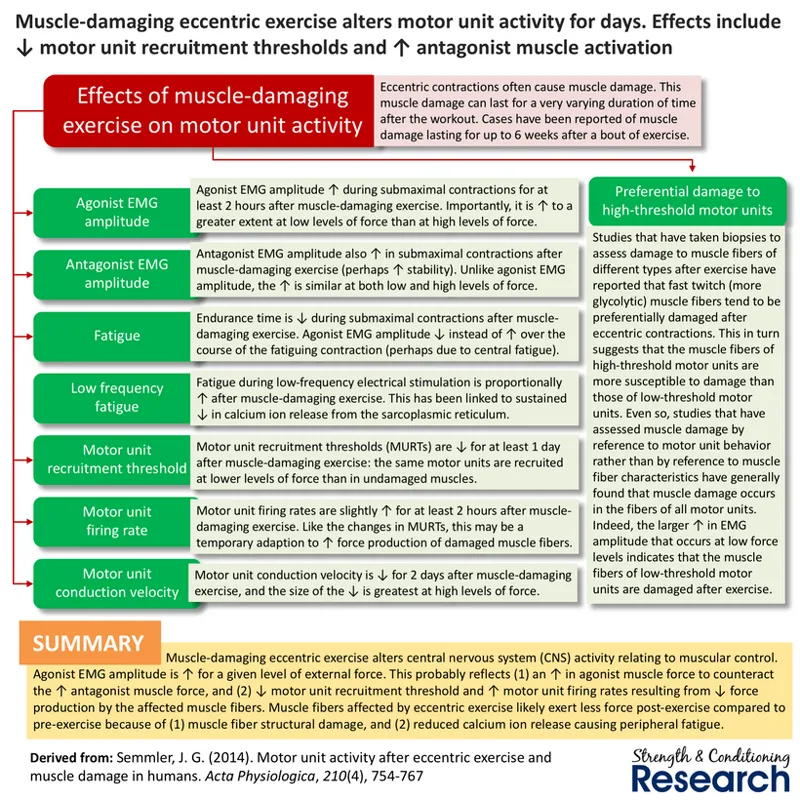
When any kind of exercise is performed while fatigue is present from a previous muscle-damaging workout, that exercise will involve a higher level of motor unit recruitment for the same standard of exercise performance. In practice, this means that the perception of effort will be higher (owing to the higher level of central motor command) and the resulting fatigue from that workout will similarly be greater (owing to more fast twitch muscle fiber activation).
.
Indeed, research has shown that when submaximal aerobic exercise bouts are performed after a bout of muscle-damaging exercise, this results in an increase in perceived effort for that fixed level of performance. Conversely, in maximal effort aerobic exercise, the perceived effort level did not alter but performance was reduced. Interestingly, blood lactate is also lower when performing these workouts after the muscle-damaging exercise bout, which suggests that fast twitch muscle fiber activation was lower and this implicates central nervous system (CNS) fatigue.
.
Conclusions
Fatigue is a temporary and reversible reduction in exercise performance due to a previous bout of exercise. It is caused by fatigue mechanisms in the muscles or inside the central nervous system (CNS). Post-workout fatigue is a sustained reduction in exercise performance resulting from any fatigue mechanisms that persist for hours after a bout of exercise. While post-workout fatigue has been well-studied after strength training, it is not well-understood after aerobic exercise. Yet, aerobic exercise does cause calcium ion-related fatigue mechanisms and it does cause fatigue that lasts for >24 hours post-workout, even in endurance athletes. Since calcium ion-related fatigue mechanisms tend to occur in tandem with one another, it is likely that exactly the same main post-workout fatigue mechanisms occur after aerobic exercise as occur after strength training, being [1] excitation-contraction coupling failure, [2] muscle damage, [3] supraspinal CNS fatigue due to the inflammatory response to muscle damage. If we do a strength training workout while this post-workout fatigue is still present, it will stimulate reduced adaptations owing to the lower levels of muscle fiber tension and motor unit recruitment. If we perform aerobic exercise workouts while this post-workout fatigue is still present, they will require higher perceived effort for the same level of performance and lower blood lactate, indicating reduced fast twitch muscle fiber activation due to supraspinal CNS fatigue.
Comments (3)
You could put it on tuesday and Thursday at late afternoon (and strength workouts at the morning if possible). Although, I would leave thursday for rest day and maybe do the endurance training at saturday.
So how can we plan a training week with both hypertrophy and endurance training and meanwhile manage fatigue? Full body mon-wed-fri seems fine. But where to put the endurance ref 24 hour post workout window to not be touched??
Fatigue varies depending on the training variables. So you can reduce the amount of post-workout fatigue caused by [1] strength training workouts, and also [2] aerobic exercise workouts. Also, aerobic exercise is less negatively affected by post-workout fatigue mechanisms simply because high levels of motor unit recruitment and high levels of mechanical tension are not needed to stimulate endurance adaptations.