





Autonomic nervous system recovery
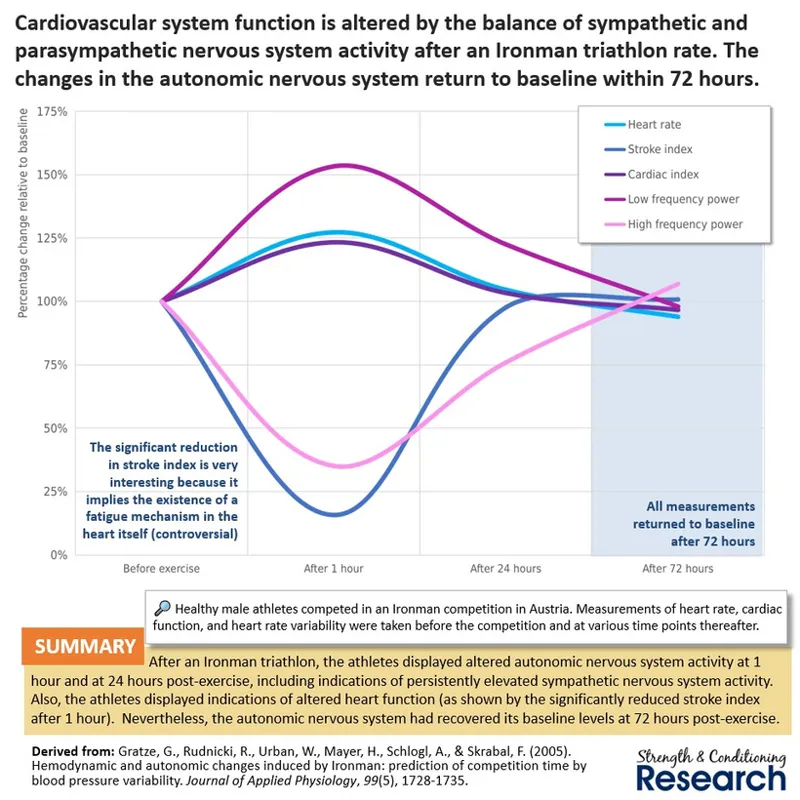
After exercise, cardiovascular function is altered for a short period of time. There is a decrease of parasympathetic nervous system activity (PNS) as well as an increase in sympathetic nervous system (SNS) activity relative to the resting state.
.
#1. Cardiovascular function is altered after exercise
After exercise, cardiovascular function is altered for a short period of time. There is a decrease of parasympathetic nervous system activity (PNS) as well as an increase in sympathetic nervous system (SNS) activity relative to the resting state. The disruption is most apparent in the hours post-exercise and recovers somewhere in the following couple of days.
.
Nevertheless, even very long durations of relatively intense exercise, such as competitive extremely long-distance triathlons, involve full recovery of the autonomic nervous system within 72 hours of finishing the bout of exercise. This is in stark contrast to the neuromuscular system, which can display alterations for several weeks after extremely damaging workouts.
.
#2. Higher intensity exercise causes greater alterations in cardiovascular function
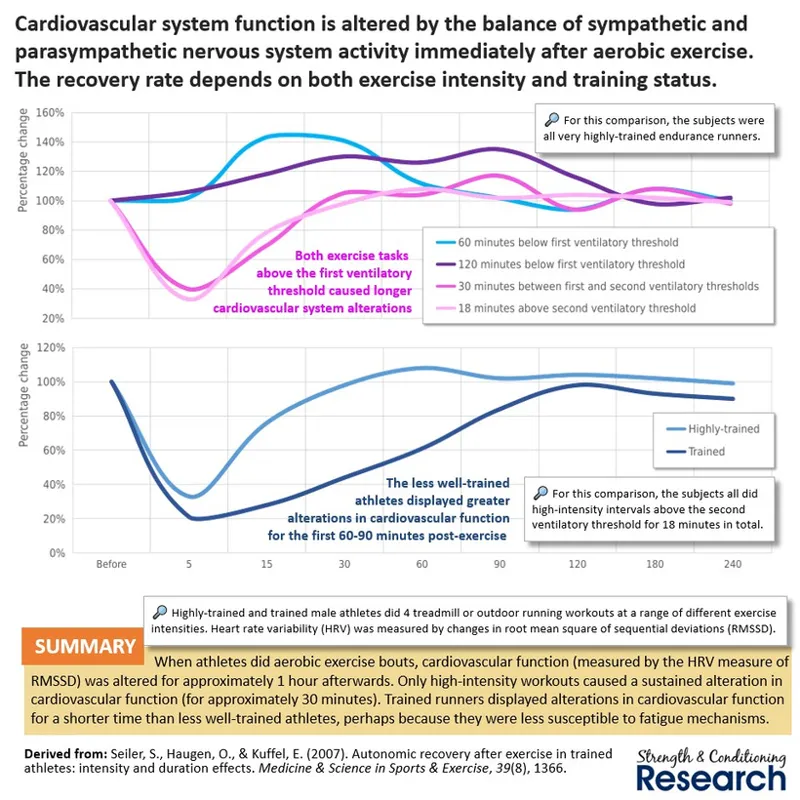
When aerobic exercise is performed at a higher intensity, this causes a greater post-exercise change in cardiovascular function. When the contributions of sympathetic and parasympathetic nervous system activities are assessed separately, it seems likely that higher intensities of exercise cause both a greater withdrawal of parasympathetic nervous system activity and also a greater increase in sympathetic nervous system activity.
.
#3. Highly-trained endurance athletes display much shorter-duration changes in cardiovascular function
When highly-trained endurance athletes perform high-intensity exercise, they display shorter durations of altered cardiovascular function in comparison with more moderately well-trained athletes. When they perform low-intensity exercise, there are almost no changes whatsoever.
.
#4. How does cardiovascular function change in the days after exercise?
Since cardiovascular function tends to display its largest changes in the minutes and hours immediately post-workout, most studies have only tracked changes in sympathetic and parasympathetic nervous system activity for a short period of time after completing a bout of exercise. Yet, some studies have observed delays in autonomic nervous system recovery for up to and including 48 hours post-workout, especially in the standing or seated positions, which are probably more sensitive to heart rate variability measurements (since it does not run the risk of parasympathetic nervous system saturation like the lying supine position).
.
Strength training workouts similarly cause autonomic nervous system disturbances that last for approximately 48 hours, depending on the heart rate variability measurement used to track them. Note that this study also took measurements in the seated position rather than while supine.
.
#5. Does cardiovascular function recovery occur in line with strength recovery?
Fatigue is defined as a temporary reduction in exercise performance (for example, bar speed or maximum strength). If exercise performance is not reduced, then there is no fatigue. Consequently, we can have a situation when the autonomic nervous system is still recovering but fatigue has dissipated (as in the previous infographic) or we can have a situation when the autonomic nervous system has already recovered but there is still fatigue (as is the case in the following infographic).
.
It is more common for the autonomic system to recover before the neuromuscular system even when the exercise performed was primarily a challenge for the cardiovascular system.
.
Conclusions
After exercise, cardiovascular function is altered for a short period of time. There is a decrease of parasympathetic nervous system activity as well as an increase in sympathetic nervous system activity relative to the resting state. Cardiovascular function recovery occurs in two distinctive phases. The initial phase lasts for a couple of hours and involves very rapid changes back towards resting levels. Recovery of this phase is slower when the intensity of the exercise is higher and when exercise participants are less well-trained. The later phase lasts for up to a couple of days, although changes in cardiovascular function may only be identifiable when heart rate variability measurements are taken in standing or seated positions rather than when lying supine. In this phase, the intensity and type of the exercise play a smaller role, with high-intensity interval exercise, constant aerobic exercise, and strength training exercise all producing similar alterations in the autonomic nervous system balance for approximately 48 hours post-workout (albeit data are limited). Importantly, changes in autonomic nervous system activity are not mirrored by strength recovery after exercise, which follows a different time course. It is likely that neuromuscular fatigue is caused by calcium ion-related fatigue, muscle damage, and also supraspinal central nervous system fatigue that results from the inflammatory response produced by muscle damage. In contrast, the temporary alterations in cardiovascular function seem to be the result of a completely different set of physiological changes that largely affect the heart and the vasculature.
Comments (3)
Thank you Chris! This is a well written and super interesting post. #5 especially where you compared perceived soreness, HRV and CMJ peak power recovery.
Want to phrase this in a way that isn’t just “gimme a split”… but in an example of a person who has trained for hypertrophy (intermediate to advanced levels, mid 40’s) who now wants to use running (I know it’s not ideal) as their primary cardiovascular exercise because of the mental health aspect…. What would strength training considerations be? Runs are three times a week… I was thinking similar basic programming with possible reduction in frequency to allow for more recovery? Eg move from a 4 day u/l to a rotating 3 day. Also ensuring no sets to failure. Anything that would be missing from this to ensure a continued (albeit slower) progression?
Yes, basically alter training frequency to increase time for recovery. When we add in another form of muscle-damaging exercise, it's similar to training more frequently from a fatigue point of view.