






Post-workout fatigue interference effects
Many researchers and fitness industry commentators are heavily invested in the idea that fatigue mechanisms (like metabolite accumulation and muscle damage) can actually stimulate hypertrophy. Nevertheless, it is clear that many fatigue mechanisms instead interfere with the hypertrophy stimulus, either by stopping motor units from being recruited or by stopping the muscle fibers themselves from producing mechanical tension. This is very clear when we look at the post-workout recovery period.
.
#1. What are the mechanisms of post-workout fatigue?
Fatigue mechanisms are the physiological changes that cause fatigue, which is a temporary and reversible reduction in exercise performance. Just as there are a variety of adaptations that cause strength gains (but a gain in strength gains is not an adaptation), there are several fatigue mechanisms that cause fatigue. When we look at the post-workout period, we can see five fatigue mechanisms: [1] muscle damage, [2] excitation-contraction coupling failure, [3] losses in cell membrane conductibility, [4] supraspinal central nervous system (CNS) fatigue, and [5] changes to coordination leading to a reduction in the efficiency of the movement.
.
#2. How does muscle damage affect adaptations?
Muscle fibers are stimulated to grow when they experience a sufficiently high level of muscle fiber mechanical tension. The main way in which muscle fibers produce mechanical tension is by the formation of actin-myosin crossbridges. Consequently, when the muscle damage process causes the loss of myofibrils (which involves the loss of actin and myosin), we lose some ability to generate mechanical tension and this has a negative impact on our ability to stimulate hypertrophy in that fiber.
.
#3. How does excitation-contraction coupling failure affect adaptations?
Muscle fibers are stimulated to grow when they experience a sufficiently high level of muscle fiber mechanical tension. The main way in which muscle fibers produce mechanical tension is by the formation of actin-myosin crossbridges. Thus, when the excitation-contraction coupling failure process switches off the ability of muscle fibers to convert electrical signals into the chemical signals that create actin-myosin crossbridges, we stop the hypertrophy stimulus.
.
Indeed, this is why very light loads do not produce much (if any) hypertrophy. The level of whole muscle force is too low to prevent blood from escaping the muscle during concentric contractions and therefore metabolite-related fatigue cannot occur. This means that the main local fatigue mechanisms must be calcium ion-related fatigue.
.
#3. How does cell membrane damage affect adaptations?
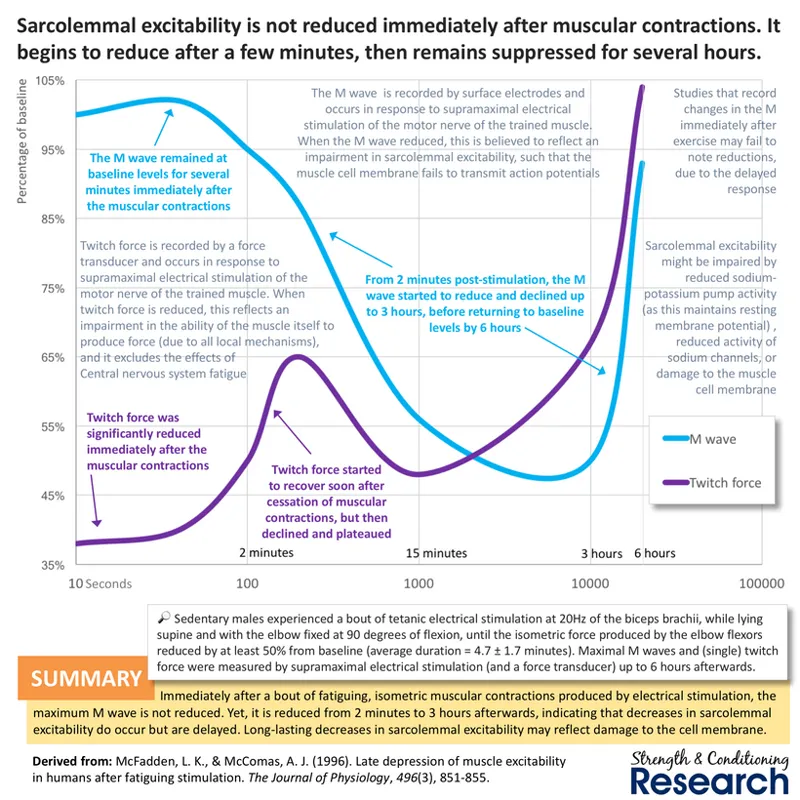
Muscle fibers are stimulated to grow when they experience a sufficiently high level of muscle fiber mechanical tension. The main way in which muscle fibers produce mechanical tension is by the formation of actin-myosin crossbridges. Thus, when cell membrane of a muscle fiber is damaged and this stops action potentials from reaching the triadic junction to produce the excitation-contraction coupling process, this stops muscle fibers from receiving the electrical signals that it typically converts into chemical signals that create actin-myosin crossbridges. Evidently, just like excitation-contraction coupling failure, this stops the hypertrophy stimulus.
.
#4. How does supraspinal CNS fatigue affect adaptations?
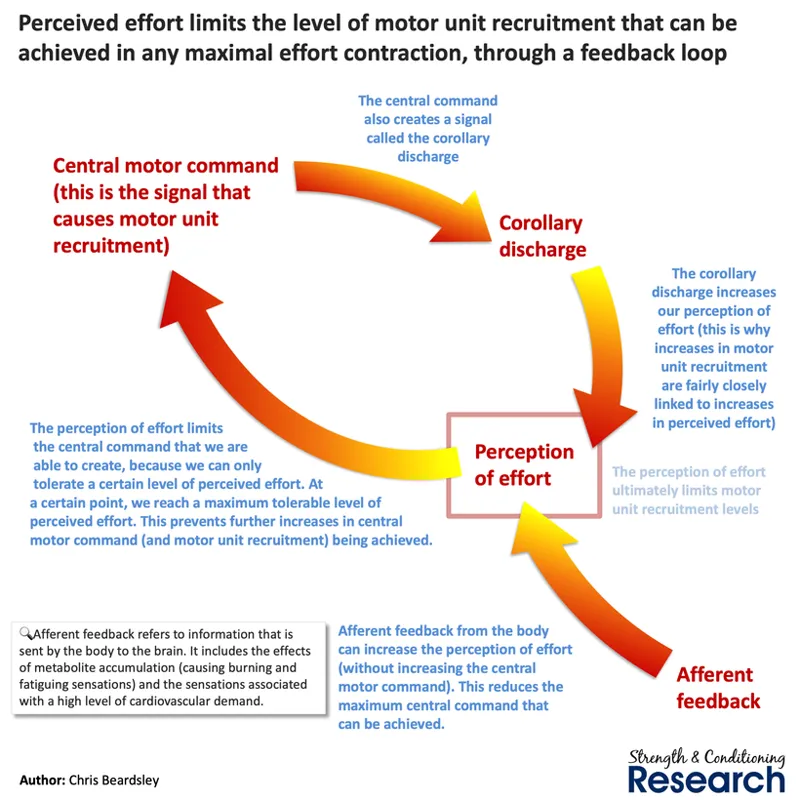
To stimulate an increase in the level of central motor command (and therefore in the level of motor unit recruitment) that can be achieved for a given muscle group, we need to be able to send a very high level of central motor command to that muscle. This means that the presence of any supraspinal CNS fatigue will inhibit this adaptation from occurring. It is well-known that any negative feeling during exercise can cause a reduction in our ability to generate a central motor command. Such negative feelings can occur due to metabolites causing burning sensations, a lack of muscle glycogen or blood glucose, pain and of course the post-workout inflammatory response that is responsible for muscle damage repair.
.
Indeed, this is why light loads (or low isometric forces) cannot achieve the same level of motor unit recruitment as heavy loads (or high isometric forces). The afferent feedback from the metabolites causes burning feelings inside the muscles. These feelings then are added to our perceived effort level and stop us achieving the same level of central motor command.
.
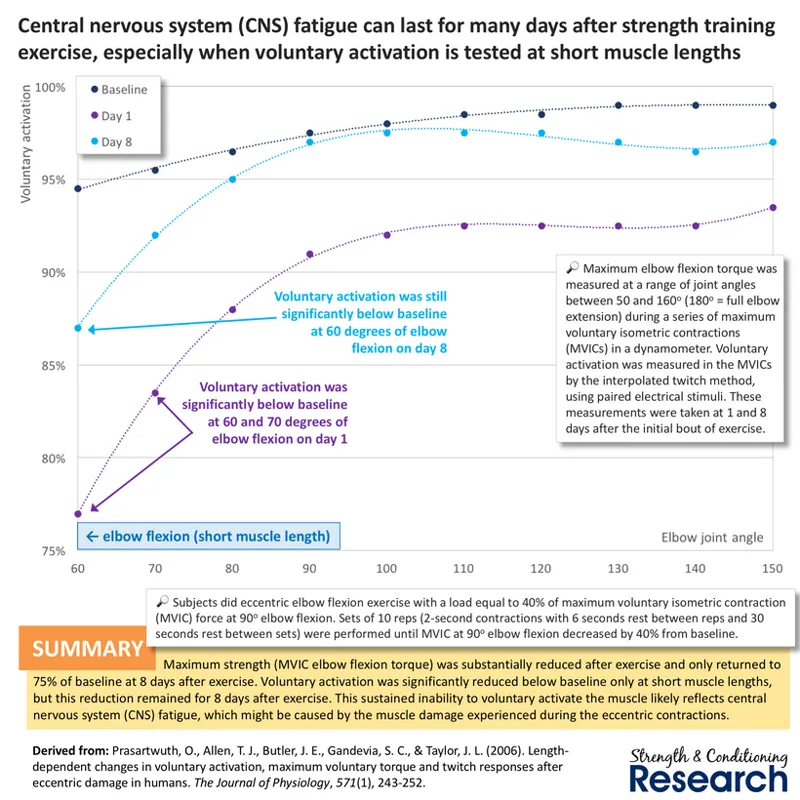
Supraspinal CNS fatigue is caused by the inflammatory response to muscle damage.
.
Indeed, this is why supraspinal CNS fatigue is greater after eccentric training workouts. It is also why the supraspinal CNS fatigue itself tends to last almost as long as the muscle damage.
.
#5. How does coordination-related fatigue affect adaptations?
To improve coordination in an exercise or a movement, we need to be able to perform that exercise or movement with the best possible degree of coordination. This means that the presence of any fatigue mechanism inside the muscles will prevent this adaptation from happening. Indeed, we know that the presence of fatigue negatively affects motor patterns.
.
Motor learning research has shown that when exercises or movements are practised with poor coordination due to the presence of fatigue, this fails to enhance coordination in those exercises or movements. This is very important, because many sports coaches believe that it is possible to improve the ability to improve the ability to maintain good movement patterns while in a fatigued state by practising in a fatigued state. This does not seem to be the case.
.
Conclusions
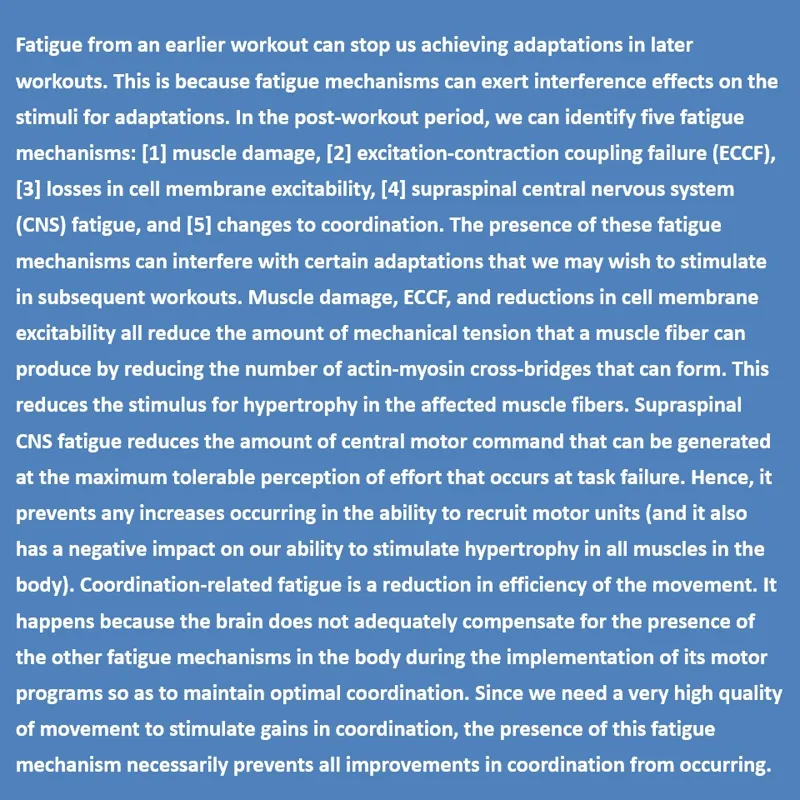
Fatigue from an earlier workout can stop us achieving adaptations in later workouts. This is because fatigue mechanisms can exert interference effects on the stimuli for adaptations. In the post-workout period, we can identify five fatigue mechanisms: [1] muscle damage, [2] excitation-contraction coupling failure (ECCF), [3] losses in cell membrane excitability, [4] supraspinal central nervous system (CNS) fatigue, and [5] changes to coordination. The presence of these fatigue mechanisms can interfere with certain adaptations that we may wish to stimulate in subsequent workouts. Muscle damage, ECCF, and reductions in cell membrane excitability all reduce the amount of mechanical tension that a muscle fiber can produce by reducing the number of actin-myosin cross-bridges that can form. This reduces the stimulus for hypertrophy in the affected muscle fibers. Supraspinal CNS fatigue reduces the amount of central motor command that can be generated at the maximum tolerable perception of effort that occurs at task failure. Hence, it prevents any increases occurring in the ability to recruit motor units (and it also has a negative impact on our ability to stimulate hypertrophy in all muscles in the body). Coordination-related fatigue is a reduction in efficiency of the movement. It happens because the brain does not adequately compensate for the presence of the other fatigue mechanisms in the body during the implementation of its motor programs so as to maintain optimal coordination. Since we need a very high quality of movement to stimulate gains in coordination, the presence of this fatigue mechanism necessarily prevents all improvements in coordination from occurring.
Comments (2)
thanks for this. this is why I struggle to see how it'd be good for *most people* to train back to back days, even if using different muscle groups, UNLESS (1) everything else in their recovery is fully thought through and optimized and (2) a professional trainer is being EXTREMELY mindful of limiting fatigue from the previous day's workout.
Great round-up Chris thanks for posting. How do you see this application of theory in the world of endurance cycling where training hours on the same day as strength training can be 2-3 hour of work, not all maximal or hard but a spread of low to mid zone and sometimes some sprint work included? Current research suggests the biggest factor would be time between the two sessions being key, eg as much time as possible and either one could go first in order on that day. However with the way the timing tends to work is they ride first and strength train later in the late afternoon or early evening.