




Satellite cell responses
Satellite cell responses to exercise are sometimes referenced as proxy markers for the amount of hypertrophy that is stimulated by a strength training workout. Even so, there are good reasons to argue that the satellite cell response to exercise is totally unrelated to muscle growth, as I explain in this article.
.
#1. Satellite cell responses to exercise are stimulated by calcium ions
First of all, it is important to note that the stimulus that activates satellite cells is the release of calcium ions inside the cytoplasm of the muscle fiber. This is most likely because the primary role of satellite cells is to facilitate muscle damage repair processes. Hence, whenever the calcium ion influx into the cytoplasm is suppressed, this prevents the activation of the satellite cells.
.
This is important, because muscle fibers can be strongly activated (leading to a very high degree of calcium ion influx into the cytoplasm) without any meaningful hypertrophy occurring. Therefore, we might expect that satellite cell activation can also occur without this then leading to much muscle growth happening.
.
#2. Satellite cell responses occur similarly after exercise that causes hypertrophy and after exercise that does not cause hypertrophy
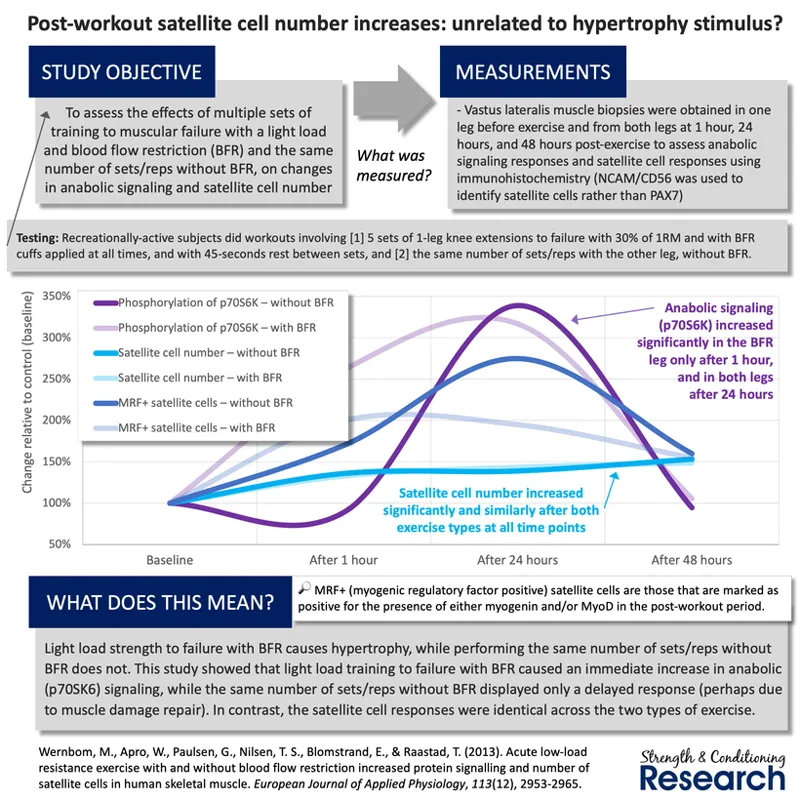
After a bout of strength training exercise that involves multiple sets to failure, we might reasonably assume that there is a signaling cascade that is responsible for stimulating muscle growth. In contrast, after a bout of exercise that involves lifting a light load and stopping a long way from muscular failure, we might reasonably assume that there is no such cascade, and that hypertrophy is not stimulated. Interestingly, the satellite cell responses after both of these types of exercise is basically identical, suggesting that the satellite cells play no role in limiting muscle growth after individual workouts.
.
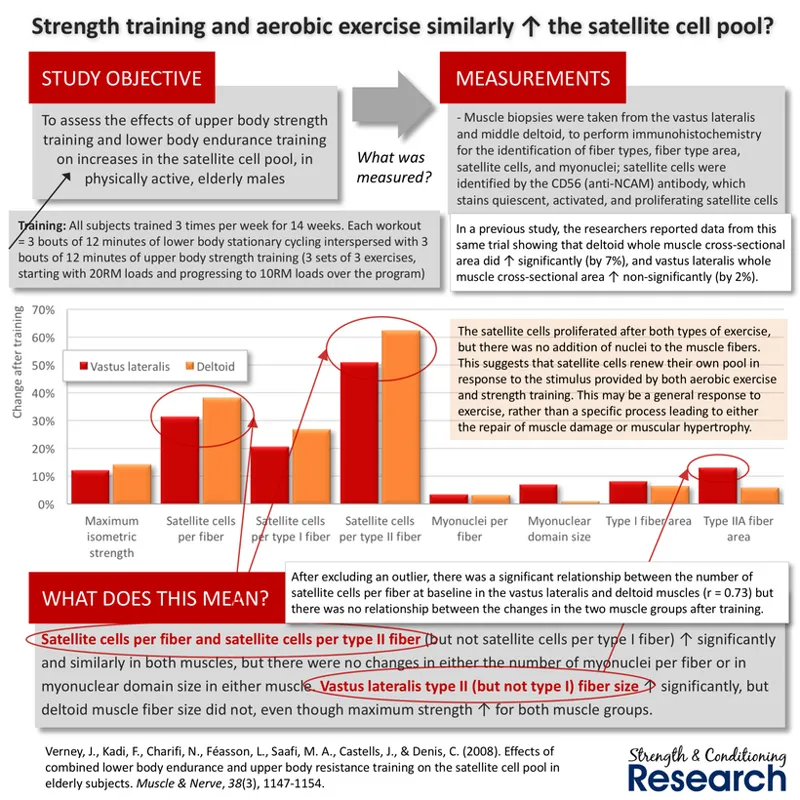
Indeed, satellite cell responses after strength training programs and after aerobic exercise programs are very similar, despite the fact that only the strength training programs produce hypertrophy.
.
It seems most likely that the role of satellite cells after both strength training workouts and aerobic exercise workouts is to repair muscle damage, as indicated by the activation of the most satellite cells around those (hybrid) muscle fibers that display the most signs of muscle damage (centrally-located nuclei). This makes sense if the initial signal for satellite cell activation is the influx of calcium ions into the muscle fiber cytoplasm, because it is calcium ion accumulation inside the muscle fiber that then produces the majority of the muscle damage.
.
#3. Satellite cells are NOT required for myofibrillar addition
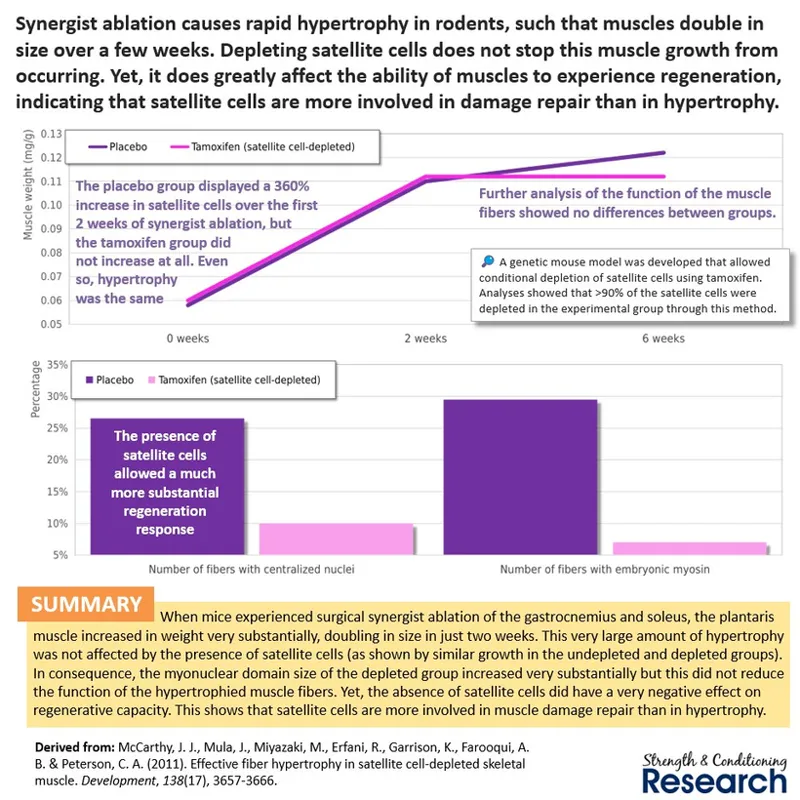
Importantly, animal models have shown that satellite cells themselves are not actually required for myofibrillar addition to occur, but they are required for muscle regeneration after damage.
.
They might also be required for sarcomerogenesis, although not all studies have reported this finding.
.
Conclusions
Satellite cell responses to exercise are sometimes argued to indicate the potential for the type of exercise in question to stimulate hypertrophy. Indeed, this assumption is a key argument put forward by researchers who argue that more muscle-damaging types of exercise (like eccentric contractions) are more stimulating for hypertrophy than less muscle-damaging types of exercise (like concentric contractions) because more muscle-damaging exercise typically produces greater satellite cell responses than less muscle-damaging exercise. Yet, the satellite cell responses to a workout do not indicate the hypertrophic potential of that workout for three key reasons. Firstly, satellite cells are activated by the influx of calcium ions into the muscle fiber (we known this because suppressing calcium ion influx prevents satellite cell responses) and we can achieve high levels of calcium ions inside muscle fibers without stimulating hypertrophy. Secondly, satellite cell responses to exercise can be similar irrespective of hypertrophy stimulus that is produced. Workouts involving training with light loads to failure (which causes hypertrophy) and with light loads very far from failure (which does not cause hypertrophy) nevertheless cause similar satellite cell responses. Moreover, both aerobic exercise workouts and strength training workouts cause similar satellite cell responses despite one being famous for producing hypertrophy and the other being much less effective. Thirdly, satellite cells are not actually necessary for myofibrillar addition to happen, whereas they seem to be much more important for muscle damage repair and regeneration (and perhaps also sarcomerogenesis).
Comments (5)
How does the fact that satellite cells apparently do not aid in hypertrophy rather than in muscle regeneration relate to the statement/ fact/ opinion that taking steroids increases the number of satellite cells and thus increases your maximum potential to build muscle, even after stopping to take steroids? I'd really appreciate your answer. Thanks!
Hey, Chris! I remember I asked once: do advance lifters need more volume, and you said that in fact, they will not need more volume most of the time, is it possible to know why is that the case? For example, a lot of personal trainers say: beginners need low volume, then they need more and advanced once need the most volume. Is that true? I also was wondering about other thing you said: we can get accustomed to more volume but it doesn’t mean it will speed up hypertrophy. For example, if I am doing 3 sets for chest, later I increase it to 6 sets, it doesn’t mean I will grow twice as fast even if I can recover from that. Why is that the case? Thank you!
The problem that advanced lifters face is that they can probably only grow the muscle fibers of the highest threshold motor units, which are the first motor units to be affected by CNS fatigue and the first muscle fibers to be affected by calcium ion-related fatigue. So once an advanced lifter has done a few sets for a muscle group, the rest of the sets are basically junk volume.
Thank you very much Chris - I'm curious about how you reconcile the calcium ion accumulation relationship with CNS fatigue (reducing motor unit recruitment) and peripheral fatigue (causing excitation contraction coupling failure) and the research showing that light load training to failure is as effective as heavier loading. It would seem that the calcium ion accumulation would reduce high threshold motor unit activation despite the CNS detecting a need to recruit fresh non fatigued fibers. I believe you also pointed out that eventually advanced trainers need to access the highest high threshold motor units. Also due to the fact that the high threshold motor units contain an exponentially greater number of fibers it would seem hypertrophy would be reduced with light load training to failure. Could it be that the length of the studies are not long enough? Thanks for your insight.
Yes, the long-term training studies comparing light and heavy loads don't currently reflect what we would expect based on the physiology. I think it is partly [1] the duration of the studies, [2] the fact that they don't involve advanced lifters, and [3] the fact that volumes are usually 3 sets to failure. Different results might occur in longer durations, with higher volumes, and with more advanced lifters.