




Eccentric tempo (bodybuilding)
Slow lowering (eccentric) tempos are often used in bodybuilding to increase the amount of hypertrophy stimulated per set. But how do they work?
.
#1. Does a slower eccentric tempo cause more hypertrophy?
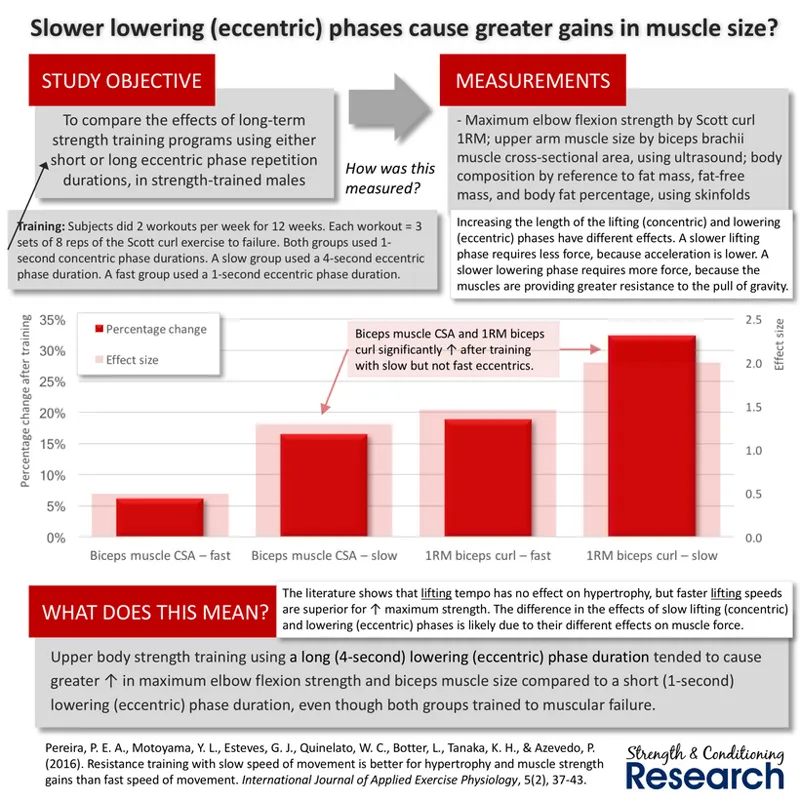
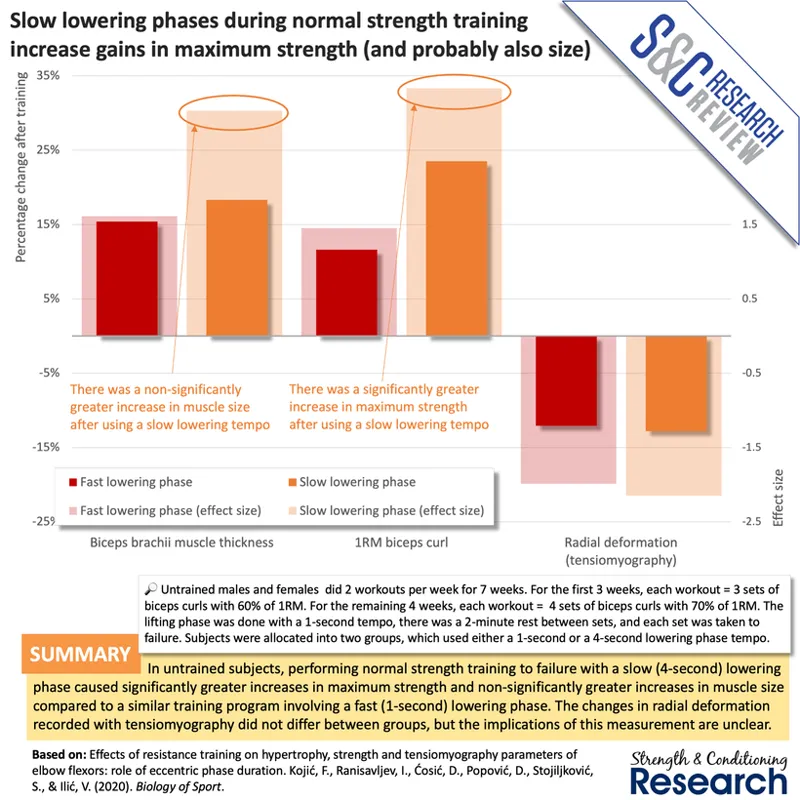
Some studies have reported that using a slower eccentric tempo during normal strength training can increase gains in muscle size.
.
Yet, not all studies have reported significant effects, which suggests that either [1] the effect varies between lifters, or that [2] the effect is relatively small and may not make that big of a difference.
.
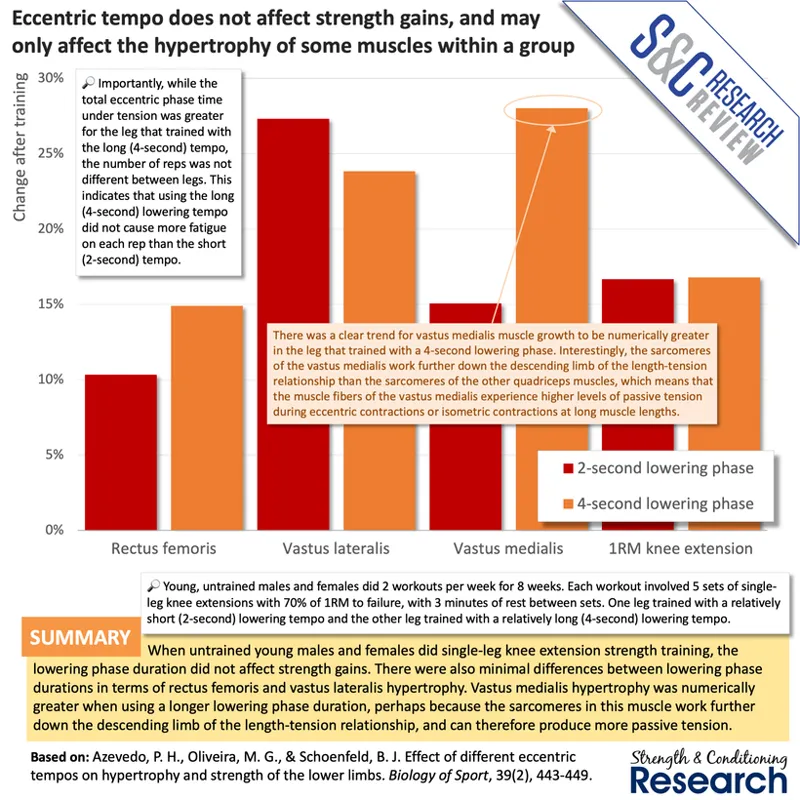
Even so, the effect has been observed to a greater degree in some muscles than in others, which may be because some muscles are more susceptible to stretch-mediated hypertrophy than others.
.
Indeed, in the above study, the vastus medialis displayed a greater response to the slow lowering (eccentric) phase than the vastus lateralis, and the vastus medialis is known to have a much longer descending limb than the vastus lateralis, so is more susceptible to stretch-mediated hypertrophy.
.
#2. How does a slower eccentric tempo cause more hypertrophy?
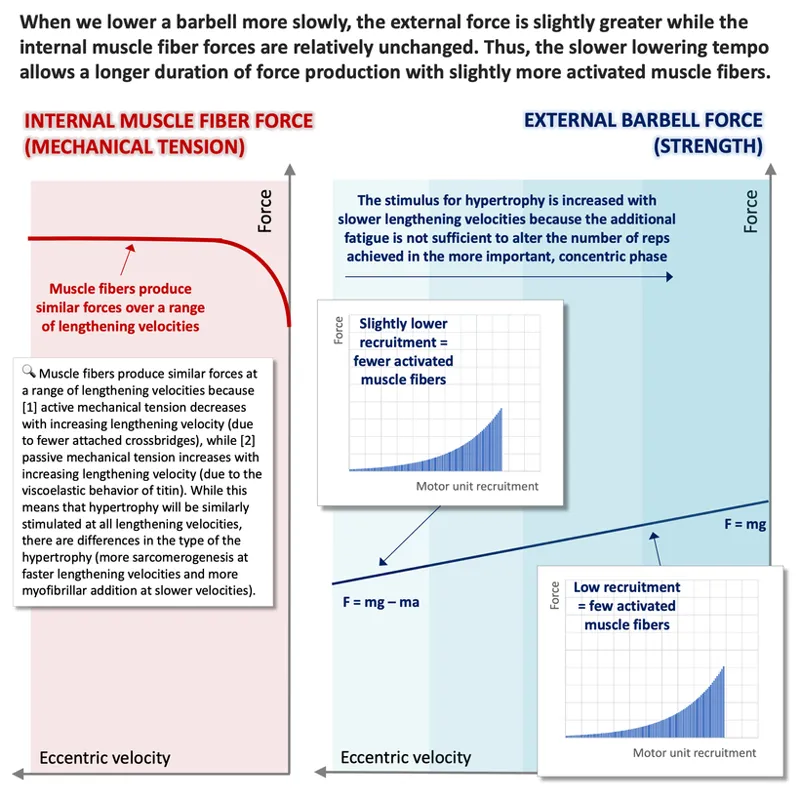
The greater dosage of passive mechanical tension during the slow lowering (eccentric) phase is likely made possible by three factors: [1] the fairly flat eccentric force-velocity relationship of single muscle fibers, [2] the slightly greater external forces required to lower a weight more slowly, and [3] the reduced fatigue that occurs in the lowering phase of a normal strength training exercise compared to the lifting phase. The flat eccentric force-velocity relationship of single muscle fibers means that activated muscle fibers produce similar forces at all lowering tempos, and the slightly greater external forces required to lower a weight more slowly means that more muscle fibers are activated.
.
Additionally, fatigue is minimal during lowering (eccentric) phases in conventional strength training. Hence, the extra time spent lowering the weight does not really interfere with the ability of the lifting (concentric) phase to stimulate muscle growth, so long as the duration is sensible.
.
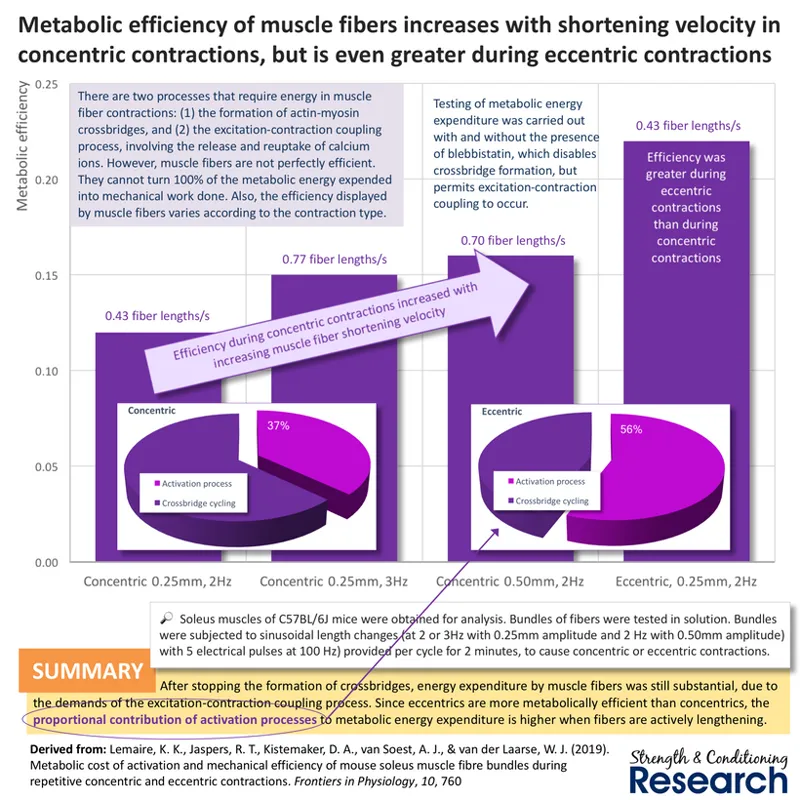
The relatively low level of fatigue during the lowering (eccentric) phase of normal strength training exercises occurs for two reasons. Firstly, it occurs because eccentric contractions are very efficient and hence use little ATP. Since they use less ATP, they produce far less metabolite accumulation. Thus, the extra amount of metabolite-related fatigue is small during slow lowering (eccentric) phases.
.
Secondly, it occurs because the lowering (eccentric) phase of normal strength training reps involves a low level of muscle activation. Since it involves a low level of muscle activation, the fast twitch fibers are not activated and therefore any calcium ion-related fatigue cannot easily occur. The accumulation of calcium ions inside the slow twitch fibers is prevented by the larger number of mitochondria inside the more oxidative, slow twitch fibers. Therefore, the amount of calcium ion-related fatigue is also relatively small in slow lowering (eccentric) durations.
.
#3. Can the slow eccentric phase duration be excessively long?
When the lowering (eccentric) phase duration is lengthened to 6 seconds, the number of reps that can be performed to failure in the lifting (concentric) phase is reduced. This indicates that there is fatigue occurring in the lowering (eccentric) phase that negatively affects the concentric phase stimulus. This is not something that we want to do because it is only in the concentric phase that we are able to train the muscle fibers of the high-threshold motor units.
.
Conclusions
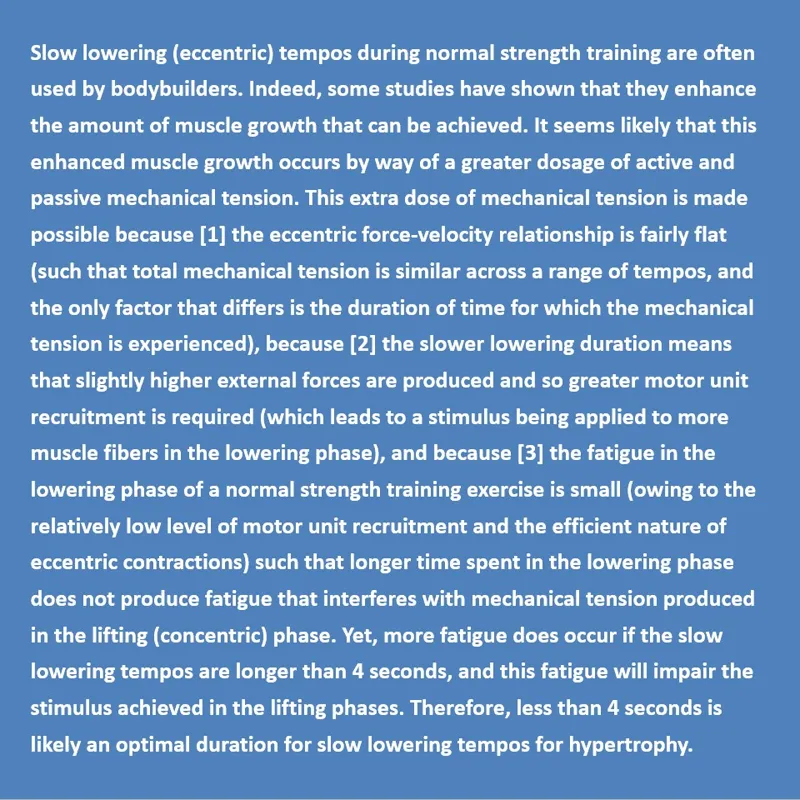
Slow lowering (eccentric) tempos during normal strength training are often used by bodybuilders. Indeed, some studies have shown that they enhance the amount of muscle growth that can be achieved. It seems likely that this enhanced muscle growth occurs by way of a greater dosage of active and passive mechanical tension. This extra dose of mechanical tension is made possible because [1] the eccentric force-velocity relationship is fairly flat (such that total mechanical tension is similar across a range of tempos, and the only factor that differs is the duration of time for which the mechanical tension is experienced), because [2] the slower lowering duration means that slightly higher external forces are produced and so greater motor unit recruitment is required (which leads to a stimulus being applied to more muscle fibers in the lowering phase), and because [3] the fatigue in the lowering phase of a normal strength training exercise is small (owing to the relatively low level of motor unit recruitment and the efficient nature of eccentric contractions) such that longer time spent in the lowering phase does not produce fatigue that interferes with mechanical tension produced in the lifting (concentric) phase. Yet, more fatigue does occur if the slow lowering tempos are longer than 4 seconds, and this fatigue will impair the stimulus achieved in the lifting phases. Therefore, less than 4 seconds is likely an optimal duration for slow lowering tempos for hypertrophy.
Comments (13)
Hey Chris! I have a question regarding eccentrics and the force-velocity curve. If we slow down the eccentric (during both normal and overloading) would that allow for more cross bridges to form and therefore more force to be produced since eccentrics have a flat line on the curve they can produce high forces not just at high velocities but also when we decrease the velocity correct? Additionally, if we were to really slow the eccentric >10 sec wouldn’t that be too much reduction in velocity and therefore eccentrics won’t produce a lot of force there regardless of higher cross bridge formations? Thank you!
Hey Chris - RE calcium ion related fatigue, in the calcium ion post you said eccentric contractions open stretch activated channels - is this not the case or only an issue if the muscle is then active straight after? I.e. followed by a concentric
Stretch opens stretch-activated ion channels, so any situation in which the muscle is stretched causes this effect. But the effect is greater when the muscle is simultaneously activated and stretched. Whether there is a concentric afterwards is not relevant, however.
Would you say this 4 second eccentric is practically possible across movements? From personal experience it's more easy on some than others for example, a bicep curl vs. a squat, where on the squat it's quite a lot of fight/effort to lower a heavy weight slowly, which I tend to think has a a toll on the concentric than if lowering with just enough control to not be dropping.
Exercises with a very steep ascending strength curve (like the squat) will be more difficult because we need to start decelerating at the end of the eccentric phase but the strength curve is causing the movement to get more difficult. In contrast, exercises with flat or descending strength curves will be much easier.
Hi Chris, has anyone looked at pauses in the bottom of the lift I.e. pausing a the bottom of the squat? Would it cause greater gains since you are getting a much bigger stretch for longer time or would it fatigue the muscle too much?
Pauses in the stretched position will increase the stretch-mediated hypertrophy stimulus for sarcomerogenesis (which will be relevant for beginners and some intermediates) but will also increase calcium ion-related fatigue. So generally, I don't tend to program them, but if someone is quite resistant to post-workout fatigue, they might make sense.
Is there a similar collection of infographics for the Concentric phase?
Yes, here: https://www.patreon.com/posts/tempo-52260568
Great post, Chris! Could you please clear this up for me; does the ECCF effect not have any meaningful drawbacks regarding force production if the tempo is 4 seconds or less? Thanks in advance!
It doesn't look like ECCF is able to form in the slow twitch muscle fibers that are activated during slow lowering phases if the duration of the phase is 4 seconds or less. That may differ a bit between individuals, but on average it looks that way.
Thank you - I noted lower motor unit recruitment with the slow lowering compared to lifting - does that mean the ultimate hypertrophy stimulus would be a device that increased the load by 25% on each lowering phase - so the imaginary machine 100 load lift is an automatic 125 load lowering? Thanks
Actually no, because of the extra calcium ion-related fatigue that the extra eccentric force produces. I have a follow-up post planned to explain exactly this point soon.