



Antagonist coactivation
Antagonist coactivation refers to the activation of the opposing (antagonist) muscle during a muscular contraction. While the agonist is the prime mover, the antagonist is also activated in order to maintain joint stability. Yet, when the level of antagonist coactivation is too high, this can reduce joint torque for a given level of agonist muscle force.
.
#1. Antagonist coactivation reduces after strength training
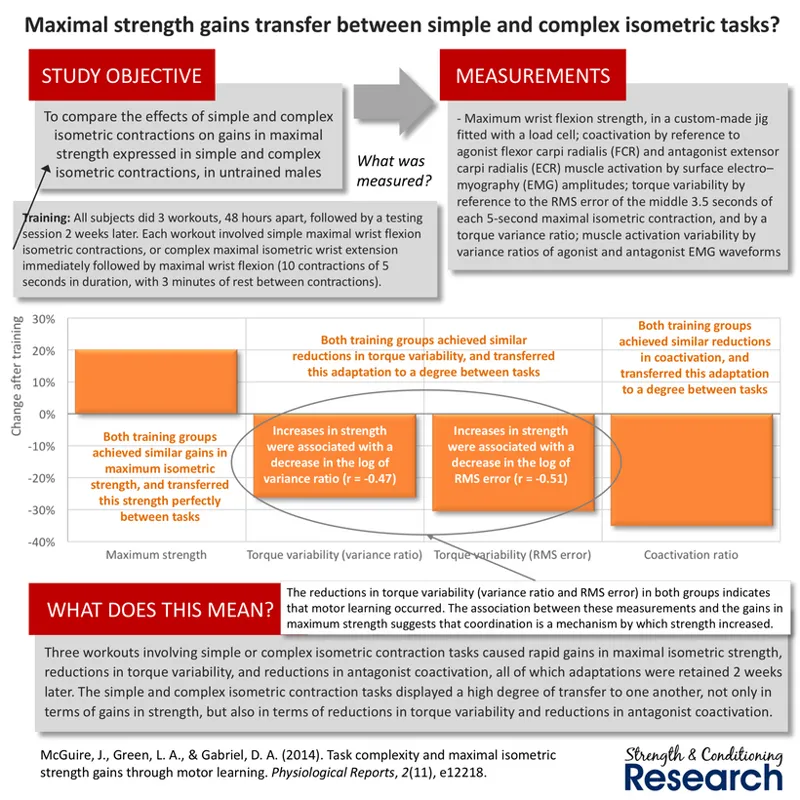
Some strength training studies have found that strength training programs can reduce the level of antagonist coactivation over a very short period of time. This reduction in antagonist coactivation contributes to increases in maximum strength.
.
Even so, an extremely long period of time is required for any meaningful reductions in antagonist coactivation to occur. This makes the reductions in antagonist coactivation a uniquely slow neural adaptation.
.
#2. Changes in antagonist coactivation are velocity-specific
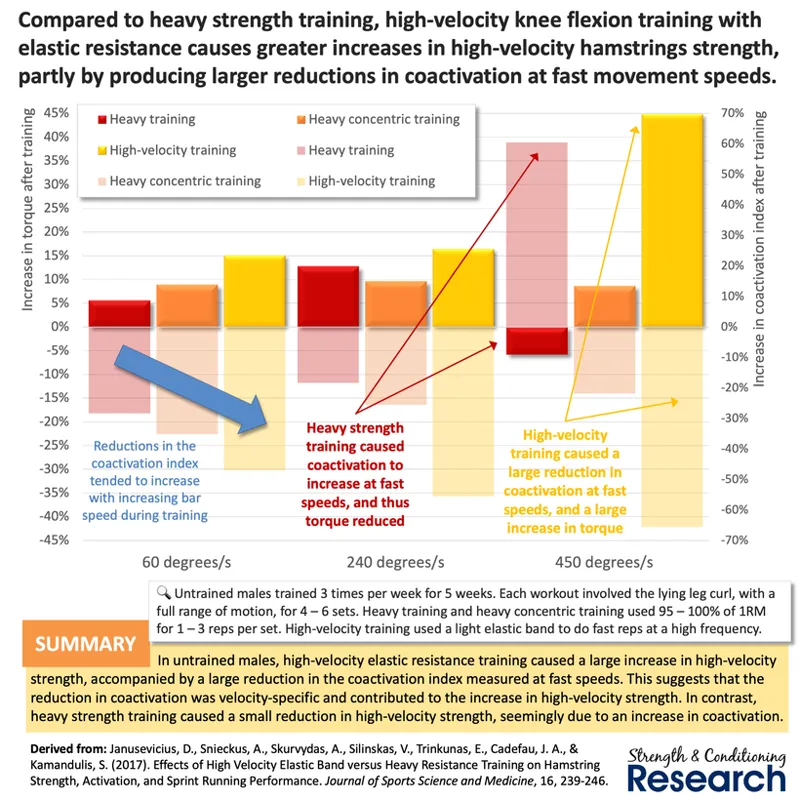
Long-term training studies have found that while heavy strength training programs may reduce antagonist coactivation during slow, high force movements, they increase antagonist coactivation in fast movements. Conversely, fast movement training programs reduce antagonist coactivation during both slow and fast movements (but more so in fast movements).
.
#3. Changes in antagonist coactivation are stability-specific
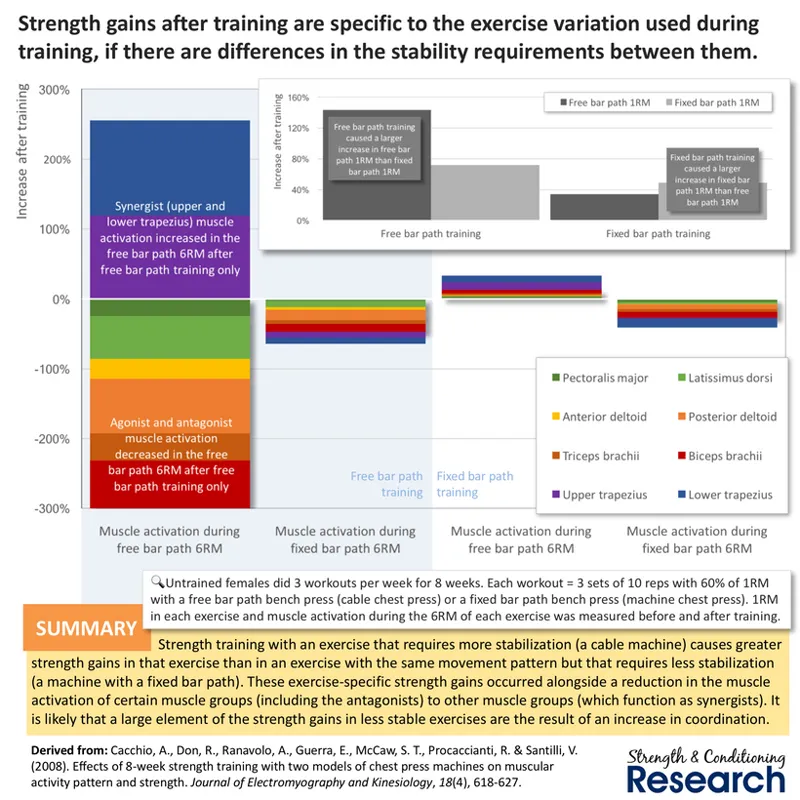
Antagonist coactivation tends to be much higher when performing unstable surface exercises compared to when performing exercises with greater inherent stability.
.
Yet, after strength training with a less stable exercise variation, the initially much higher level of antagonist coactivation reduces much more quickly and substantially. This change likely occurs as balance and coordination improve in the unstable exercise.
.
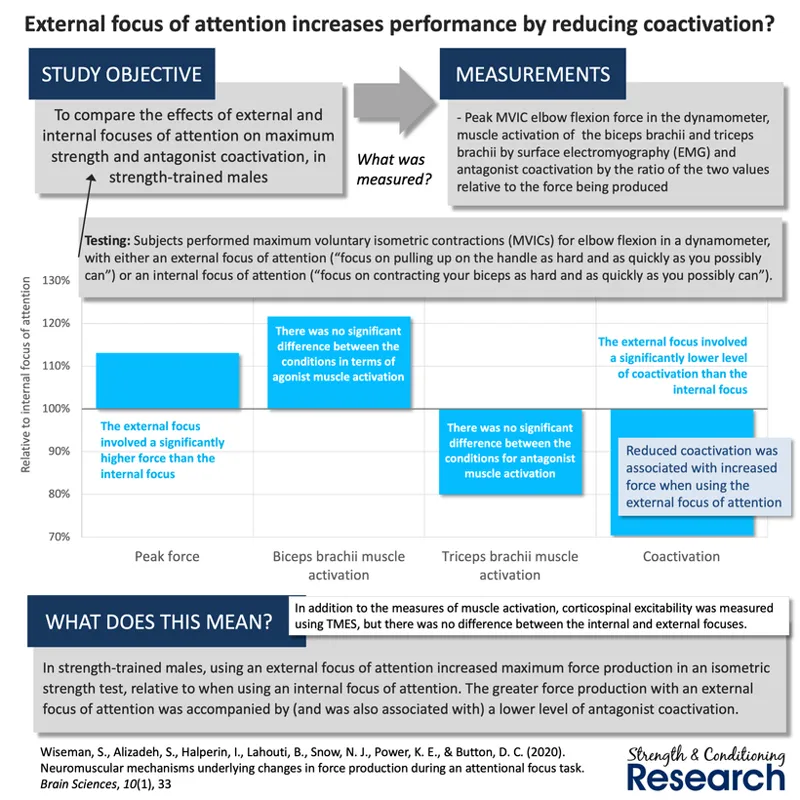
#4. External focus of attention immediately decreases antagonist coactivation
When performing an exercise with an external focus of attention, antagonist coactivation is immediately reduced. This likely contributes to the greater exercise performance that can be achieved when using this attentional focus cue.
.
#5. Fatigue immediately increases antagonist coactivation
When performing an exercise with fatigue, antagonist coactivation is increased. This likely contributes in part to the reduced exercise performance that occurs when fatigue is present.
.
Conclusions
Antagonist coactivation refers to the activation of the opposing (antagonist) muscle at a joint during a muscular contraction. Since a higher level of antagonist coactivation reduces the net joint torque, a reduction in antagonist coactivation is a temporary change or permanent adaptation that increases maximum strength. Strength training produces an adaptation that involves a reduction in antagonist coactivation (rapid changes have been observed but most of the reductions seem to take years to appear). Such adaptations in antagonist coactivation are both velocity-specific and stability-specific. Fast movement training reduces antagonist coactivation mainly in fast, low-force movements, while heavy strength training reduces antagonist coactivation mainly in slow, high-force movements. Similarly, unstable surface training reduces antagonist coactivation mainly during strength tests on unstable surfaces, while more stable training reduces antagonist coactivation mainly during relatively stable strength tests. If achieving a relatively low level of antagonist coactivation during an exercise is the stimulus for reducing antagonist coactivation post-workout, then an external focus of attention is likely to enhance this adaptation (as it transiently reduces antagonist coactivation) while fatigue is likely to prevent the adaptation (because it transiently increases antagonist coactivation).
Comments (5)
hey Chris, is decreased co-activation on an unstable surface be transferred to exercises performed on a stable surface in the long term? In this respect, would it be right to spend a part of strength training with unstable surface training?
Hey Chris, loved this article, in your opinion would it be beneficial to isolate and contract an antagonists of an fast exercise before performing? My thought process is having the antagonist do an isolated contraction will actually help reduce it's coactivation of the main movement. Because in my understanding if a muscle can't contract well it won't lengthen well or is that thinking off base?
Hey Chris, I am working as a s&c coach in climbing. I've been wondering for quit some time about what long-term adaptations might explain why elite athletes continue to perform better between the ages of 30 and 40 (some even older). What are your thoughts on the extent to which antagonistic coactivation plays a role? In this case, specifically, the co-activation of the wrist extensors while simultaneously flexing the fingers (small hand grips) while the rest of the body moves (i.e. the position of the ulna and radius in relation to the wrist changes). Do you think this plays an important role?
Thanks Chris - what constitutes a slow or fast muscle fiber shortening velocity? What I see in the gym usually appears fast - a 1 - 1 second tempo. Slow would seem to be a 3 second lift or lowering or greater. A 2 -2 tempo moderate. Does that make sense?
In this context, fast refers to athletic movements like throwing or jumping, or maybe power-type training such as jump squats and medicine ball throws.