


Trapezius
Unfortunately, there is little information available in the literature about strength training for the trapezius. Also, what information exists is often contradictory. Here are some key features of the trapezius muscle that can help us identify the best ways to train its various regions.
.
#1. Trapezius regions and functions
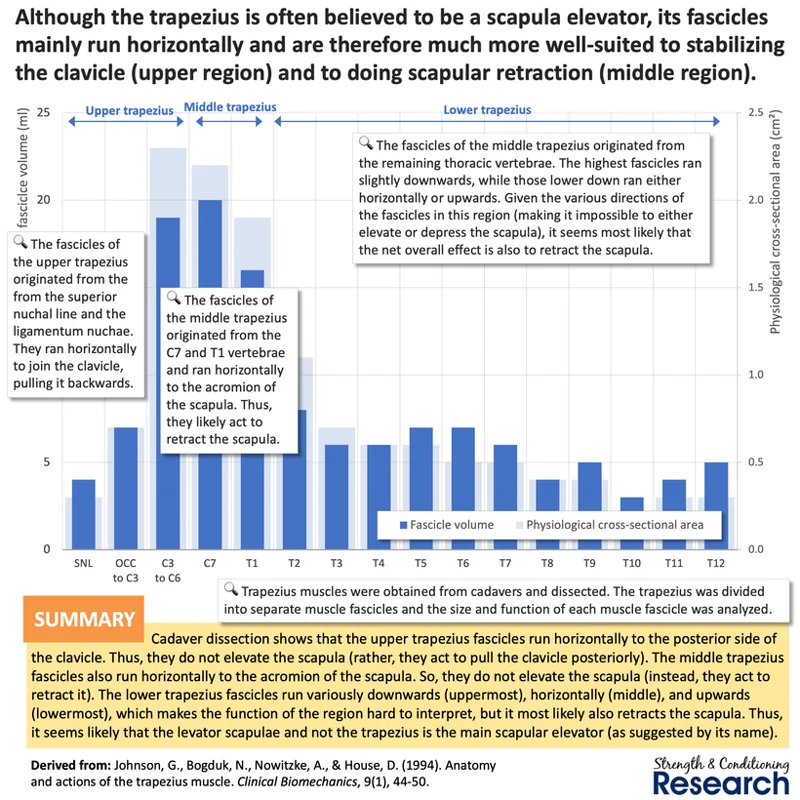
The trapezius has three main regions (upper, middle, and lower). The upper trapezius runs vertically down the neck and then diverts horizontally across to the clavicle. This region cannot elevate the scapula directly, because it is not attached to it (some speculation has been made about how it may influence the scapula indirectly). The middle trapezius runs horizontally from the C7 and T1 vertebrae across to the acromion of the scapula, pulling it posteriorly. By running horizontally, it cannot easily elevate the scapula, and likely works mainly as a scapula retractor. The lower trapezius has fascicles running at various angles from the spine to the scapula and so may help produce scapula retraction. It cannot produce scapula elevation since its origins are below its insertions.
.
#2. Shrugs or scapula retractions?
Historically, the trapezius has be trained primarily by shrugs. Yet, several studies have found that movements including more scapular retraction are far more effective at activating all regions of this muscle. This important new study found that transverse plane shoulder horizontal extension combined with scapular retraction was more effective for activating all three regions of the trapezius.
.
Similarly, this next study that investigated only the middle and lower regions of the trapezius similarly found that shrugs were much less effective than scapular retractions for the lower trapezius (although they seemed similarly effective for the middle trapezius). Even so, the levator scapulae was shown to be the main prime mover during shrugs, displaying a much higher level of activation in this exercise compared to either of the two trapezius regions.
.
Indeed, we can see that the upper trapezius is not the prime mover in vertical shrugs by looking at long term training studies. The upper trapezius comprises one third of neck size by volume, and yet the neck does not grow much in response to shrugging training.
.
This study showed that a comprehensive program including shrugs, rows, and deadlifts was unable to cause any increase in neck muscle size. If the upper trapezius was trained by these exercises then that would inevitably cause an increase in neck size, owing to the location of the upper trapezius muscle fascicles inside the neck.
.
#3. Unique anatomy and function of the upper trapezius
The upper trapezius is the only region of the muscle that inserts on the clavicle. The middle and lower regions insert on the scapula. In addition to this unique anatomical feature, the upper trapezius also displays smaller cross-sectional area than the middle and the lower trapezius regions, and a muscle faster fiber type proportion. The predominance of fast twitch fibers suggests that the habitual role of the upper trapezius is not postural in nature (indeed, the extremely slow twitch fiber proportion of the middle and lower trapezius does indicate that they are important postural muscles). However, it is not clear precisely what function the upper trapezius does perform.
.
#4. Challenges with electromyography (EMG) literature
A problem with the literature regarding the upper trapezius is that many EMG studies place the electrode for the upper trapezius relative to the C7 vertebra, which is actually the origin for the middle trapezius. So, we have to be very careful with the studies that we include in our analysis, since many upper trapezius studies actually measure middle trapezius muscle activation. This study did measure upper trapezius muscle activation and it showed that the activation of this region was much lower during shrugs than in shoulder abduction. In contrast, the middle and lower trapezius regions were higher in shrugs than in shoulder abduction. This does confirm that the upper trapezius performs a different function from the middle and lower trapezius. Perhaps it simply acts to stabilize the clavicle during shoulder movements.
.
#5. Stretch-mediated hypertrophy
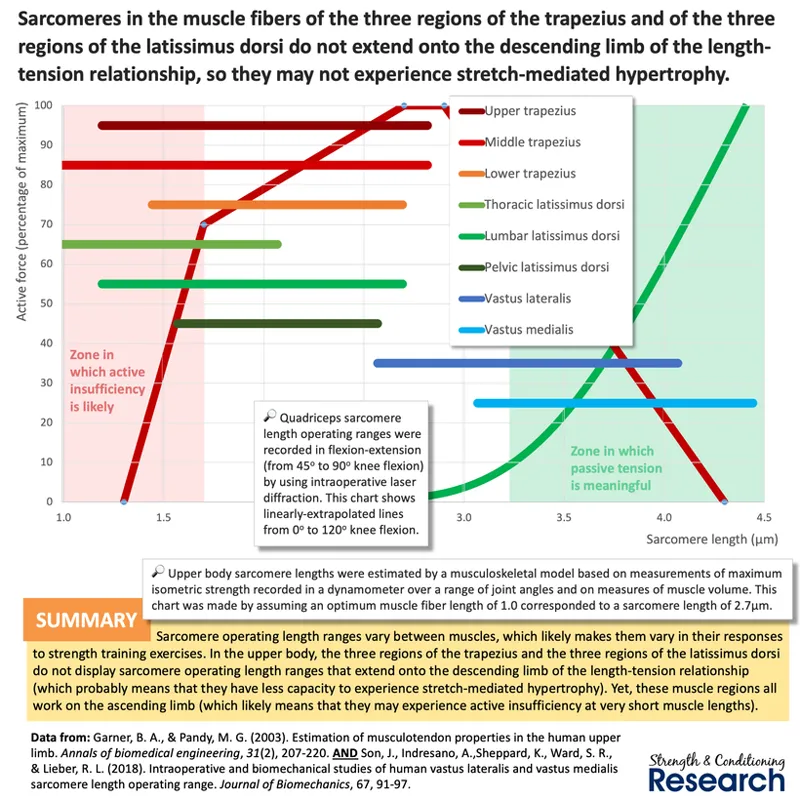
There are only limited data regarding the operating sarcomere lengths of the trapezius and they indicate that the three regions likely work on the ascending limb and plateau and do not reach the descending limb of the length-tension relationship. Also, there are no long-term training studies assessing either [1] whether the muscle grows when trained at long or short muscle lengths, or [2] whether the muscle displays increases in fascicle length after training. Thus, its capacity to display sarcomerogenesis is unclear.
.
Conclusions
The trapezius has three main regions (upper, middle, and lower). The upper trapezius runs vertically down the neck before diverting horizontally across to the clavicle. It cannot elevate the scapula directly, because it is not attached to it. Thus, any effect on scapular elevation must be indirect (so far, no such indirect effect has been established, although speculations abound). It may act mainly to stabilize the clavicle. The middle trapezius runs horizontally from the C7 and T1 vertebrae to the acromion of the scapula and pulls it medially/posteriorly. By running horizontally, this region cannot easily elevate the scapula, and likely works mainly as a scapula retractor. The lower trapezius fascicles run at various angles from the T2-T12 vertebrae to the scapula, and likely also perform scapula retraction. These fascicles cannot easily produce scapula elevation because most of their origins are below their insertions. Historically, the trapezius has been trained by shrugs. However, research suggests that the levator scapulae is the prime mover in this exercise, and that the upper trapezius at least does not grow following a program of shrugs, rows, and deadlifts. Overall, the trapezius regions seem most strongly activated by scapula retractions, which can more easily and practically be implemented by horizontal (Kelso) shrugs than by the more conventional vertical shrug.
Comments (9)
IMHO, the main function of the upper trap is to rotate the head, eyes and ears towards the source of sound. This is reflected by the common innovation of the trap ant the scm as well as the shares nuclei with the ears and eyes.
The lower traps in shrugs is interesting, would it be to offset downward rotation of the levator maybe? Or just antagonist activation?
Certainly, it seems there are anti-rotational actions of the trapezius due to other muscle actions at the scapula. I tend to see it mainly still as a retractor of the scapular, however.
Thank you, Robert Konza and I'll post my opinion here. 1- In Chris' text, he mentions: «A problem with the literature regarding the upper trapezius is that many electromyography studies place the electrode for the upper trapezius relative to the C7 vertebra, which is actually the origin for the middle trapezius.» In the study «Surface electromyographic analysis of exercises for the trapezius and serratus anterior muscles» (2003), refers to the procedures «For electrode placement over the upper trapezius … two electrodes were placed to one-half the distance between the C7 spinous process and the lateral tip of theacromion». 2- I think it's consensual that shrugs activates the upper trapezius; the question is whether scapular retraction generates superior activation.
Yes, the cited study by Robert above does not measure upper trapezius activation, so is not relevant. Regarding shrugs activating the upper trapezius, I think any shoulder movement will cause activation of the region to stabilize the clavicle. The upper trapezius certainly does not elevating the scapular, however, which is the main movement. So it can probably be described as a synergist.
To add some scientific backing: https://pubmed.ncbi.nlm.nih.gov/12774999/
That study did not measure upper trapezius activation. If you read the section regarding electrode placement, you will see that the electrodes were placed nrelative to C7 and not C6. Therefore, it measured middle trapezius activation. This is the problem in the literature that I explained at the end of the above post.
I love your stuff Chris. Respectfully, this doesn't mesh with reality though. Specifically, Shrugs and Deads not working the traps? Shrugs definitely work the upper traps. Not just the LS. The LS has a very distinctive feel. Deads, even by this, would work the traps in a few lines of force simply from preventing protraction of the scapula (the favored lines of force would go from the middle traps towards the upper as one stands up). A few possible explanations: 1. The use of isometric contractions for EMG. 2. Electrode placement. Something is amiss though. I know the lowest fibers of the traps are worked somewhat counterintuitively. But Shrugs work so well that people in the past avoided them to avoid overdevelopment of the traps, making the shoulders appear more narrow. 1/4 deads (rack pulls) will put traps on a skeleton.
The upper trapezius acts to move the clavicle, so its contribution during a shrug will only ever be as a synergist or stabilizer to the muscles that are elevating the scapula, which is the main task.