





Static stretching and workouts
Bodybuilders sometimes use static stretches to stimulate additional muscle growth. Static stretches can be done either [1] before a workout, [2] during a workout (such as between sets of exercises that involve the same muscle group), or [3] after a workout. Which approach is best?
.
#1. Static stretching does cause muscle growth
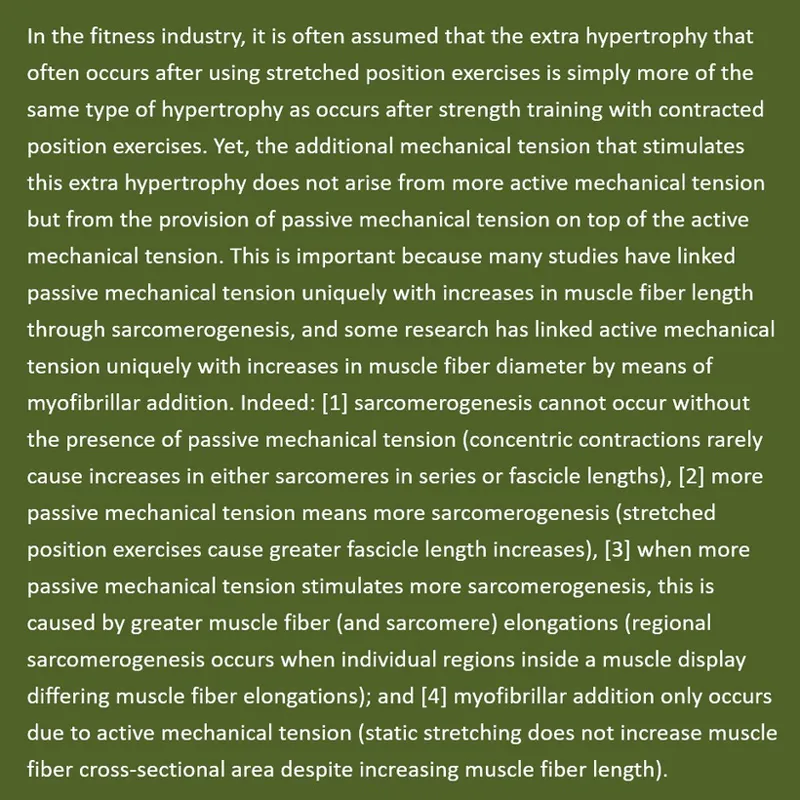
First of all, let us establish that research is clear that static stretching can indeed cause meaningful muscle growth in humans (despite claims to the contrary). Even so, our ability to create muscle growth by means of passive mechanical tension is limited by both our personal tolerance to the stretch sensation and also by the number of sarcomeres inside the stretched muscle fibers (read more).
.
Importantly, the increase in muscle size that is stimulated by the passive mechanical tension produced during static stretching is solely an increase in sarcomeres in series (read more)
.
#2. Static stretching also causes fatigue
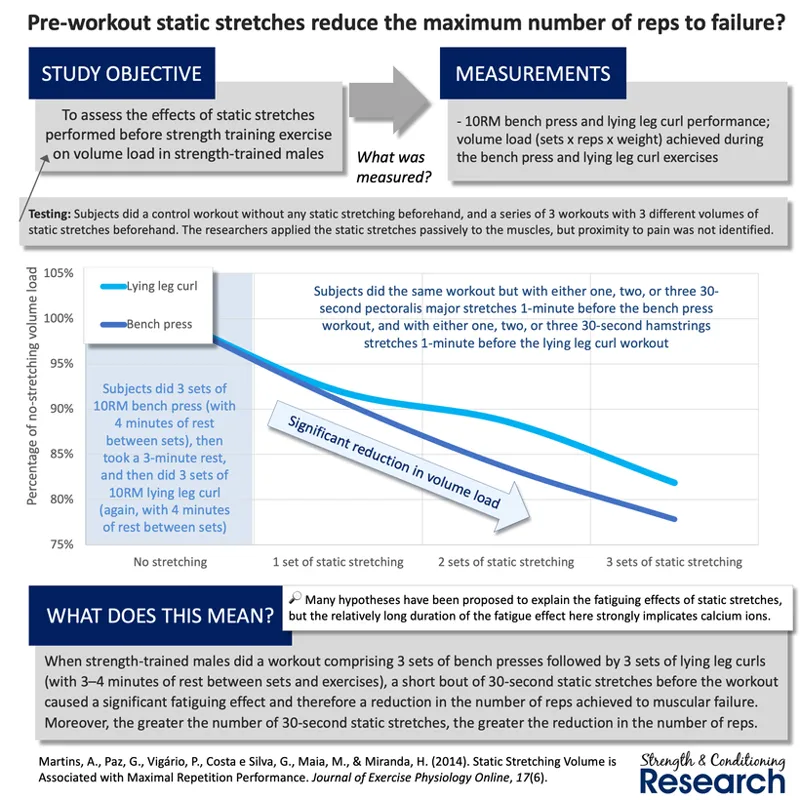
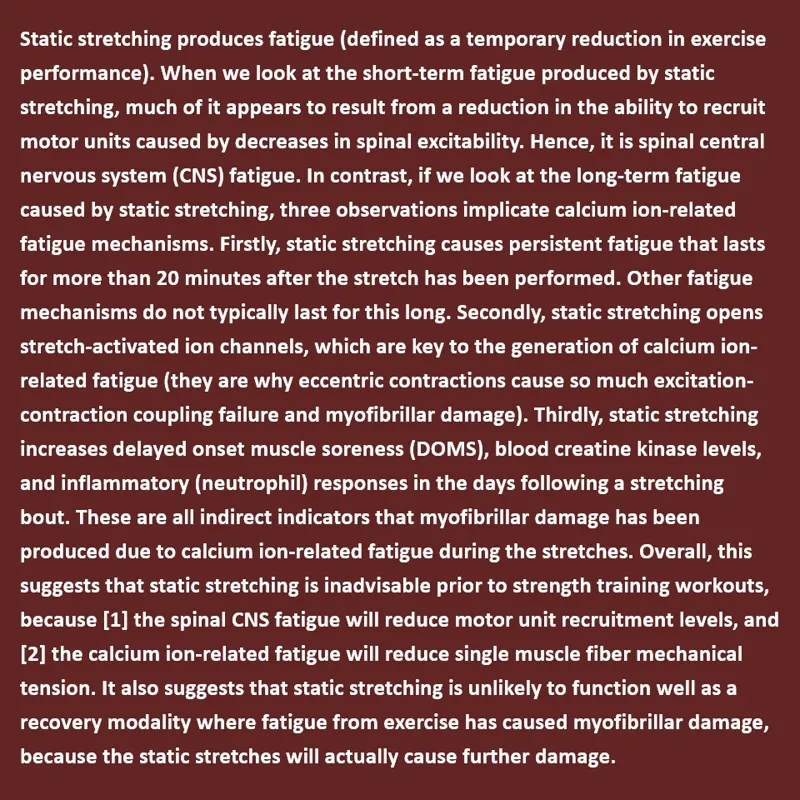
In addition to producing hypertrophy, static stretching also causes calcium ion-related fatigue. This means that the fatigue has a negative impact on mechanical tension, and thereby impairs the stimulus for hypertrophy of any subsequent exercise (read more).
.
#3. Static stretching before a workout
The fatiguing effects of static stretching are very apparent when we look at the literature examining the effects of pre-workout static stretches. There is a clear reduction in the number of reps that can be performed in the strength training sets of a workout, when static stretching is performed beforehand. This most likely reduces the number of stimulating reps, because the calcium ion-related fatigue reduces mechanical tension.
.
#4. Static stretching during a workout
The fatiguing effects of static stretching are also likely to be present when stretches are performed between strength training sets. Yet, the hypertrophic effects of static stretching seem to overpower its fatiguing effects in this context, and the overall impact of inter-set static stretches seems to be positive (although bear in mind that the positive effect will occur by means of sarcomerogenesis and the negative effect will be imposed upon myofibrillar addition).
.
This phenomenon has been observed in more than one study, giving confidence that the balance of hypertrophy stimulus and fatigue is likely towards the hypertrophy stimulus, at least in those muscles like the quadriceps and soleus that [1] very easily experience a passive tension stimulus, and which [2] do not easily experience calcium ion-related fatigue.
.
#5. Static stretching after a workout
Generally, most research into post-workout static stretching has focused on the ability of static stretches to ameliorate the fatigue produced by strength training, which is absurd because static stretching also produces fatigue. Yet, since the passive mechanical tension in static stretching is not affected by the fatigue produced by strength training, post-workout stretching can produce the same stimulus hypertrophy as either pre-workout stretching or inter-set stretching, without causing any reduction in the number of stimulating reps produced in the strength training part of the workout.
.
Conclusions
Bodybuilders sometimes use static stretches to stimulate additional muscle growth. Static stretches can be done either [1] before a workout, [2] during a workout (such as between sets of exercises that involve the same muscle group), or [3] after a workout. Which approach is best? First of all, it is important to note that the passive mechanical tension produced by static stretching does indeed stimulate muscle growth (by means of sarcomerogenesis) in humans as well as in animals (despite claims to the contrary). Yet, static stretching also produces calcium ion-related fatigue, owing to the opening of stretch-activated ion channels. This fatigue mechanism is both relatively long-lasting and also reduces the ability of the muscle fibers to generate active mechanical tension by crossbridge formation. Indeed, when static stretches are performed prior to strength training sets, they do reduce the number of reps that can be performed (which very likely reduces the hypertrophic stimulus caused by the strength training set). Therefore, when static stretches are performed either pre-workout or between sets, the passive tension generated will stimulate an increase in muscle size (by means of sarcomerogenesis), but the fatigue produced will reduce the active mechanical tension stimulus for myofibrillar addition produced by subsequent strength training sets. This suggests that the optimal strategy for incorporating static stretching into a bodybuilding program is to perform it at the very end of the workout.


Comments (4)
Hello, Chris, I wanted to ask you a question about strength improvements and recovery. Say a person does 3x2, with RIR3 squats on Monday and he then repeats it on Friday, but he "feels" that it is more like RIR1 or 2, so we can assume that fatigue is still present from previous workouts My questions are: 1. if exercise feels heavier and our main goal is to increase strength should we skip that workout (or change) where we feel that we cannot match or improve previous performance? 2. If our main goal is to improve squat one rep max and we still feel fatigued from previous workouts (as in example one day RIR3, other day it feels RIR1-2), so should we lower volume from squats (do less sets) or should we cut volume from accessory exercises? 3. How do we know that it is a volume issue? Maybe it was poor sleep quality or stressful week. Should then we just lower weight on Friday and continue squat workout with 3x2 just with lower weight? I know these are more of a programming questions but I tried to be as clear as possible. If that is too hard to answer - I will understand Thanks, Chris!
Yes, if the Monday workout is 3 x 2 (3RIR) and the Friday workout with the same weight is 3 x 2 (2RIR) then fatigue is almost certainly present on the Friday workout.
Thank you Chris for the great article - also the last one on the trapezius - I just read a study that showed a greater contracted rectus abdominis muscle volume after utilizing STEMS - do you believe that adding EMS (wearing a suit with electrodes) will enhance motor unit recruitment and muscular hypertrophy? Thanks!
I will probably do an FAQ on EMS because it displays interesting characteristics. IMO, it is not worth using because it tends to cause disproportionate amounts of muscle damage relative to the hypertrophy that is generated. Also, I don't think it can stimulate increases in motor unit recruitment, because I believe that the stimulus for increasing motor unit recruitment is achieving a high level of central motor command, which is obviously not applicable with EMS.