






Light load strength training to failure
It is commonly believed that we always achieve maximum levels of motor unit recruitment when training to muscular failure, regardless of the load on the bar. This is not true. Using lighter loads leads to slightly lower levels of motor unit recruitment at the point of task failure due to the presence of other contributors to the perception of effort.
.
#1. What causes muscular failure?
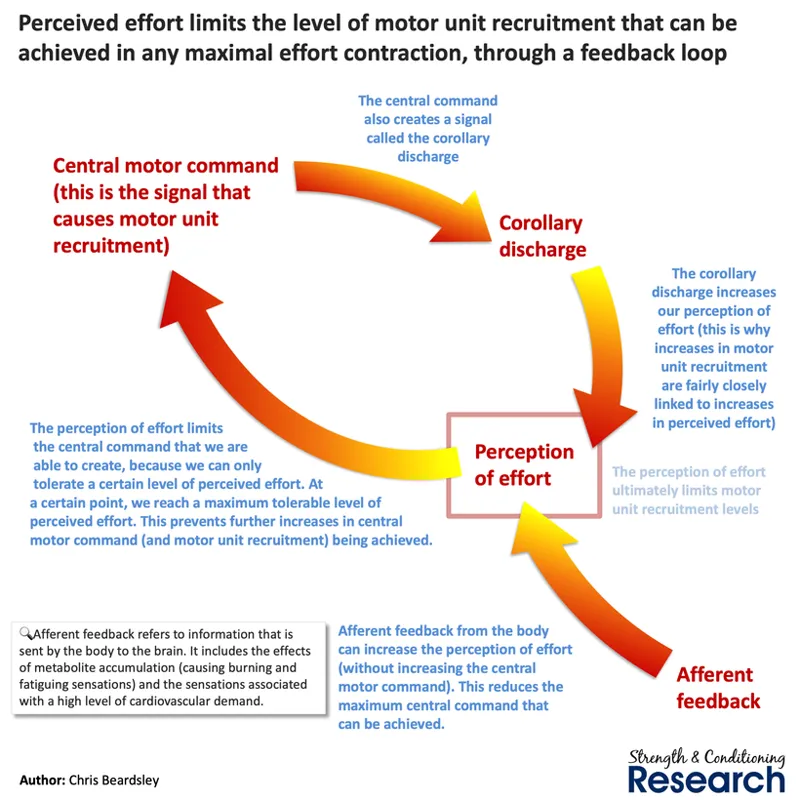
Muscular failure (which physiology researchers more accurately call "task failure") is not reached when we achieve a maximum level of motor unit recruitment. It is reached when we achieve our maximum tolerable perception of effort, and voluntarily decide to stop the set. Nevertheless, our perception of effort is mainly generated by the corollary discharge from the central motor command that causes motor unit recruitment. Consequently, as we increase central motor command to increase the number of motor units recruited, we simultaneously increase our perceived level of effort. This theory is called the "sensation of innervation."
.
If the corollary discharge was the only factor contributing to the perception of effort, then it would still be accurate to state that we reach muscular failure when we achieve our maximum level of motor unit recruitment. Nevertheless, there are other factors that can contribute to the perception of effort, such as mental effort, the afferent feedback from metabolite accumulation, and the messages associated with cardiovascular demand. The discomforting feelings caused by afferent feedback have been shown to contribute to an increase in the perception of effort, and this causes us to reach our maximum tolerable perception of effort even before we achieve our maximum levels of central motor command (and therefore also our maximum levels of motor unit recruitment).
.
The psychobiological model of fatigue model of exercise combines effort perceptions caused by: [1] the corollary discharge from the central motor command, [2] sensory information from the body (including afferent feedback), and [3] psychological factors that are capable of influencing motivation, into a unifying model that is able to explain how different levels of motor unit recruitment occur at the point of muscular failure, even though maximum efforts are always still experienced.
.
#2. What happens during light load strength training to failure?
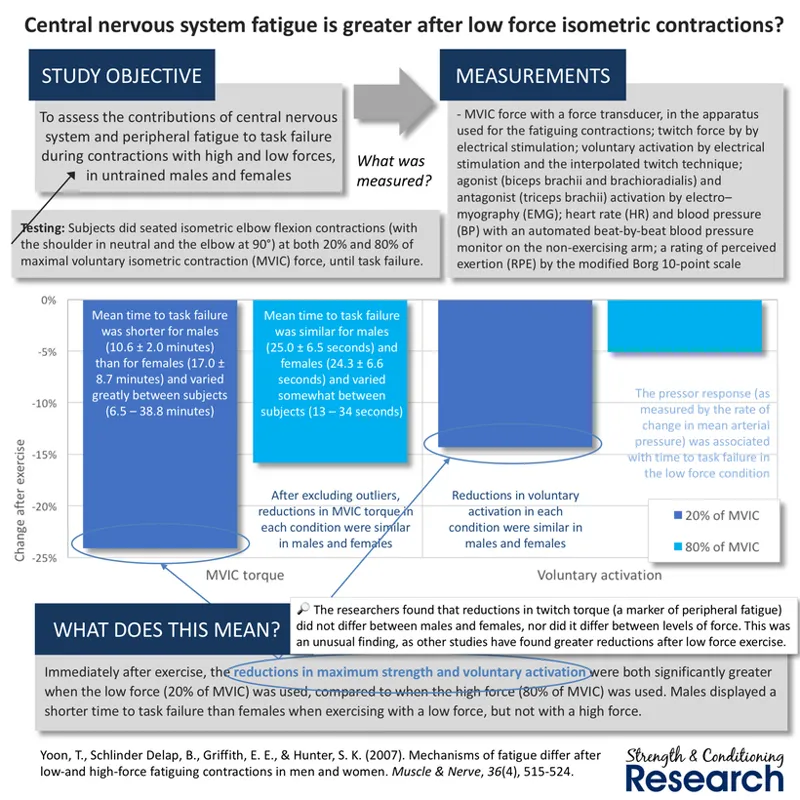
When performing sets of light loads to failure, we experience a maximum level of perceived effort on the final rep of the set. Yet, this does not correspond to a maximum level of motor unit recruitment (most likely due to the presence of afferent feedback from metabolite accumulation).
.
Although this idea has only been recently accepted, researchers noticed the phenomenon more than 15 years ago when comparing the behavior of low force and high force isometric contractions under conditions of fatigue.
.
Moreover, it is a extremely reliable finding. Several studies have observed the same phenomenon and there are very few contrary indications.
.
#3. What happens after light load strength training to failure programs?
After light load strength training to failure training programs, there are minimal adaptations in motor unit recruitment. Since it is likely that achieving a high level of central motor command in the workout is the key factor that stimulates this adaptation, this provides further evidence that even though light load strength training to failure involves a maximum level of effort at muscular failure, it does not involve a maximum level of central motor command or a maximum level of motor unit recruitment.
.
Conclusions
It is commonly believed that we always achieve maximum levels of motor unit recruitment when we reach muscular failure during strength training, regardless of the load on the bar. This is not true. Using lighter loads leads to slightly lower levels of motor unit recruitment at muscular failure compared to lifting heavier loads. This has been recorded in multiple studies and is an extremely reliable finding. Muscular failure at the end of a strength training set is attained when we reach our maximum tolerable perception of effort, and not necessarily when we reach the maximum level of motor unit recruitment. Our perception of effort is affected by three factors: [1] the corollary discharge from the central motor command that produces motor unit recruitment, [2] sensory information from the body (including afferent feedback), and [3] psychological factors that are capable of influencing motivation. Thus, when negative sensory information from the body happens (such as when metabolite accumulation or cardiovascular activity cause discomforting sensations or pain), we reach our maximum tolerable perception of effort at a lower level of motor unit recruitment compared to when such negative sensory information is not present. For this reason, light load strength training to failure cannot and does not produce the same level of motor unit recruitment at muscular failure as heavy load strength training, even though the same maximum level of perceived effort is achieved on the final rep of the set (and this is clearly demonstrated by the fact that it cannot stimulate adaptations in the ability to recruit motor units after a training program).
Comments (4)
During strength training with a light load to failure, greater fatigue ensues, prevents the maximum level of motor unit recruitment... but, however, muscle increased to a similar extent after both thickness training program (light and heavy, in the last study). Is it due to type II motor units recruitment in the last reps of the set?
Maximum motor unit recruitment at task failure is similar during light load and heavy load strength training, but almost certainly not identical. The data here show that the level of recruitment is slightly lower when using light loads. So hypertrophy is similar but gains in motor unit recruitment are not.
Hello Chris - if the stimulus for hypertrophy is the length of time that the high threshold motor units are activated and their muscle fibers are shortening slowly, then doesn't this information demonstrate that it is not possible for light load training to failure to generate as much hypertrophy as heavy loading? Furthermore if the goal is maximal mechanical tension with minimal fatigue to reduce wear and tear then fatigue itself is a long term net negative. What am I missing in this equation?
I suspect that light load strength training to failure is not quite as effective as training with moderate/heavy loads, but the difference is not large enough to be noticed in short-term studies with low-moderate volumes. Maybe future research will reveal a difference.