



Fascicle length
Muscle fascicle lengths often increase after strength training and then decrease during detraining, in the same way as muscle fibers increase and decrease in cross-sectional area. Nevertheless, there are important differences to take into consideration.
.
#1. Increases in muscle fascicle length are caused by sarcomerogenesis
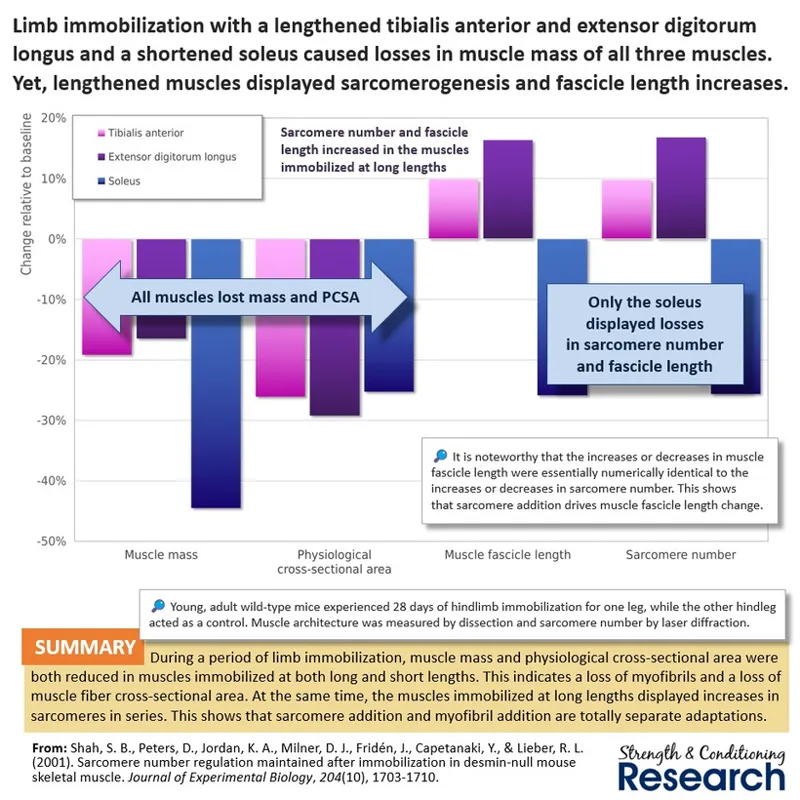
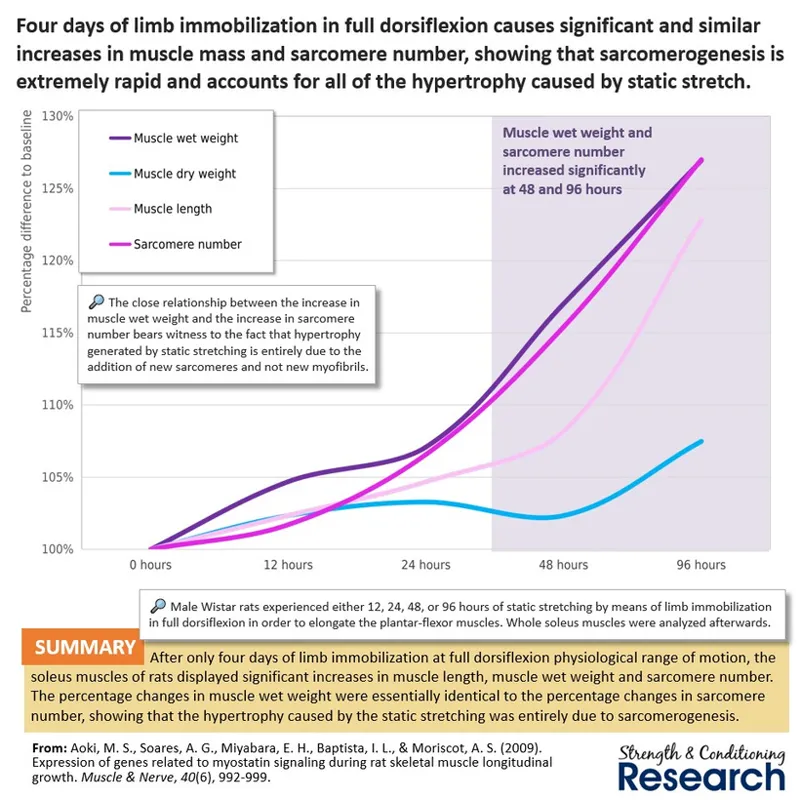
When muscle fascicle length increases, this is the result of the addition of sarcomeres in series. In this study that reported increases in sarcomeres in series in humans, the region-specific addition in the number of sarcomeres was reflected by a proportional region-specific increase in fascicle lengths.
.
The same phenomenon is very frequently reported in animal models, with increases in sarcomere number and muscle fascicle length tending to be similar when measured in different muscle regions.
.
#2. Increases in muscle fascicle length occur more quickly
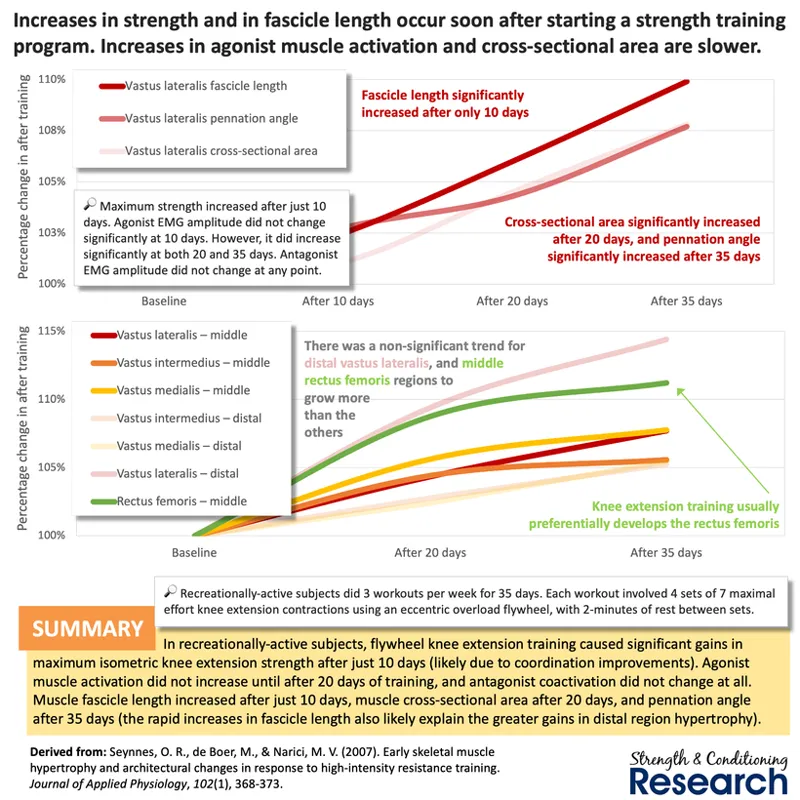
At the start of a strength training program, many adaptations occur at the same time. Yet, increases in muscle fascicle length are faster than increases in muscle cross-sectional area. During flywheel training, increases in muscle fascicle length have been observed after only 10 days of training.
.
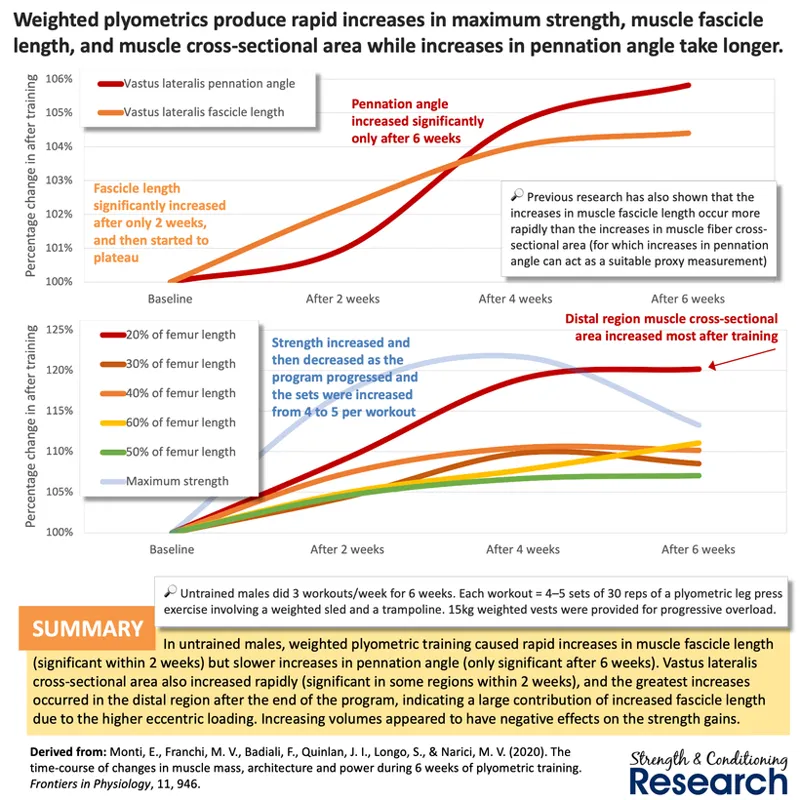
Similarly, after weighted plyometrics training, there are significant increases in fascicle length after just 2 weeks. In contrast, increases in pennation angle (which are indicative of genuine increases in muscle fiber cross-sectional area owing to myofibrillar addition), take 6 weeks to become apparent.
.
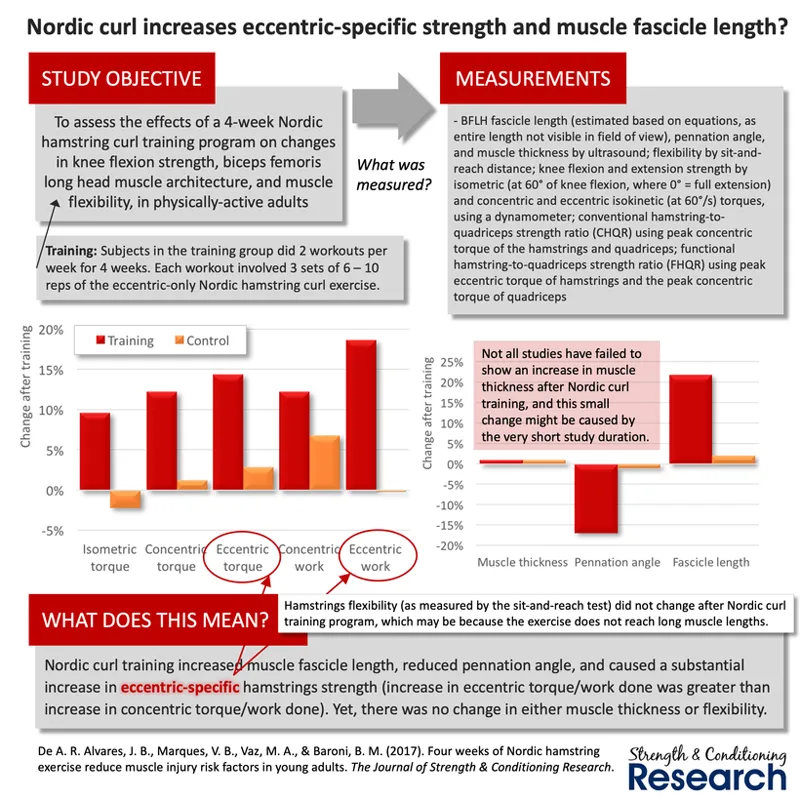
Nordic hamstring curl studies have similarly reported significant increases in fascicle length after only 4 weeks of training. Increases in muscle fascicle lengths occurring by means of sarcomerogenesis occur more rapidly than increases in muscle fiber cross-sectional area due to myofibrillar addition.
.
The exact same phenomenon has been observed in animal models, with sarcomere addition occurring extremely rapidly (within four days) when passive mechanical tension is applied to a muscle.
.
#3. Increases in muscle fascicle length plateau more quickly
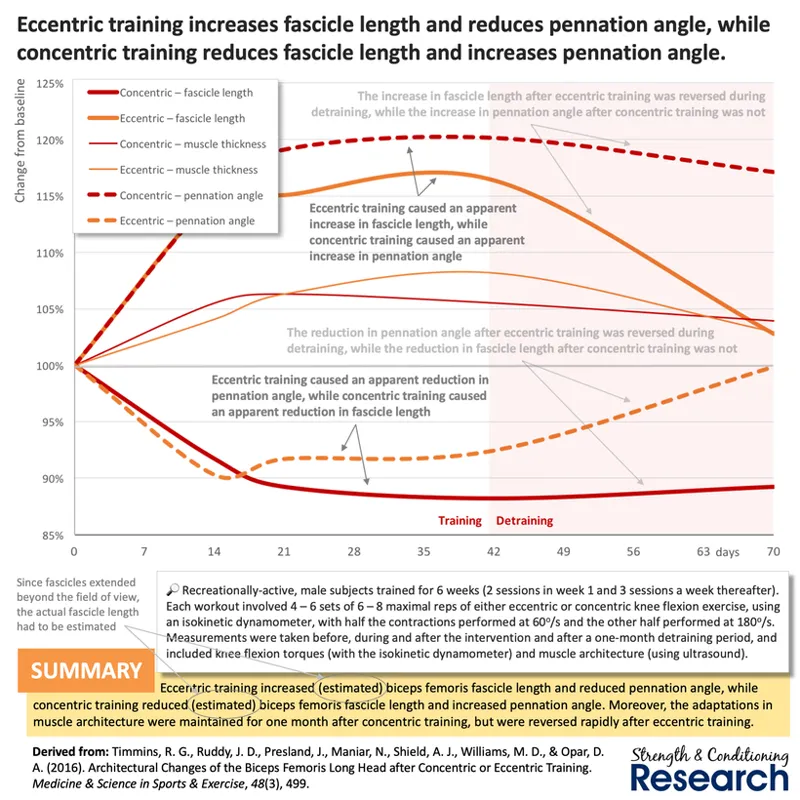
Increases in fascicle length appear to reach a plateau quickly during an eccentric training program.
.
Indeed, this is a relatively well-established finding across multiple studies involving eccentric training.
.
Exactly the same finding has been reported in the sarcomerogenesis literature in relation to the application of passive mechanical tension by static stretch or a similar model (like distraction). This research literature has established that when sarcomeres are added, this reduces the amount of passive mechanical tension that stretching the muscle fiber to a given maximum muscle length is able to generate. Thus, there are diminishing returns of training within a certain ROM until a plateau occurs.
.
Indeed, this is likely why muscle fascicle lengths do not increase much when strength-trained lifters perform strength training programs that involve stretched position exercises.
.
#4. Muscle fascicle length decreases very quickly during detraining
During a detraining period after a strength training program, many adaptations dissipate. However, the rate at which the adaptations dissipate differs. It seems likely that decreases in fascicle length occur more quickly than decreases in muscle cross-sectional area and the associated pennation angle. This indicates that sarcomeres are probably lost more quickly than myofibrils.
.
Conclusions
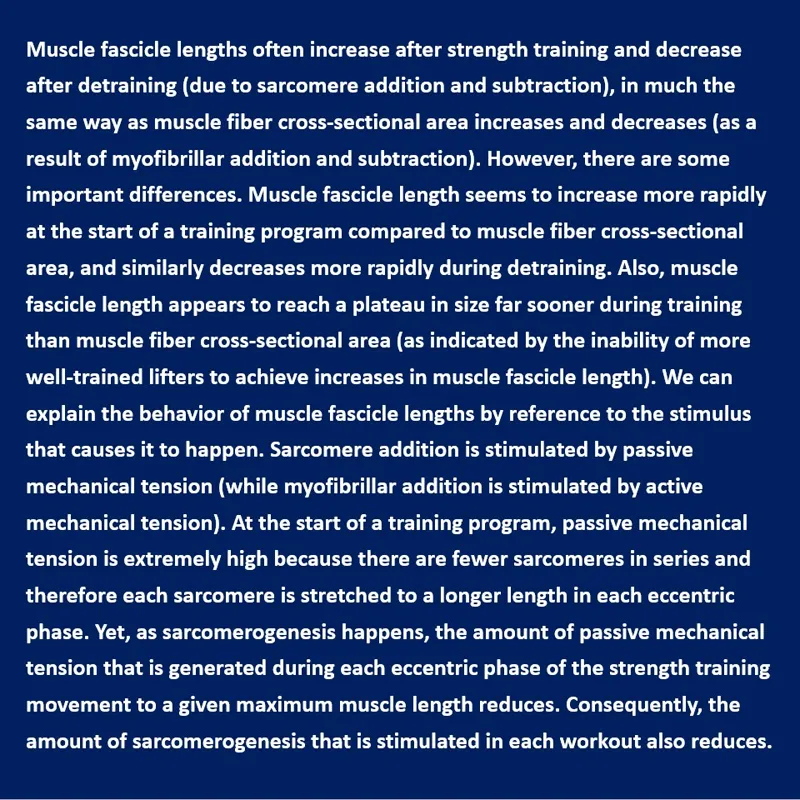
Muscle fascicle lengths often increase after strength training and decrease after detraining (due to sarcomere addition and subtraction), in much the same way as muscle fiber cross-sectional area increases and decreases (as a result of myofibrillar addition and subtraction). Yet, there are some important differences. Muscle fascicle length seems to increase more rapidly at the start of a training program in comparison to muscle fiber cross-sectional area, and similarly decreases more rapidly during detraining. Also, muscle fascicle length appears to reach a plateau in size far sooner during training than muscle fiber cross-sectional area. We can explain the behavior of muscle fascicle lengths by reference to the stimulus that causes it to happen. Sarcomere addition is stimulated by passive mechanical tension (while myofibrillar addition is stimulated by active mechanical tension). At the start of a training program, passive mechanical tension is very high because there are fewer sarcomeres in series and therefore each sarcomere is stretched to a longer length during each eccentric phase. Yet, as sarcomerogenesis happens, the amount of passive mechanical tension that is generated during each eccentric phase of the strength training movement to a given maximum muscle length reduces. Consequently, the amount of sarcomerogenesis that is stimulated in each workout also reduces.
Comments (6)
May seem like a dumb question, but fascicle length will increase ROM?
Most of the increase in ROM seems to happen because of an increase in stretch tolerance rather than due to increases in fascicle length
This is a really good article. Question for my understanding is during detraining and loss of facile length are sacromeres absorbed and fibers no longer as long, essentially unable to hold the adaptation to fiber length?
During detraining from passive mechanical tension, we lose sarcomeres in series, yes. So the muscle fiber reduces its volume, which is a loss of muscle fiber size. This will happen any time that we remove the passive mechanical tension stimulus from the adapted muscle fibers.
Thank you Chris - awesome article - 2 questions - does this means fascicle length gains could be sustained by periodic stimulation after the initial plateau? So consistent long length for 3 months followed by one week per month thereafter? Also passive insufficiency - does this matter? Can we train at too long muscle length? Thanks!
Any adaptation can be maintained by small volumes of appropriate training that provides the necessary stimulus. So increased fascicle lengths can indeed be maintained once achieved by small volumes of passive tension (either from static stretches or eccentric contractions or isometrics at long muscle lengths).