




Multiple repeated bout effect
The repeated bout effect (RBE) is the technical term given to the observation that a second workout produces much less fatigue (as well as much less delayed onset muscle soreness [DOMS]) than an initial workout. The RBE has been extremely well-documented but much less is known about the changes in the amount of fatigue and DOMS that occur over subsequent workouts.
.
#1. What is the RBE?
The RBE is the well-described observation that post-workout fatigue reduces substantially from workout one to workout two. It says nothing about the changes in post-workout fatigue from workout two onwards (read more).
.
#2. Does post-workout fatigue reduce from the second workout to the third workout?
Post-workout fatigue does not reduce from workout two to workout three. This indicates that the RBE is predominantly a phenomenon that describes the reduction in fatigue (and DOMS) from workout one to workout two. It does not describe a continuous process that leads to progressively reducing fatigue over a series of workouts at the start of a strength training program.
.
#3. Does post-workout fatigue reduce from the second workout to later workouts?
Although post-workout fatigue does not appear to reduce from the second to the third workout, there are studies showing a general trend for a small reduction in post-workout fatigue from the first workout to subsequent workouts. In contrast, DOMS appears to experience the vast majority of the changes from workout one to workout two and only minimal changes thereafter.
.
#4. Which post-workout fatigue mechanisms are responsible for the multiple RBE?
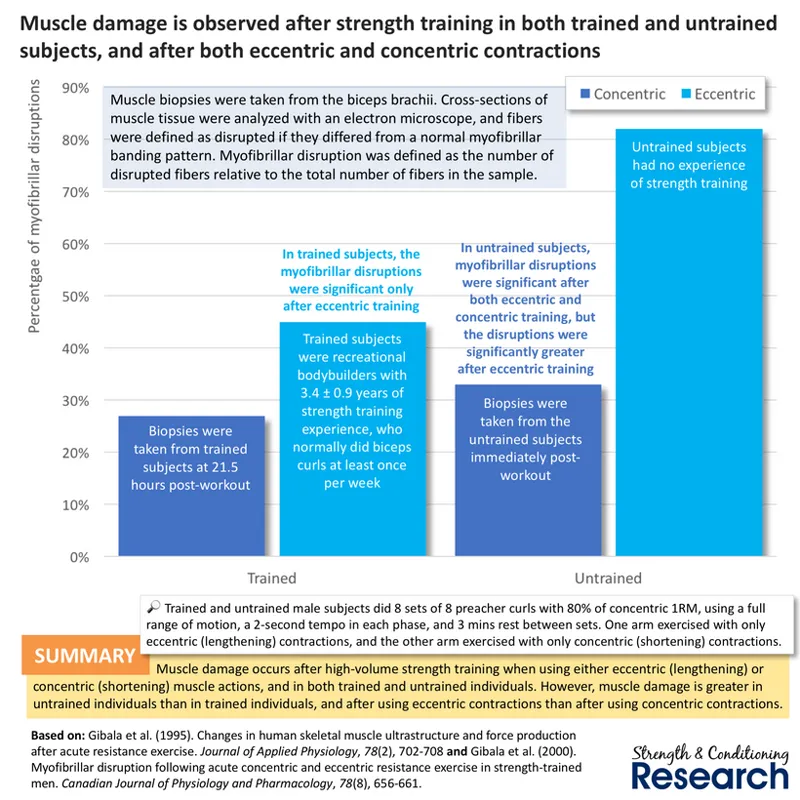
There are three main post-workout fatigue mechanisms present after any fatiguing bout of exercise: (1) myofibrillar damage, (2) excitation-contraction coupling failure [ECCF], and (3) supraspinal central nervous system (CNS) fatigue. Researchers have often noted that the amount of myofibrillar damage is much reduced in trained individuals compared to in untrained individuals, which suggests that it could contribute to the multiple RBE.
.
In contrast, supraspinal CNS fatigue does not seem to vary greatly between trained and untrained individuals, which strongly suggests that it cannot contribute meaningfully to the multiple RBE.
.
It seems likely that the maintenance of similar levels of supraspinal CNS fatigue in trained individuals as in untrained individuals is the result of a greater sensitization of the inflammatory response to the presence of myofibrillar damage. Thus, the inflammatory response in trained subjects (that causes supraspinal CNS fatigue) is greater for a given amount of myofibrillar damage.
.
Interestingly, research has shown that ECCF does not reduce very much over a series of workouts at the start of a strength training program. Instead, it remains at a fairly consistent level despite overall post-workout fatigue reducing. This can be seen by the lack of change in low-frequency fatigue despite high-frequency fatigue reducing progressively over a series of five workouts. This suggests that ECCF does not contribute to the multiple RBE either.
.
Conclusions
The repeated bout effect (RBE) is the observation that a second workout produces much less post-workout fatigue and delayed onset muscle soreness (DOMS) than an initial workout. Yet, it does not describe the changes in post-workout fatigue and DOMS from the second workout to subsequent workouts, for which we might term the "multiple RBE" instead. Post-workout fatigue seems not to change from the second workout to the third workout. Yet, it does gradually reduce over a series of later workouts. In contrast, DOMS appears not to change at all after the second workout. Thus, it appears that the multiple RBE is very much smaller than the RBE itself both in respect of post-workout fatigue and also in respect of DOMS. There are three main mechanisms of post-workout fatigue (myofibrillar damage, excitation-contraction coupling failure [ECCF] and supraspinal central nervous system [CNS] fatigue). It seems likely that ECCF does not change much over the initial workouts of a strength training program. And, while the amount of myofibrillar damage caused by a workout does reduce with increasing training status, the magnitude of supraspinal CNS fatigue does not (likely due to a greater inflammatory response being stimulated by any given amount of myofibrillar damage). This therefore indicates that continued reductions in myofibrillar damage are likely the predominant mechanism by which post-workout fatigue continues to reduce over time.
