


Stretch-mediated hypertrophy = sarcomerogenesis
In the fitness industry, it is often assumed that the extra hypertrophy that often occurs after using stretched position exercises is just more of the same type of hypertrophy as occurs after strength training with contracted position exercises. Yet, this assumes that active and passive mechanical tension produce exactly the same signaling effects, which we know is not the case (since titin has strong signaling effects). It seems likely that the extra hypertrophy produced by passive mechanical tension actually stimulates an increase in muscle fiber length caused by sarcomerogenesis and does not stimulate an increase in muscle fiber cross-sectional area because of myofibrillar addition. We can see this for several reasons, as follows.
.
#1. PASSIVE TENSION IS REQUIRED FOR SARCOMEROGENESIS
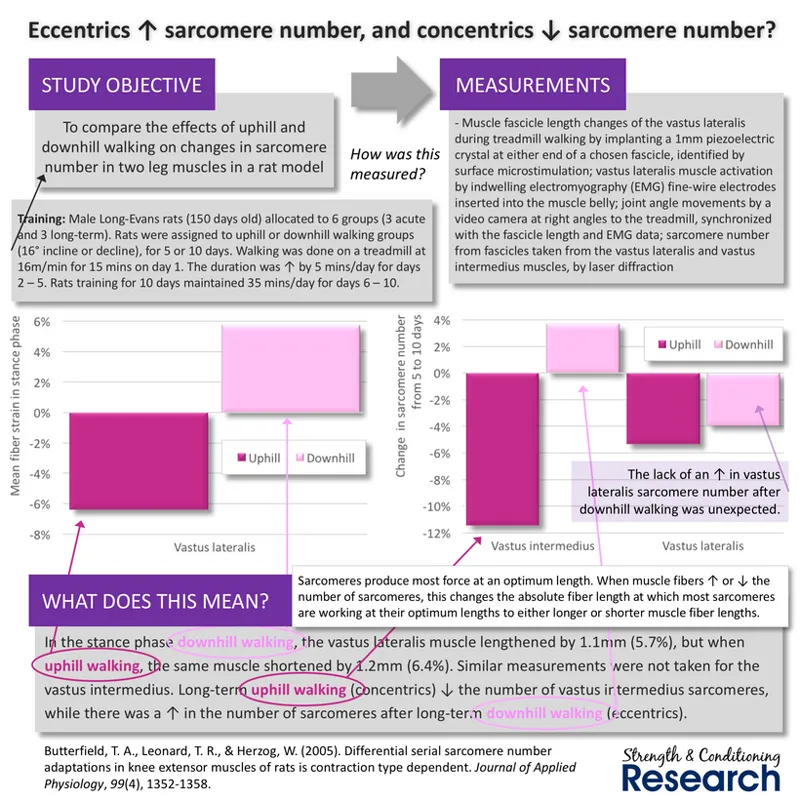
Eccentric training causes sarcomerogenesis (concentric training cannot)
Animal models have shown that eccentric-only training increases muscle fiber length (through sarcomerogenesis) while concentric-only training does not. In fact, concentric-only training seems to reduce the number of sarcomeres in series.
.
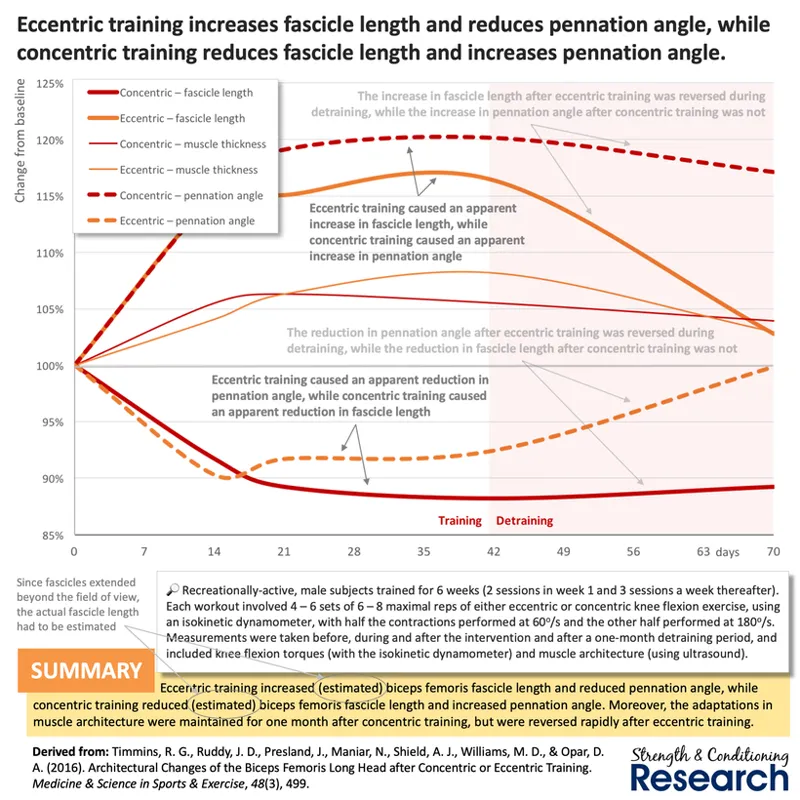
Similar results can be observed in humans when measuring fascicle lengths (as a proxy for sarcomerogenesis) and pennation angles (for myofibrillar addition). The concentric training program actually appears to reduce muscle fascicle lengths.
.
#2. MORE PASSIVE TENSION MEANS MORE SARCOMEROGENESIS
Stretched position exercises cause more fascicle length increases
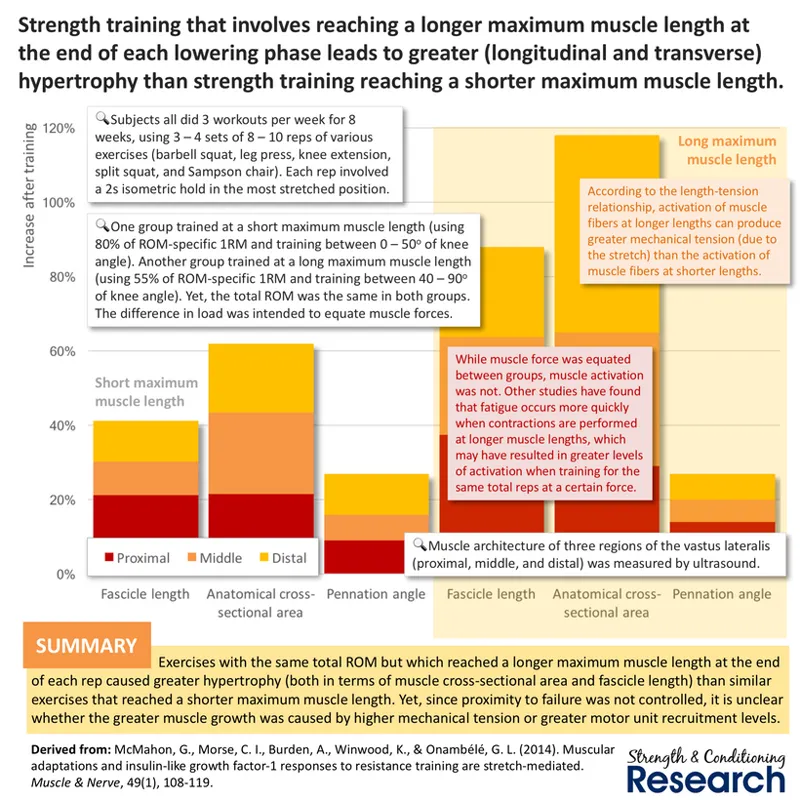
Although it is often assumed that stretched position exercises cause greater hypertrophy generally (as measured by increases in anatomical cross-sectional area, which can result from either myofibrillar addition or sarcomerogenesis), there is good evidence that fascicle lengths specifically do increase more after training with stretched position exercises.
.
Indeed, several studies have reported this greater fascicle length increase after strength training with exercises involving peak forces at longer muscle lengths.
.
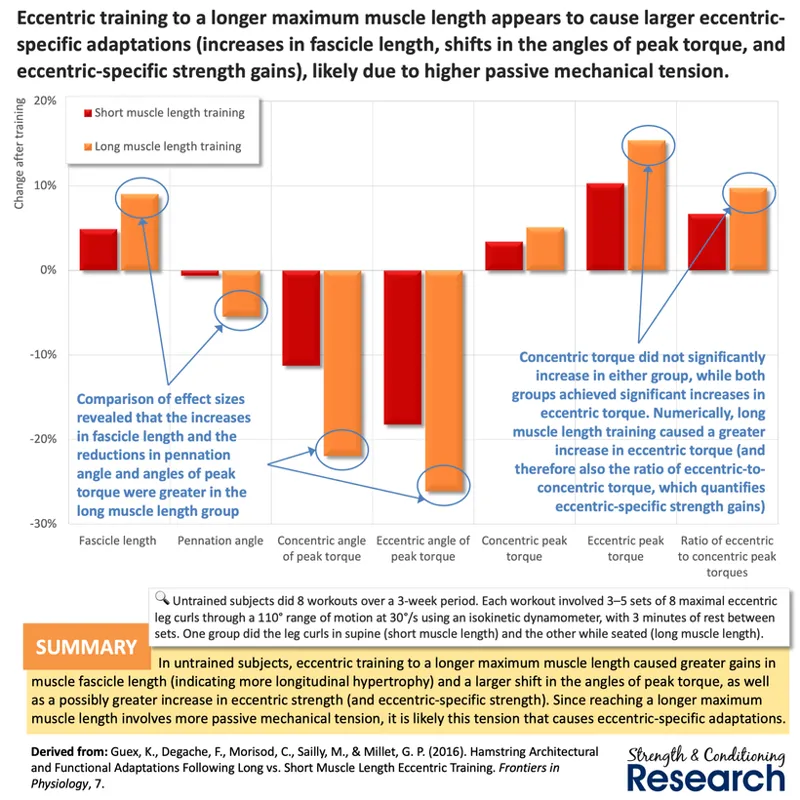
Interestingly, this greater increase in fascicle length occurs after training with stretched position exercises even in the context of eccentric-only training.
.
Artificially enhancing titin-based passive tension causes sarcomerogenesis
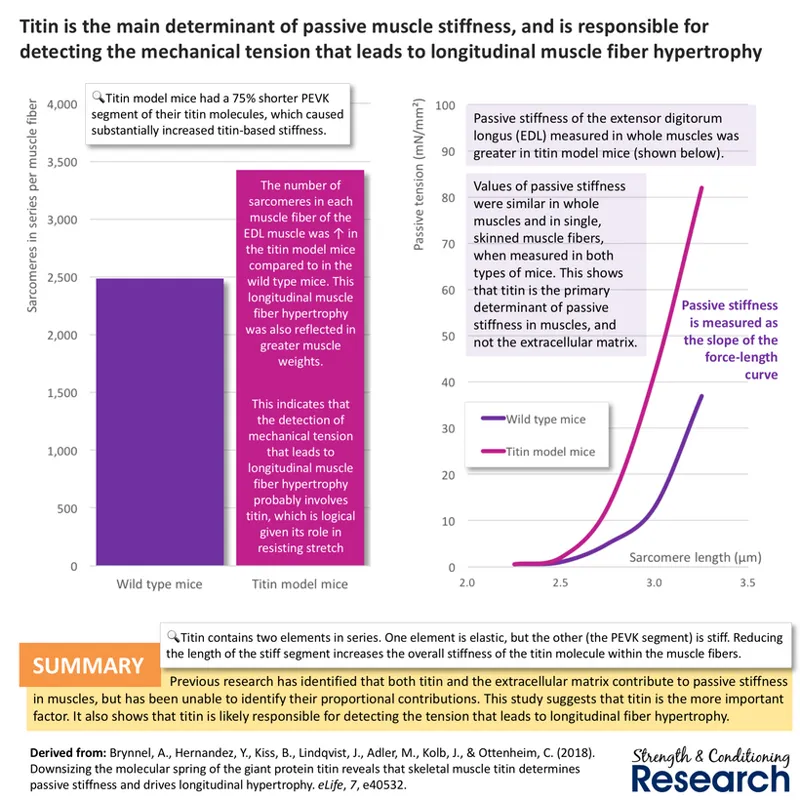
Some researchers have used animal models that involve alterations to titin (making it stiffer). They have reported that sarcomerogenesis occurs in the animals with stiffer titin molecules, and that this longitudinal hypertrophy adaptation increases the overall size of the muscles of these animals.
.
#3. MORE FIBER STRAIN MEANS MORE SARCOMEROGENESIS
Stretching single muscle fibers is what causes sarcomerogenesis
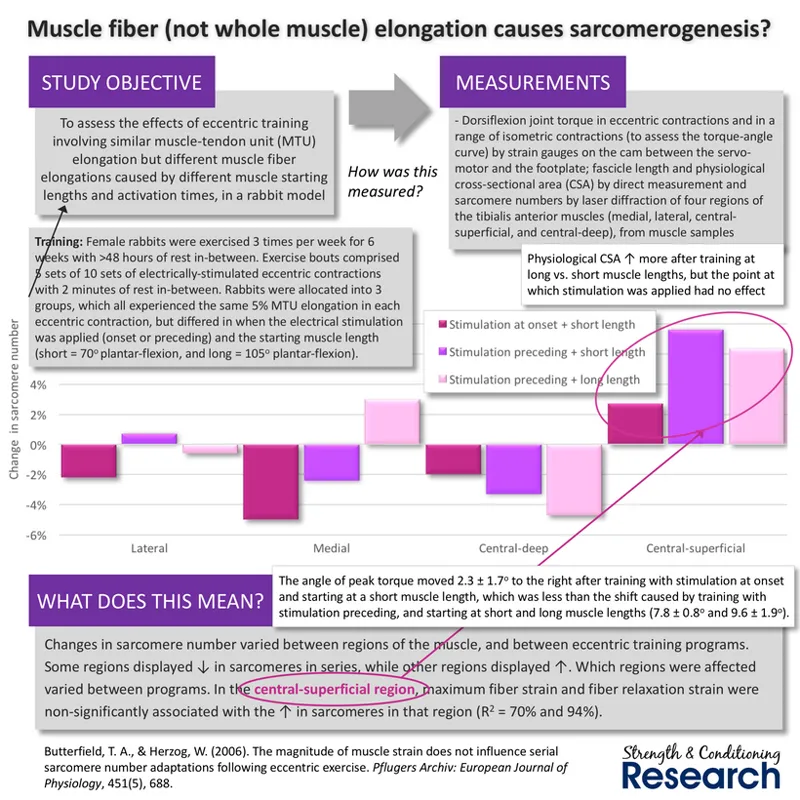
It has been demonstrated that when muscle fibers experience greater strains, the amount of sarcomerogenesis is greater. Obviously, this greater muscle fiber strain causes greater passive mechanical tension to be experienced during exercise.
.
#4. NO MYOFIBRILLAR ADDITION WITHOUT ACTIVE TENSION
Static stretching does not increase muscle fiber cross-sectional area
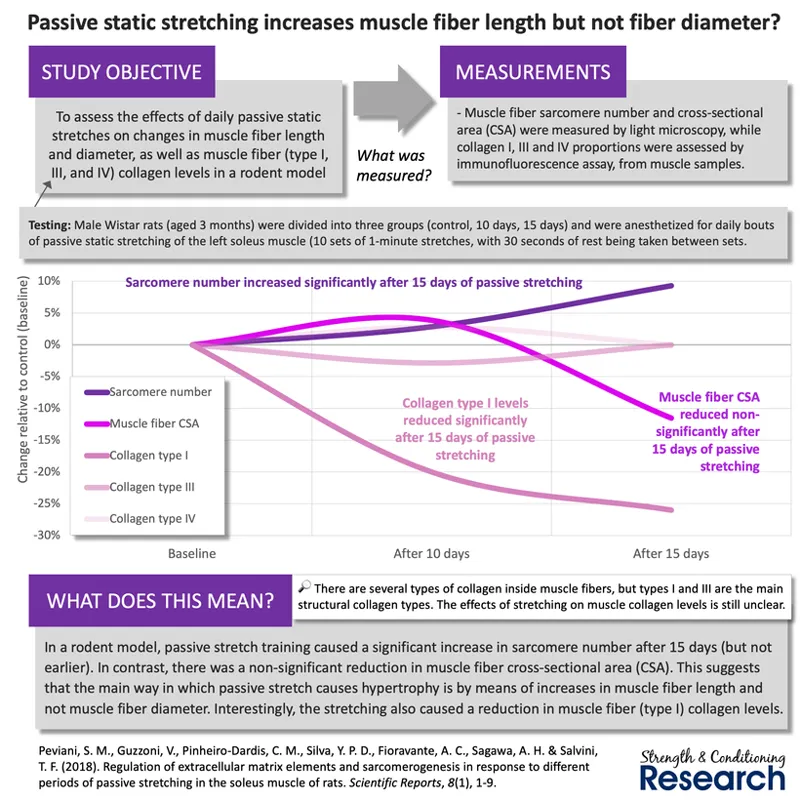
When researchers have studied that effects of static stretching in animal models, they have often reported an increase in muscle size. However, this increase in size appears to occur exclusively due to an increase in sarcomeres in series and does not involve an increase in myofibrils in parallel increasing cross-sectional area.
.
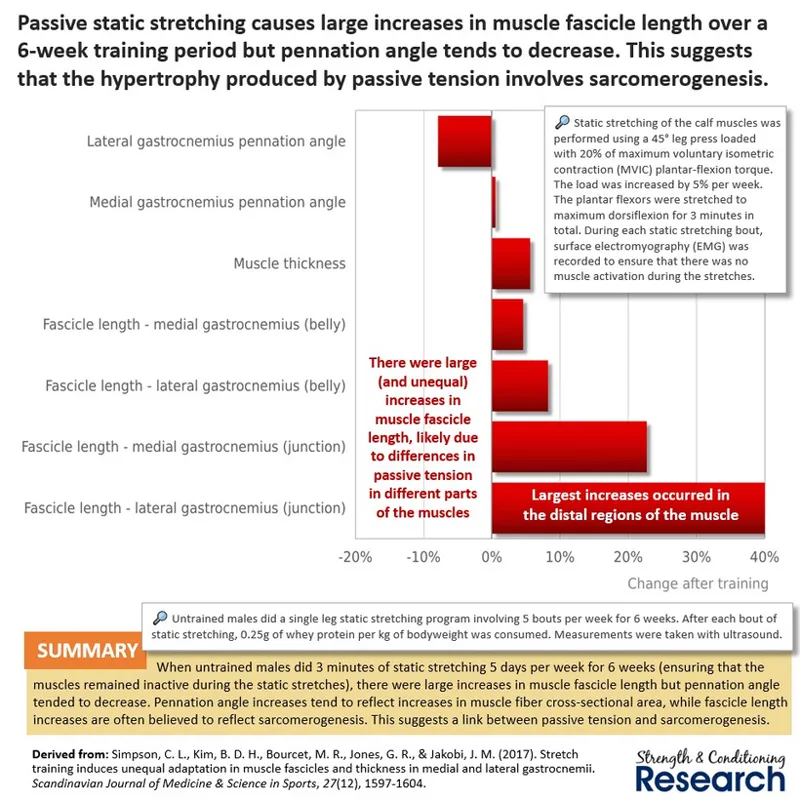
Indeed, while it is difficult to determine whether the increases in muscle thickness and muscle cross-sectional area in human studies are caused by increases in myofibrillar number or in sarcomere number, passive static stretching does seem to have a marked effect on increasing muscle fascicle length with minor changes in pennation angle, which imply sarcomerogenesis.
.
Conclusions
In the fitness industry, it is often assumed that the extra hypertrophy that often occurs after using stretched position exercises is simply more of the same type of hypertrophy as occurs after strength training with contracted position exercises. Yet, the additional mechanical tension that stimulates this extra hypertrophy does not arise from more active mechanical tension but from the provision of passive mechanical tension on top of the active mechanical tension. This is important because many studies have linked passive mechanical tension uniquely with increases in muscle fiber length through sarcomerogenesis, and some research has linked active mechanical tension uniquely with increases in muscle fiber diameter by means of myofibrillar addition. Indeed: [1] sarcomerogenesis cannot occur without the presence of passive mechanical tension (concentric contractions rarely cause increases in either sarcomeres in series or fascicle lengths), [2] more passive mechanical tension means more sarcomerogenesis (stretched position exercises cause greater fascicle length increases), [3] when more passive mechanical tension stimulates more sarcomerogenesis, this is caused by greater muscle fiber (and sarcomere) elongations (regional sarcomerogenesis occurs when individual regions inside a muscle display differing muscle fiber elongations); and [4] myofibrillar addition only occurs due to active mechanical tension (static stretching does not increase muscle fiber cross-sectional area despite increasing muscle fiber length).
Comments (3)
In Functional Range Conditioning (FRC), there is a technique where you go into a passive stretch and actively contract that tissue isometrically. Would this facilitate sarcomerogenesis?
Hi Chris - I trust your judgement - however respectfully - if all this matters - then why do I not see yoga producing muscle growth? Am I wrong in saying that muscle size/volume is determined ultimately by strength? So my muscle will be larger due to strength gains?? Please educate me = thanks!
Yoga does cause muscle growth when it involves holding very stretched positions consistently