



Fatigue during and after workouts
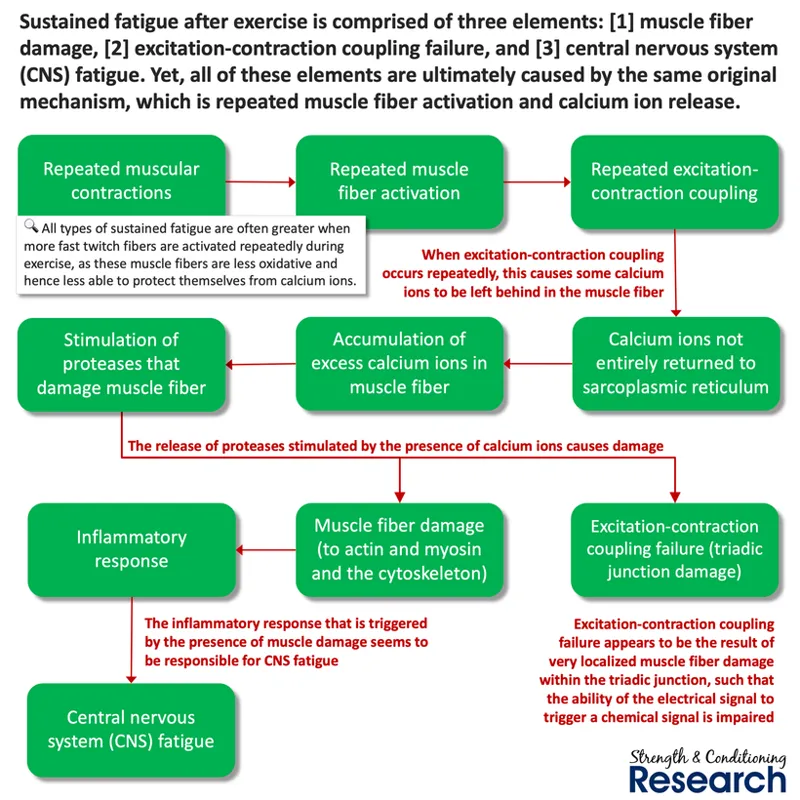
Often, it is assumed that the amount of fatigue that is experienced in a workout determines the amount of fatigue that occurs after that workout and therefore the length of time that is required for recovery. Nevertheless, this is not the case. In fact, large amounts of fatigue can dissipate very quickly if they are not produced by calcium ion accumulation. In contrast, when even small amounts of calcium ion-related fatigue are produced during a workout, the workout can take a long time to recover from.
.
#1. Fatigue during a workout does not predict fatigue after a workout
It is often assumed that if a large amount of fatigue is produced in a workout, then the post-workout fatigue will similarly be very large and long-lasting. Yet, this is not the case. For example, eccentric contractions cause fatigue to recover much more slowly after a workout than concentric contractions, even when a similar amount of fatigue is present at the end of the workout.
.
Similarly, fatigue recovers much more slowly after strength training exercise that involves a higher level of motor unit recruitment in comparison with endurance exercise that involves a much lower level of motor unit recruitment, again even when the fatigue immediately post-workout is relatively similar.
.
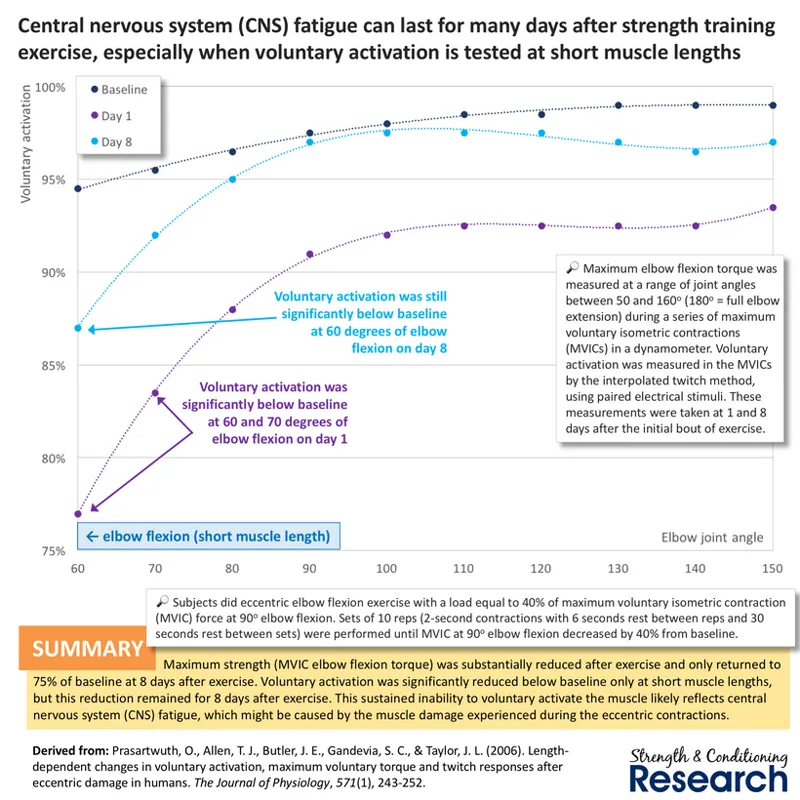
It is also noteworthy that it is not necessary to achieve a high level of central motor command and motor unit recruitment during a workout in order for post-workout CNS fatigue to occur. In fact, it can be achieved after very low force electrically-stimulated contractions that do not involve any central motor command being generated. This again shows that there is a large disconnect between workout fatigue mechanisms and post-workout fatigue mechanisms.
.
#2. Post-workout fatigue depends on the amount of calcium ion-related fatigue during the workout
The amount of fatigue that is experienced in the post-workout recovery period is not dependent upon the absolute magnitude of fatigue that is caused during the workout itself but by the relative contribution of calcium ion-related fatigue mechanisms. When relatively more calcium ion-related fatigue is present during a workout, then post-workout fatigue is much greater. In contrast, when other types of fatigue predominate in the workout, post-workout fatigue is less (read more).
.
Calcium ion-related fatigue during a workout actually determines all of the post-workout fatigue mechanisms either directly or indirectly. Indeed, it produces muscle damage and the post-workout CNS fatigue responses due to the inflammatory response it generates.
.
Indeed, this is why the greatest post-workout CNS fatigue is always recorded after workouts that produce the most muscle damage, such as unaccustomed eccentric contractions.
.
#3. How can we reduce calcium ion-related fatigue during the workout?
The amount of calcium ion-related fatigue that is generated during a workout is dependent on [1] the influx of calcium ions from the sarcoplasmic reticulum and also [2] the influx of calcium ions from the extracellular space. To reduce the amount of calcium ion-related fatigue without also reducing the stimulus for hypertrophy, we can use heavier loads, low-to-moderate workout volumes, avoid training to failure, and avoid stretched position exercises and eccentric overload.
.
Conclusions
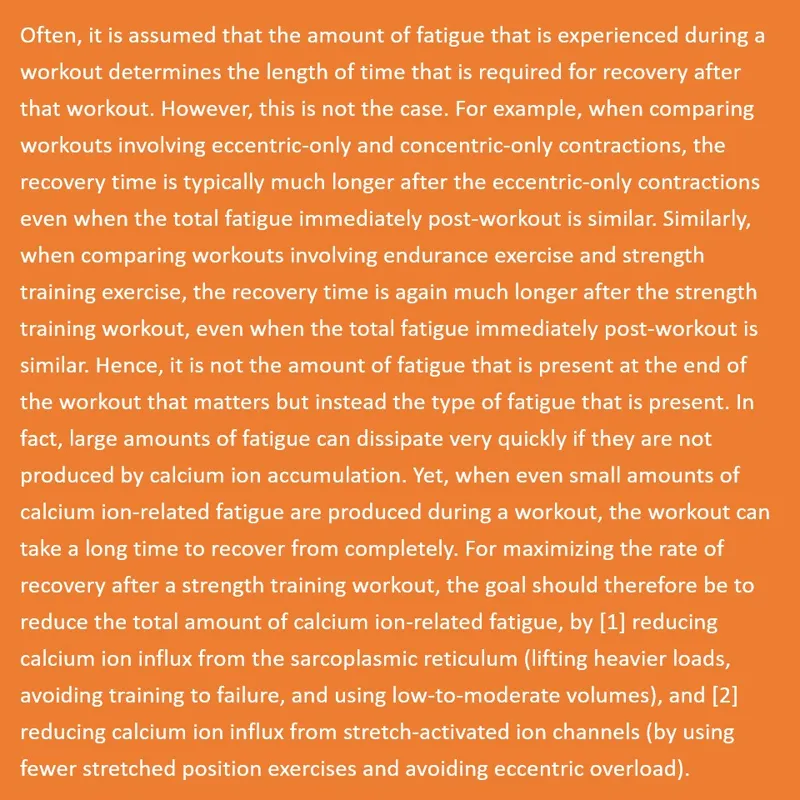
Often, it is assumed that the amount of fatigue that is experienced during a workout determines the length of time that is required for recovery after that workout. However, this is not the case. For example, when comparing workouts involving eccentric-only and concentric-only contractions, the recovery time is typically much longer after the eccentric-only contractions even when the total fatigue immediately post-workout is similar. Similarly, when comparing workouts involving endurance exercise and strength training exercise, the recovery time is again much longer after the strength training workout, even when the total fatigue immediately post-workout is similar. Hence, it is not the amount of fatigue that is present at the end of the workout that matters but instead the type of fatigue that is present. In fact, large amounts of fatigue can dissipate very quickly if they are not produced by calcium ion accumulation. Yet, when even small amounts of calcium ion-related fatigue are produced during a workout, the workout can take a long time to recover from completely. For maximizing the rate of recovery after a strength training workout, the goal should therefore be to reduce the total amount of calcium ion-related fatigue, by [1] reducing calcium ion influx from the sarcoplasmic reticulum (lifting heavier loads, avoiding training to failure, and using low-to-moderate volumes), and [2] reducing calcium ion influx from stretch-activated ion channels (by using fewer stretched position exercises and avoiding eccentric overload).

Comments (7)
Hi Chris! I have a question. If sustained calcium ion influx and the presence of calcium ions within the muscle fiber are what determine all of the post-workout-related fatigue mechanisms, and we now know that training with lower to moderate volumes, with exercises not involving peak tension in a stretched position, and avoiding going until 0 RIR minimizes this calcium ion influx, should we abstain from training with more lengthened-biased exercises and avoid going to failure to prevent the decrement in the hypertrophic stimulus? Would you say that this goes slightly against what the data tells us regarding hypertrophy training? - Biasing exercises that involve significant tension at longer muscle lengths - Training closer to or to momentary muscular failure
Thank you! I know the repeated bout effect plateaus incredibly quickly but I’m just curious as to how post aerobic workout fatigue changes with level of aerobic fitness. Is there a rapid plateau similar to what we see in resistance training or can an extremely well trained endurance athlete see significantly reduced post workout fatigue from those activities, thank you in advance!
I am currently writing up an FAQ about the fatigue mechanisms that occur after aerobic exercise. Basically, the neuromuscular fatigue mechanisms are exactly the same (to the extent that calcium ion-related fatigue occurs, which is common when the activity involves eccentric contractions like long-distance running). But there is also a cardiovascular fatigue component, which has its own set of mechanisms.
Thank you for so many teachings!
Thank you
Hi chris, very interesting, i have a question, excitation-contraction-coupling failure occur already during a workout or its negative side-effect are visibile only post-workout? For instance, i do a set of leg extension of 15 ripetitions to failure and I got a lot of calcium ion-related fatigue from this, next set of leg extension will be less stimulating because of excitation-contraction-coupling failure therefore mechanical tension will be less in the second set or the reduction of performance is due to other things and not to a reduction in mechanical tension like acidosis and so on? Thank you chris for your work
EC coupling failure will be present both during and after a workout. Yes, this does affect the stimulus for subsequent sets in a workout.