






Calcium ion-related fatigue
Calcium ion-related fatigue mechanisms are local (peripheral) fatigue mechanisms that occur inside individual muscle fibers. They occur due to the accumulation of calcium ions inside the cytoplasm (subsequent to muscle activation and stretch). Importantly, they reduce the mechanical tension that a muscle fiber can generate and this then reduces the hypertrophy stimulus that it can experience.
.
#1. What are calcium ion-related fatigue mechanisms?
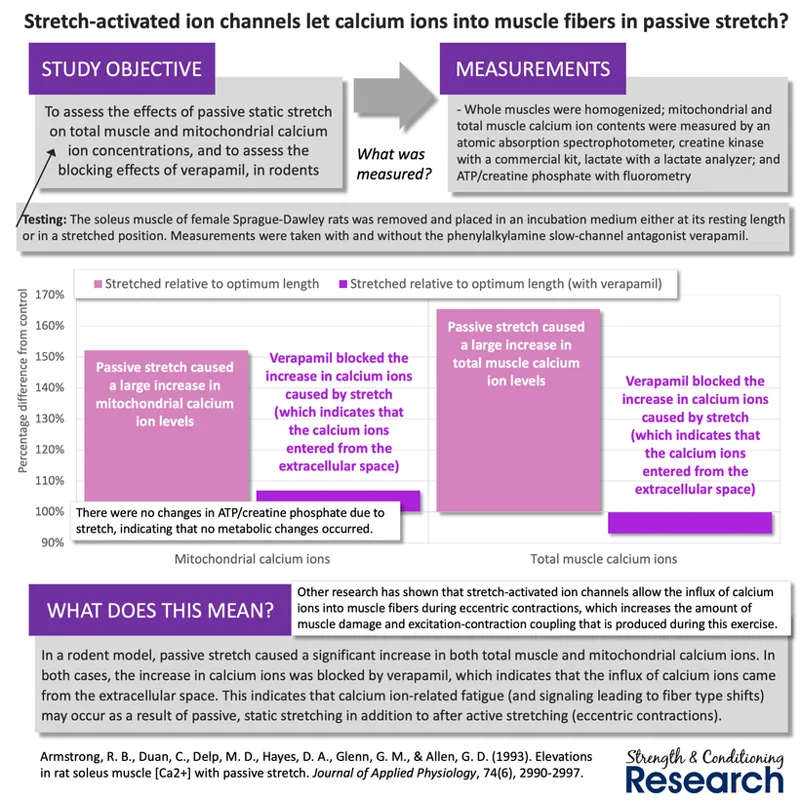
Calcium ion-related fatigue mechanisms can be defined as changes that occur inside a muscle fiber during exercise that [1] reduce exercise performance by either reducing mechanical tension or muscle fiber shortening speed, and [2] occur due to the influx of calcium ions into the cytoplasm of the muscle fiber. Calcium ions can enter either through the sarcoplasmic reticulum due to muscle fiber activation or due to the opening of stretch-activated ion channels when the muscle fiber is elongated. The most important mechanisms is excitation-contraction coupling failure, which is caused by damage to the triadic junction after calcium ions in the cytoplasm stimulate the release of enzymes.
.
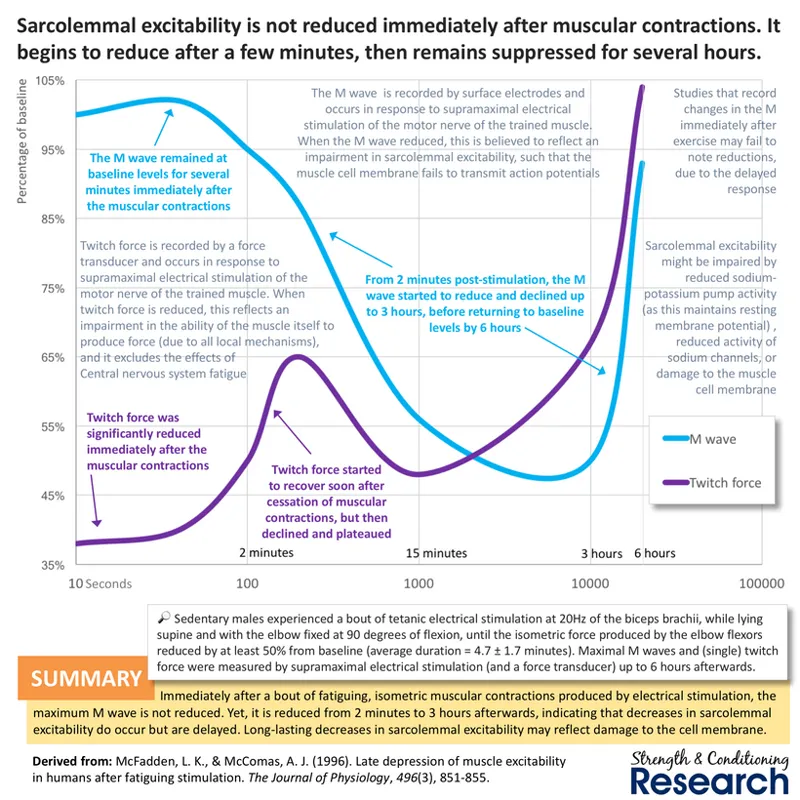
Another calcium ion-related fatigue mechanism is a loss of sarcolemmal excitability. This is most likely caused by enzymes produced in response to the presence of reactive oxygen species that themselves are generated by mitochondria that deal with the influx of excess calcium ions. These enzymes damage the cell membrane and stop it from transmitting the action potentials to the triadic junction.
.
Finally, the third calcium ion-related fatigue mechanism involves a loss of sensitivity to calcium ions by actin myofilaments. This is not a damage mechanism (unlike the preceding two mechanisms) and so it resets itself more quickly and is not problematic in the same way.
.
#2. Calcium ion-related fatigue is increased by increasing volume
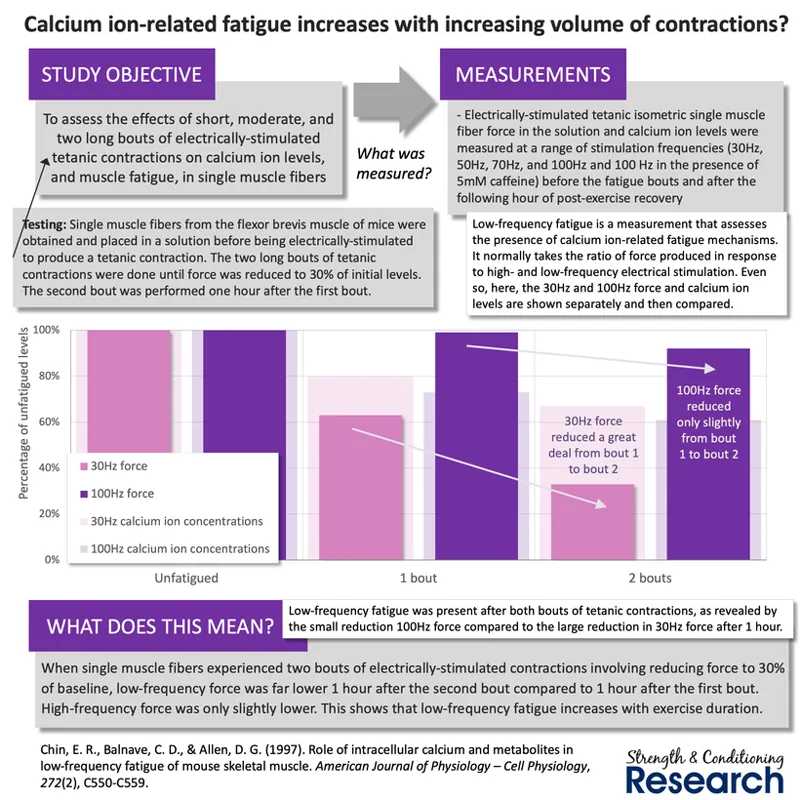
Calcium ion-related fatigue is increased by increasing training volume because each additional muscle contraction provides an additional period of muscle activation. And each additional period of muscle activation sends an additional amount of calcium ions into the cytoplasm, where they can accumulate and cause calcium ion-related fatigue mechanisms to occur.
.
#3. Calcium ion-related fatigue is increased by increasing proximity to failure
Calcium ion-related fatigue is additionally increased by increasing proximity to failure during strength training with a self-selected tempo. This occurs not only because training closer to failure involves additional repetitions in the set (compared to stopping short of failure) but also because training closer to failure involves reaching a higher level of motor unit recruitment and therefore accessing more fast twitch muscle fibers. Fast twitch muscle fibers are more susceptible to calcium ion-related fatigue, most likely because they have fewer mitochondria to remove the calcium ions as they accumulate.
.
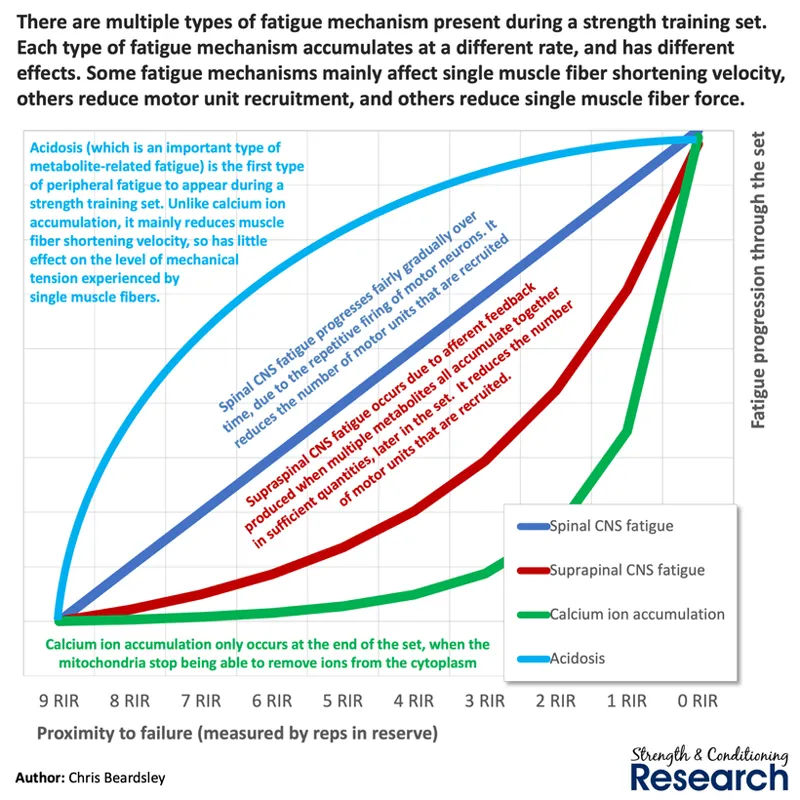
Even so, it is important to note that the effects of proximity to failure on calcium ion-related fatigue are not linear. Instead, they are exponentially non-linear and increase dramatically in the final couple of reps before reaching muscular failure. This is because the mitochondria protect the muscle fiber initially by removing the calcium ions. However, once the mitochondria can no longer remove the calcium ions, the ions accumulate very quickly.
.
#4. Calcium ion-related fatigue is increased by lighter loads
Calcium ion-related fatigue is greater when training with lighter loads compared to when training with heavier loads because the lighter loads provide a much longer period of muscle activation. The longer period of muscle activation allows more time for calcium ions to enter the cytoplasm, where they accumulate and cause calcium ion-related fatigue mechanisms to occur.
.
#5. Calcium ion-related fatigue is greater after eccentric contractions
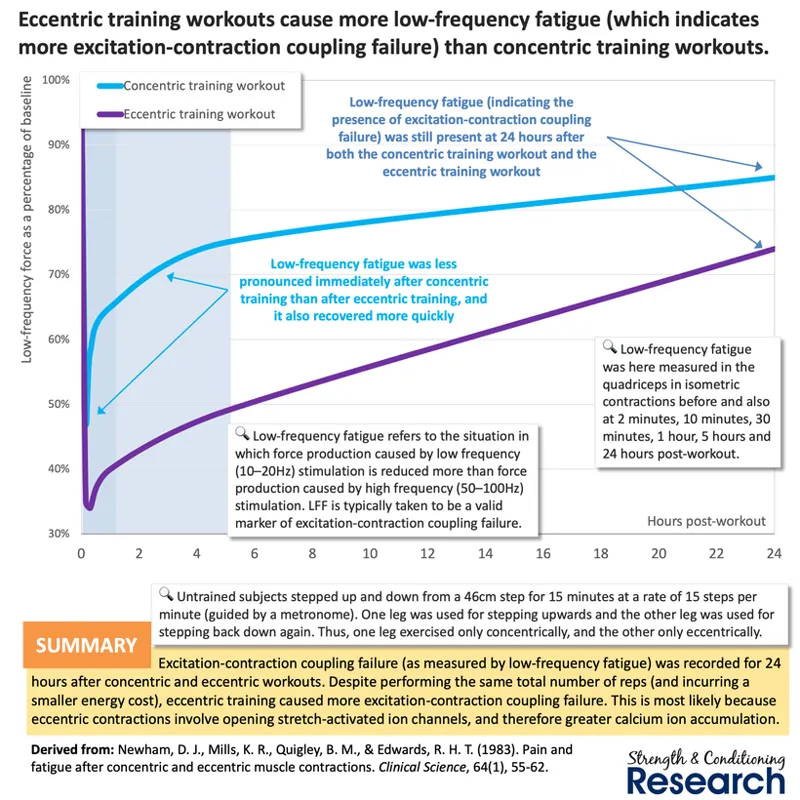
Calcium ion-related fatigue is greater during eccentric training compared to during concentric training because the stretching of activated muscle fibers causes a large influx of extracellular calcium ions through stretch-activated ion channels. These extracellular calcium ions also enter the cytoplasm, where they accumulate and cause calcium ion-related fatigue mechanisms to occur.
.
Incidentally, the stretch-activated ion channels also open during passive static stretch. We do not need to activate a muscle fiber in an eccentric contraction in order to trigger calcium ion-related fatigue.
.
#6. Calcium ion-related fatigue is greater after training at long muscle lengths
Calcium ion-related fatigue is greater during strength training with a long maximum muscle length (or a full range of motion) compared to during strength training with a short maximum muscle length (or a partial range of motion) again because the stretching of activated muscle fibers causes a large influx of extracellular calcium ions through stretch-activated ion channels. These extracellular calcium ions also enter the cytoplasm, where they accumulate and cause calcium ion-related fatigue mechanisms to occur.
.
Conclusions
Calcium ion-related fatigue mechanisms are changes that occur inside muscle fibers during exercise as a result of the influx of calcium ions. They are important to understand because [A] they reduce the mechanical tension produced and experienced by muscle fibers in a strength training workout (and hence reduce the size of the stimulus for hypertrophy), and because [B] they involve damage and are therefore long-lasting and so contribute to the duration of the post-workout recovery period. Calcium ion-related fatigue mechanisms occur largely due to the accumulation of calcium ions inside the cytoplasm (subsequent to muscle activation and/or stretch) which then triggers many effects. Calcium ion-related fatigue is increased when training: [1] with higher volumes and with lighter loads (because of the longer time for which the working muscle fibers are activated and sending calcium ions into the cytoplasm); [2] closer to failure (because of the recruitment of more higher threshold motor units and the activation of more fast twitch fibers); and [3] with long maximum muscle lengths, full ranges of motion [ROMs], and eccentric contractions (because stretching activated muscle fibers opens stretch-activated ion channels which allows extracellular calcium ions to enter the cytoplasm). Calcium ion-related fatigue can be reduced by training with lower volumes, heavier loads, further from failure, with concentric-only contractions, and to short maximum muscle lengths or with partial ROMs.
Comments (2)
Thanks Chris - due to the above is it safe to say that all "advanced training techniques" such as forced reps are counterproductive?
Any advanced training technique that increases the duration of time spent training in a fatigue state is counterproductive, yes. So the only advanced training technique that doesn't fit into that category would be cluster sets.