




Lunge variations
There are many different lunge variations. Lunges can be performed in forward, reverse, and lateral directions and with a range of loads, trunk positions, and step lengths. Changing any of these variables can affect the relative involvements of the various prime movers.
.
#1. Increasing loading increases relative contribution of the hip extensors
Although the forward lunge is typically used to develop the quadriceps, the exercise displays a much greater relative contribution of the hip extensors relative to the hip extensors. Also, as loads are increased, the relative contribution of the hip extensors increases more than the relative contribution of the quadriceps. This suggests that for targeting the hip extensors (the gluteus maximus, the hamstrings, and the adductor magnus), the lunge should be performed with heavier loads. Conversely, for targeting the knee extensors (the quadriceps), lighter loads are better.
.
#2. Leaning forwards increases relative contribution of the hip extensors
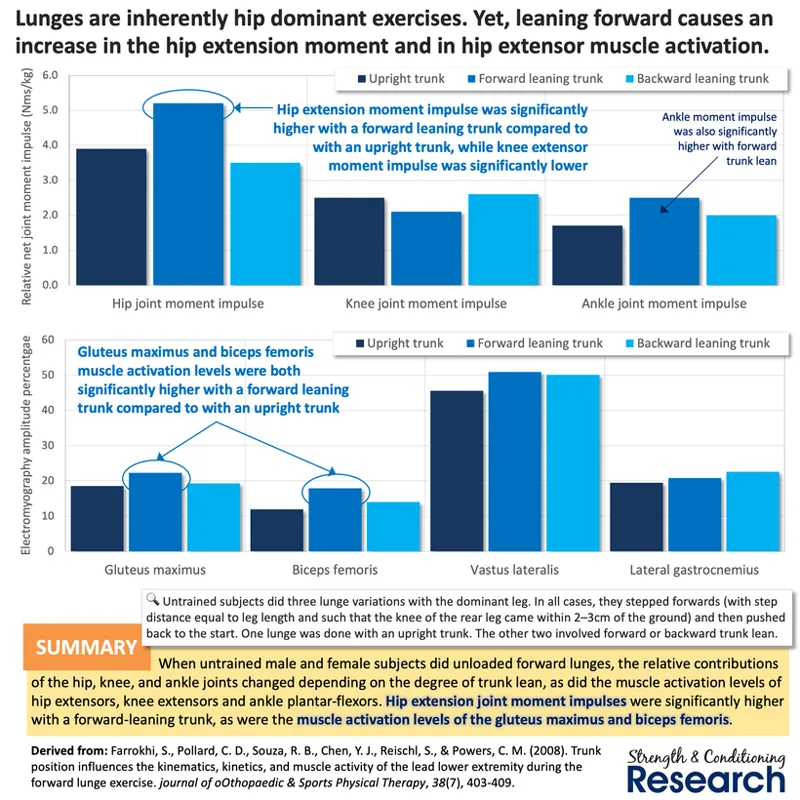
Additionally, the contribution of the hip extensors is greater when the trunk is inclined forwards in the lunge exercise, compared to when the trunk is upright. This suggests that for targeting the hip extensors (the gluteus maximus, the hamstrings, and the adductor magnus), the lunge should be performed with a forward-leaning trunk. Conversely, for targeting the knee extensors (the quadriceps), an upright trunk is better.
.
#3. Taking longer steps and moving the knee over the toes increases relative contribution of the hip extensors
Furthermore, the contribution of the hip extensors is greater when the lunge involves longer step lengths and/or involves the knee going over the toes, compared to when the steps are shorter and the shank angle is more vertical. This suggests that for targeting the hip extensors (the gluteus maximus, the hamstrings, and the adductor magnus), the lunge should be performed with long step lengths and/or with the knee going over the toes. Conversely, for targeting the knee extensors (the quadriceps), shorter step lengths and a more vertical shank angle are better.
.
#4. Forward lunges involve a greater relative contribution of the hip extensors
In comparison with lateral lunges (which involve a fairly similar contribution from the hip extensors, knee extensors, and ankle plantar-flexors), the forward lunge involves a much greater relative contribution from the hip extensors. This suggests that the forward lunge direction should be preferred for training the hip extensors, while the lateral lunge direction is likely better for the knee extensors.
.
#5. Backward lunge direction increases relative contribution of the hip extensors
Compared to the forward lunge, the backward lunge involves a slightly larger relative contribution of the hip extensors and a much smaller contribution from the knee extensors. This suggests that the backward lunge direction can be selected for training the hip extensors, while the forward lunge direction is almost certainly better for training the knee extensors.
.
Indeed, studies taking measurements in order to calculate muscle force have identified that quadriceps muscle forces are likely greater during forward lunges compared to during reverse lunges with exactly the same step lengths, depths, and loading.
.
Conclusions
During lunge variations, various factors are able to affect the relative contributions of the prime movers (being the hip extensors, the knee extensors, and the ankle plantar-flexors), including [1] loading, [2] trunk inclination, [3] step length and/or shank angle, [4] plane of motion (sagittal or frontal), [5] and direction (forwards or backwards). When performing forward lunges, using heavier loads, inclining the trunk forwards, taking longer steps, and moving the knee of the front leg in front of the toes all act to increase the relative contribution of the hip extensors. Conversely, using lighter loads, keeping the trunk upright, taking shorter steps, and keeping the shank vertical all cause an increase in the relative contribution of the knee extensors. When comparing lunges in different planes of motion and in different directions, the reverse lunge involves the largest relative contribution from the hip extensors, followed by the forward lunge, and then the lateral lunge. Thus, the reverse lunge is probably the best option for training the gluteus maximus. It also seems likely that the the reverse lunge involves the smallest relative contribution from the knee extensors, followed by the forward lunge, and then the lateral lunge. Consequently, the lateral lunge may be the best variation for targeting the quadriceps.
Comments (7)
Hi Chris, I hope to get your perspective on some thoughts of mine. I have been thinking in more details about increasing torque on the quads vs the glutes. It seems like bending the knee beyond 90° (pushing the knee beyond the toe) does actually increase the torque on the quads. Let me explain. Let's assume in all cases a split squat position where the upper body/spine is perpendicular in relation towards the floor (in line with gravity). In an 90° angle the torque on the knee would be only coming from the upper part of the leg, having to resist the hips from falling towards the floor. The more I decrease the knee angle (push the knee forwards), the more I progressively not only have to resist the hips from falling towards the floor, but also have to resist the force from the lower part of the leg pushing the shins backwards (pushing the heels towards the hips). This would theoretically increase the force on the quads. So based on this, with a given stance width, pushing the knees forwards does a few things: - places the center of mass more towards the front leg (increases absolute loads working on this front leg) - increases hip extension of the back leg towards more hyper extension, but also decreases absolute load the back leg has to generate. The external moment arm is also increased on the back leg, which increases the force per kilogram of absolute load the back leg has to generate - increases torque on the front knee, while the absolute load on the glutes probably stays somewhat similar, therefor placing more bias on the quads vs the glutes of the front leg Based on this, biasing the quads of the front leg in a split squat, the exercise would need the following modifications: - spine perpendicular in relation towards the floor - the closest stance width, to decrease the external moment of the back leg (increased stance width if you want to bias the hip flexors of the back leg) - the highest angle of knee flexion which is determined by your maximum amount of ankle dorsi flexion (can be further increased by supporting heel elevation) - performing the split squat with a down and back motion might help as well, although this does shift the center of mass towards towards the back leg All in all, it looks like I have to disagree with your conclusions related to knee flexion. What is your perspective on this and where do you think my analysis is false?
Hi Chris, interesting post and a good stimulation for some thought. Although, I think you have confused some people with this one. Here are my thoughts. I think for many people the end point of a split squat is the knee of the back leg (almost) touching the floor. A potential argument in their favor is that this would bias LML, which would likely result into more even muscle growth, by stimulating more distal growth. Arguably a more time efficient approach when the goal is putting on the maximum amount of muscle mass. What does this mean in practice for someone that wants to bias there quads? Well, like we already established, a useful aproach is the have a back and hip which is somewhat perpendicular towards the ground (no leaning forward). Also, most individuals can't hyper-extend their hip much, which limits the amount of variation possible in split squat positions, when the goal is touching the floor with the knees. In real case scenarios, basically this would mean, increasing knee flexion will also decrease step width for many people. In other words, the smallest practical step width would also bias the most knee flexion. Would you agree that decreasing step width by increasing knee flexion does actually bias the quads? Based on this, I would argue that aiming for more knee flexion can be an useful approach for biasing the quads. Would your perspective be the same on this one?
I think the confusion arises because most people are arriving at the article with the in-built assumption that more knee flexion is always going to bias the quadriceps, and there is no fundamental reason why this should be the case. Joint angle never determines relative muscle contribution to an exercise directly, only ever indirectly. In any event, lateral lunges are better for the quads, and backward lunges are better for the hip extensors, so it's probably a moot point.
Chris, I thought we have to push the front knee in front of the toes to make it more quadriceps dominant. But here you say "keep shank vertical" for more knee extensors and push knee forward over the toes for more hip dominance. This is the opposite of what mass media is saying. If we keep our shins vertical, knee extensors do not stretch that much and if we take the knee over the toes it makes more of an adductor/knee extensor movement. Could you please explain this?
You can see in the article above the research study (Schutz et al. 2014) showing that the hip extensor joint torque is increased by bringing the knee over the toes. In contrast, the knee extensor joint torque does not change. So the exercise becomes relatively more hip dominant as the knee is brought over the toes. Why the mass media says something different I cannot explain.
Thanks Chris - would you suppose all of the above would apply to a unilateral leg press machine exercise. Foot higher more hip extensor and foot lower more knee extensor? Thanks!
Yes, very probably