





Rate of muscle loss
How fast do we lose muscle mass? This question is essential to answer if we want to [1] understand the role of training frequency, and [2] program deloads, training breaks, or tapers correctly for athletes or bodybuilders preparing for a competition or a show.
.
#1. How fast is muscle loss during detraining?
There are two sources of information about the rate of muscle loss induced by detraining (in which we only carry out normal daily activity). Firstly, there are detraining studies. Such investigations simply carry out a strength training program for several weeks, measure the hypertrophy at the end of that training period, and then measure the losses in muscle size during subsequent normal daily activity once the strength training program has stopped being followed. Historically, detraining studies have reported muscle loss within 10-14 days.
.
Even so, more recent studies have reported that muscle loss during detraining occurs within a single week. Importantly, the following study was performed in the biceps brachii and with a relatively low volume of isometric contractions. Therefore, we can largely discount losses in sarcomeres in series as well as reductions in muscle swelling as contributors to the reduced muscle size.
.
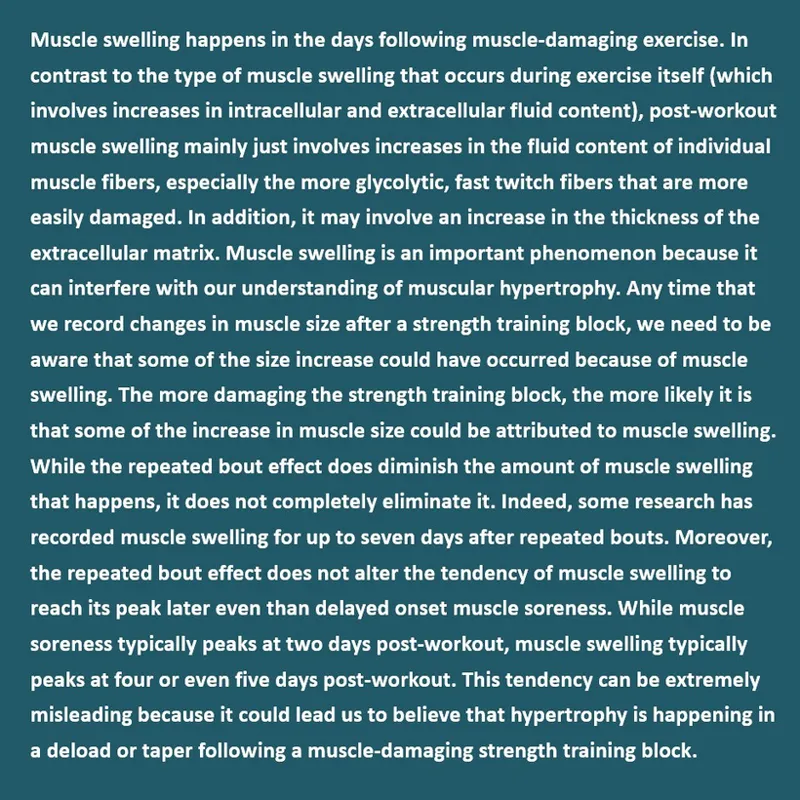
Indeed, a common problem with measuring the rate of muscle loss after strength training programs is that muscle swelling occurs lasts for 4-5 days after strength training workouts (yes, even in strength-trained lifters). This often makes observing the rate of muscle loss in the first week of detraining extremely difficult because we currently cannot tell the difference between hypertrophy and muscle swelling (read more).
.
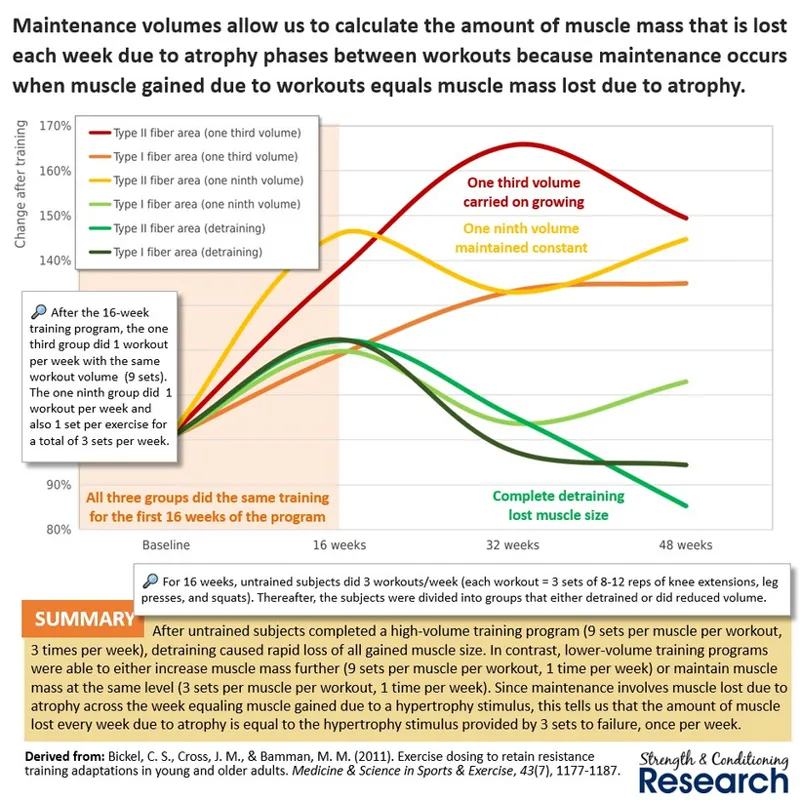
For this reason, it is very helpful that there are maintenance studies. These studies examine the amount of strength training volume that is necessary to establish an equilibrium between the rate of muscle gain and the rate of muscle loss during a strength training program.
.
Currently, it seems that training with 3-4 sets once per week produces enough hypertrophy (over approximately a two-day stimulus period) such that the following 5-day period of atrophy equals it out and there is neither muscle loss nor muscle gain. Evidently, this shows us that muscle is certainly lost over a 5-day period of normal physical activity.
.
While the majority of the data has been collected in untrained, young subjects, there are also studies showing exactly the same results over quite long periods of time in older people. The long period of maintenance is important because it shows that muscle is definitely growing and shrinking within each weekly period and not just growing very, very slowly.
.
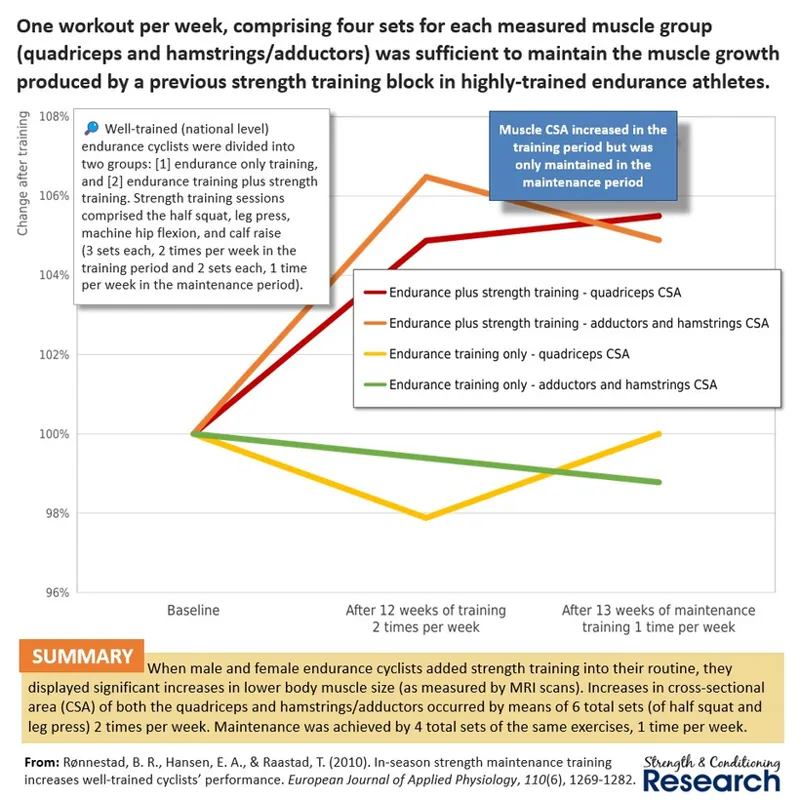
Indeed, the closest that we currently have to a maintenance study in well-trained subjects involves endurance athletes, who were able to maintain previously-achieved muscle growth by training once per week, again with 4 sets per workout.
.
#2. How fast is muscle loss during complete deloading?
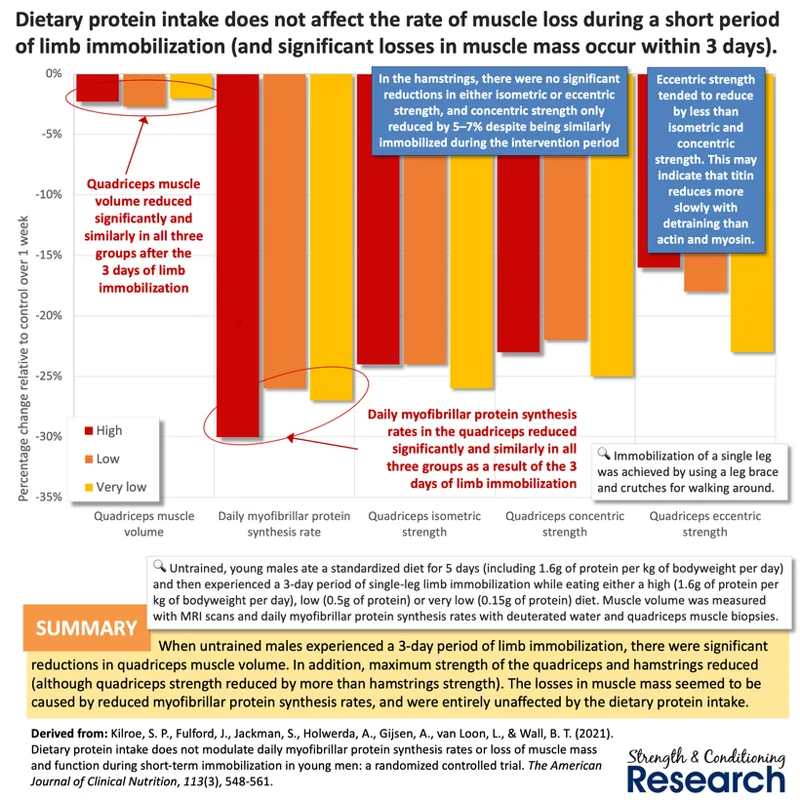
During complete immobilization (when nearly all of the muscle fibers inside a muscle are prevented from experiencing any kind of mechanical loading), whole muscles typically reduce in size within just 2–3 days. Such losses in muscle fiber size cannot be prevented by increasing dietary protein intake.
.
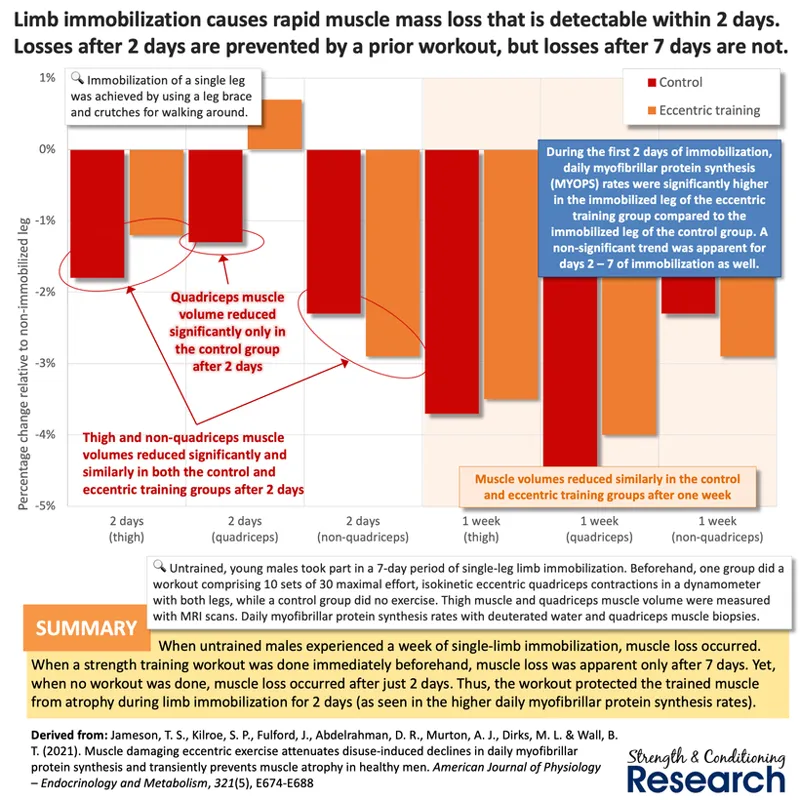
However, they can be stopped temporarily by strength training workouts. Such workouts probably elevate muscle protein synthesis rates for 48 hours in the muscle fibers of the high-threshold motor units, thereby preventing some losses of muscle mass during that period of time. Yet, the loss can still occur once that period of elevated muscle protein synthesis rates has finished. Also, we cannot rule out that the unaccustomed eccentric training workout caused swelling that was incorrectly identified as a temporary increase in muscle mass for a couple of days (or more) post-workout.
.
Importantly, the losses in whole muscle size are most rapid at the start of the period of deloading. Thus, we can infer that muscle fibers reduce in size as soon as the mechanical tension stimulus is removed, and that the reductions are greatest immediately after the stimulus disappears. This clearly contradicts the viewpoint that muscle loss "only happens" after a number of days or even weeks after finishing a period of strength training.
.
#3. Why is there a difference between complete unloading and detraining?
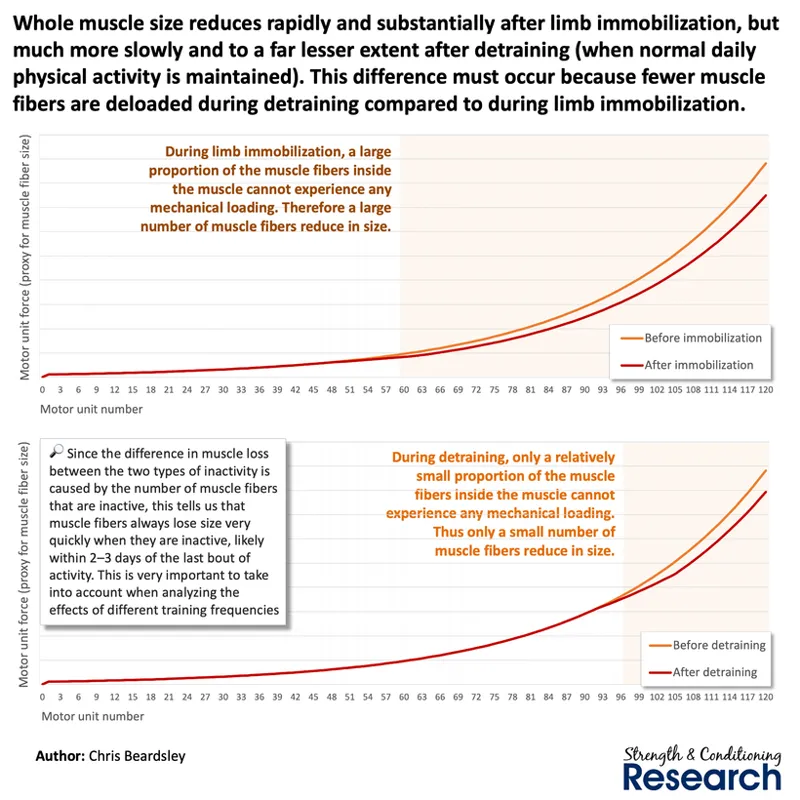
During immobilization, a very large proportion of the muscle fibers inside the muscle are prevented from activating during the intervention period. Unless a muscle is stretched, activation is the only way that muscle fibers can experience mechanical tension. Therefore, immobilization causes a very large number of muscle fibers to cease experiencing any mechanical tension. This causes observable levels of whole muscle loss within 2-3 days. During detraining that involves normal physical activity, only a small proportion of the muscle fibers inside the muscle are prevented from activating during the intervention period. Thus, detraining causes a small number of muscle fibers to cease experiencing any mechanical tension. This causes observable levels of whole muscle loss within 10-14 days. This tells us that the main difference between complete unloading and detraining is the number of muscle fibers that cease experiencing mechanical tension.
.
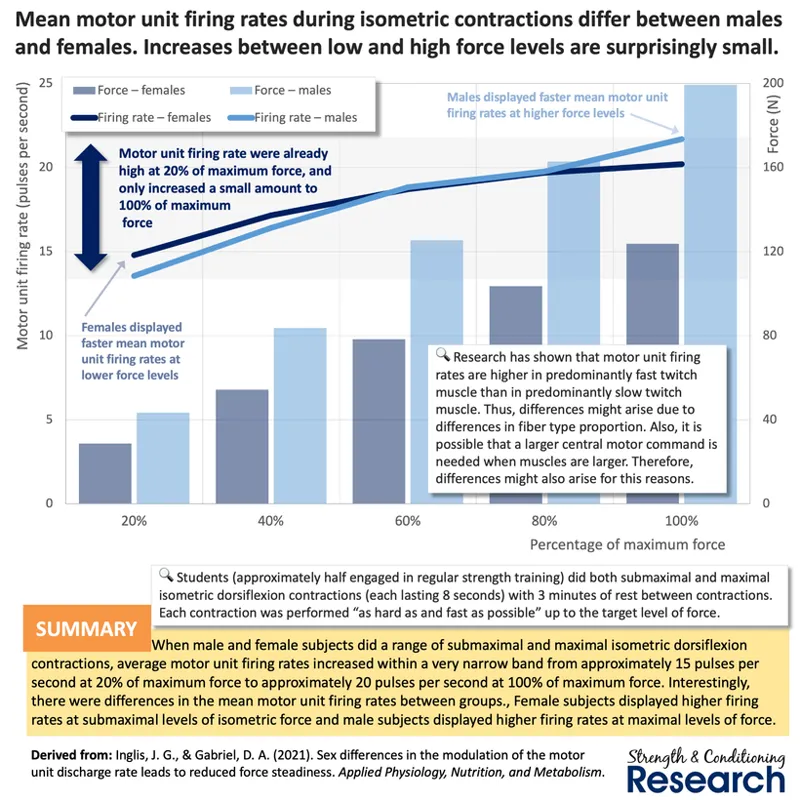
This is because the main factor that determines the amount of force experienced by an activated muscle fiber is the force-velocity relationship. Thus, when the muscle fibers of a low-threshold motor unit are activated at low levels of central motor command during the activities of daily life, they still experience very high levels of mechanical tension (sufficient to keep them from atrophying). The only other factor that could theoretically affect mechanical tension is rate coding, and this is already high at relatively low motor unit thresholds.
.
Conclusions
How fast do we lose muscle mass? Answering this question is critical for an understanding of both training frequency and the duration of deloads, training breaks, and tapers. During detraining that involves normal physical activity, the earliest that we tend to see meaningful losses in muscle mass is 10-14 days after the final workout. Nevertheless, it is very difficult to observe reductions in muscle size in the first 4-5 days after a workout because of muscle swelling. Therefore, it is quite likely that atrophy occurs much earlier than 10-14 days. Indeed, maintenance studies show that muscle loss must occur within a 5-day period involving normal physical activity. Such studies involve training once per week and the amount of hypertrophy produced by this single workout is lost due to atrophy by the following workout, such that there is neither any gain or loss in muscle size over the long-term. During detraining that involves complete immobilization of a limb, muscle loss occurs within 2-3 days after cessation of activity. It is likely that the apparently faster rate of muscle loss is simply because more muscle fibers are atrophying. Indeed, during normal physical activity, we still use all of our low-threshold motor units and some of the lowest high-threshold motor units. Therefore, we should expect muscle loss to occur more rapidly during complete deloading (such as during limb immobilization) than during a period of detraining that still involves normal physical activity.

Comments (3)
Hi Chris! If in deloading the reduction of strenght is bigger than muscle size, likely by a decrease of lateral force transmission. It’s the same reason as fiber type shift (more fast)?
Thanks Chris - I have a question about the force-velocity relationship. Why is the force per fiber low with a higher shortening velocity during a concentric while during the eccentric the force per fiber is the same regardless of fiber shortening velocity?
In both concentric contractions and eccentric contractions, a faster movement velocity (i.e. a fast muscle fiber shortening or lengthening velocity) causes a faster detachment rate of actin and myosin. This produces a smaller force with increasing speed. However, during eccentric contractions, the faster movement velocity also causes an increase in passive forces because titin is viscoelastic. Therefore, increasing speed does not affect total mechanical tension produced during eccentric contractions (but it does affect the relative contributions of active and passive force, which is why faster eccentrics cause more longitudinal hypertrophy and less transverse hypertrophy).