



Muscle swelling
Muscle swelling occurs in the days following muscle-damaging exercise. It is an important phenomenon because it can interfere with our understanding of muscular hypertrophy. Indeed, both researchers and bodybuilders can be misled by the swelling, believing it to represent an increase in muscle size after a strength training block or cycle. This can lead us to conclude that muscle-damaging types of strength training are more stimulating than they really are.
.
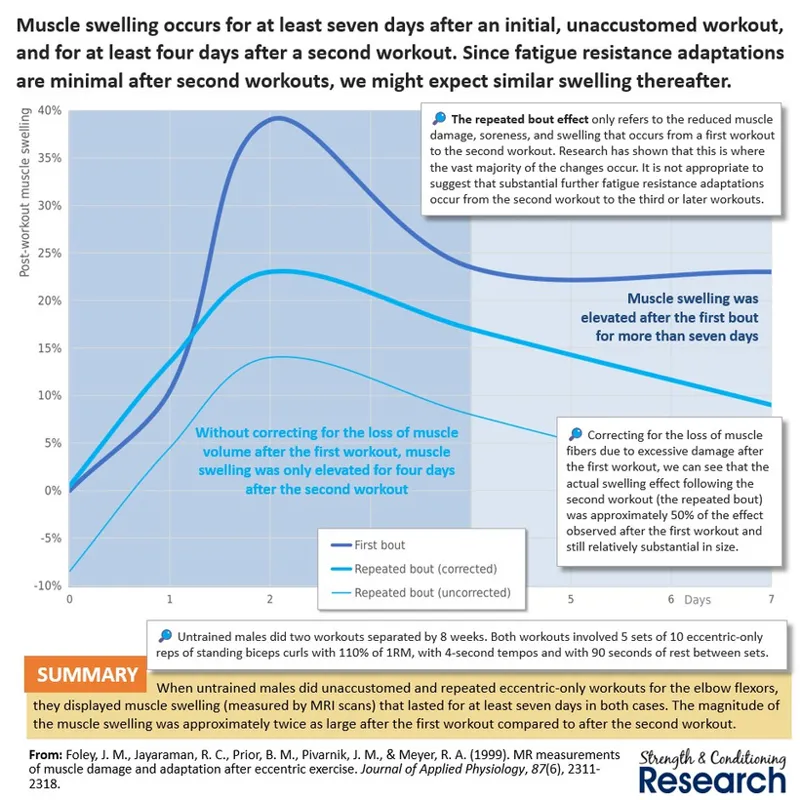
#1. Muscle swelling can last for more than a week in untrained individuals
Most of the information regarding muscle swelling exists in relation to untrained individuals, which is not ideal for our understanding of how it occurs during strength training in trained lifters. Even so, the data shows that muscle swelling is not a short-lived phenomenon and persists for much longer than muscle soreness, which typically dissipates within four or five days after a workout.
.
#2. Muscle swelling can reach a peak very late in the post-workout period
The way that muscle swelling changes after a muscle-damaging workout can be surprising. It does not occur immediately following the workout and then decline gradually over the next few days. Instead, it lags the inflammatory response and therefore its appearance can often be delayed even in comparison with delayed onset muscle soreness (DOMS).
In this second example, where individual muscle fiber size itself was measured, muscle fiber swelling reached its peak only after a week post-workout.
.
#3. Muscle swelling is reduced in trained individuals but is still present
Some researchers have argued that muscle swelling is only apparent in untrained individuals and that the repeated bout effect removes this phenomenon in trained lifters. Nevertheless, studies exploring the repeated bout effect have shown that muscle swelling is elevated even in repeated bouts for several days post-workout. Again, in this study, muscle swelling was still increasing up to and including four days after the initial bouts. Likely, the peak of muscle swelling was not reached.
.
Similar findings have been reported in other studies, with muscle swelling being recorded for at least five days following both initial and repeated bouts of eccentric contractions. Again, in this study, the peak of muscle swelling was reached only after 4-5 days following the workouts.
.
When taking account of the muscle loss that can occur after initial bouts of muscle-damaging exercise, muscle swelling may even last for up to seven days after a repeated bout. While some researchers have suggested that further protective effects occur after the repeated bout, the data suggest that there are in fact minimal additional benefits of multiple repeated bouts in comparison with the repeated bout itself (note that the repeated bout effect only refers to a second workout).
.
#4. Muscle swelling includes increases in muscle fiber size and fascia size
Although muscle swelling during exercise involves increases in intracellular fluid in addition to extracellular fluid content, the post-workout muscle swelling seems to involve predominantly intracellular (muscle fiber) swelling, especially of the more glycolytic, fast twitch muscle fibers.
.
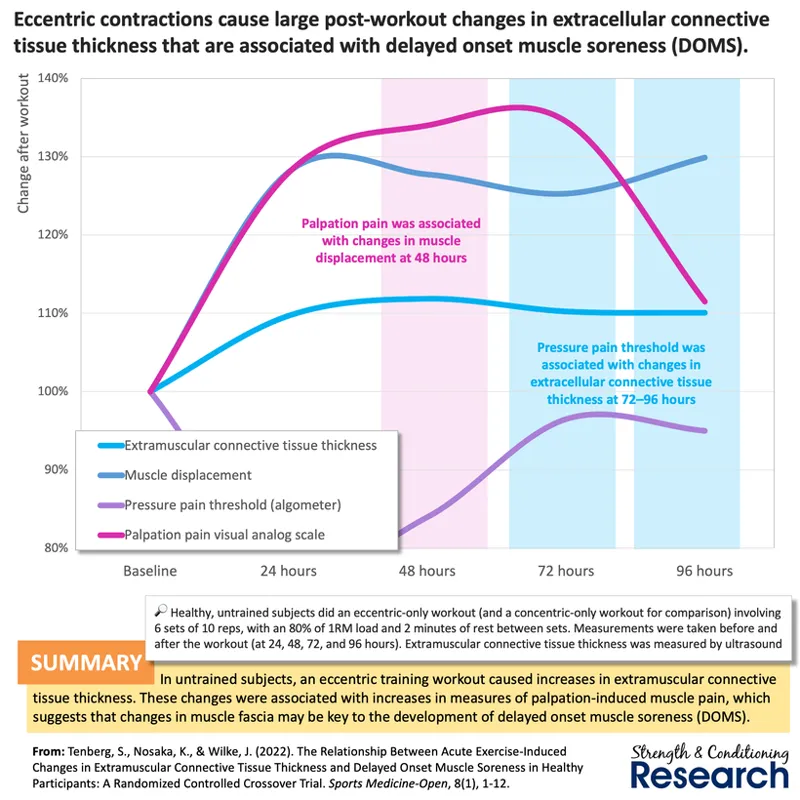
Even so, there are indications that the extracellular matrix can also display increases in thickness that may contribute to the muscle swelling phenomenon during the post-workout recovery period.
.
Conclusions
Muscle swelling happens in the days following muscle-damaging exercise. In contrast to the type of muscle swelling that occurs during exercise itself (which involves increases in intracellular and extracellular fluid content), post-workout muscle swelling mainly just involves increases in the fluid content of individual muscle fibers, especially the more glycolytic, fast twitch fibers that are more easily damaged. In addition, it may involve an increase in the thickness of the extracellular matrix. Muscle swelling is an important phenomenon because it can interfere with our understanding of muscular hypertrophy. Any time that we record changes in muscle size after a strength training block, we need to be aware that some of the size increase could have occurred because of muscle swelling. The more damaging the strength training block, the more likely it is that some of the increase in muscle size could be attributed to muscle swelling. While the repeated bout effect does diminish the amount of muscle swelling that happens, it does not completely eliminate it. Indeed, some research has recorded muscle swelling for up to seven days after repeated bouts. Moreover, the repeated bout effect does not alter the tendency of muscle swelling to reach its peak later even than delayed onset muscle soreness. While muscle soreness typically peaks at two days post-workout, muscle swelling typically peaks at four or even five days post-workout. This tendency can be extremely misleading because it could lead us to believe that hypertrophy is happening in a deload or taper following a muscle-damaging strength training block.
Comments (1)
so if muscle swelling peaks after five days and can last up to seven days, should we be wary of any studies that measure changes in muscle size within the seven day window?