

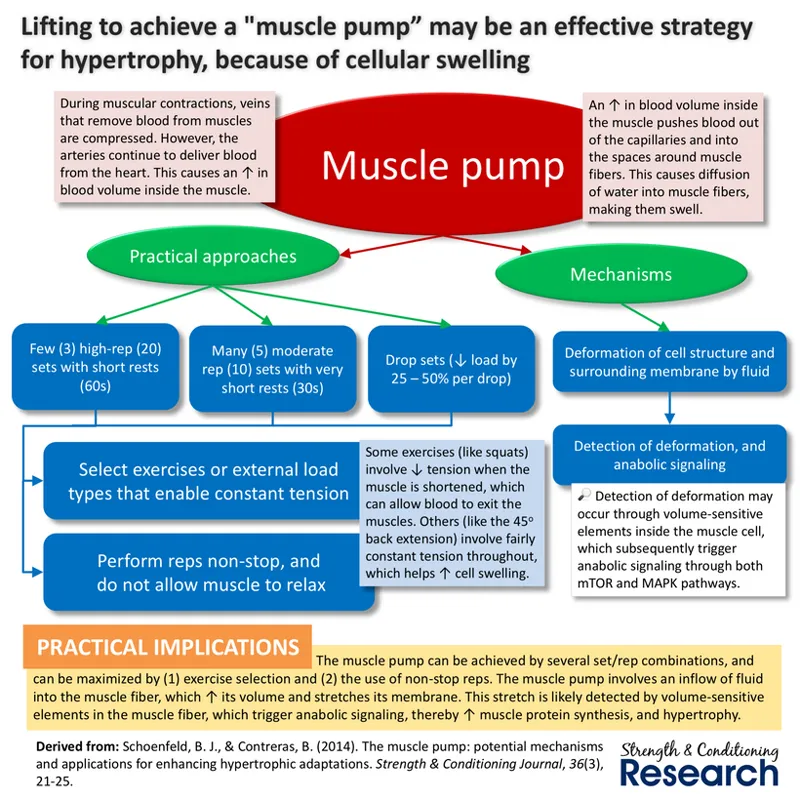


Muscle pump
The muscle pump has often been sought by bodybuilders in the hope that this will cause greater hypertrophy, even though the short rest periods that perpetuate this phenomenon are well-known to be detrimental for muscle growth. What does the research literature say?
.
#1. The muscle pump in the scientific literature
Based on observations that bodybuilders often use the muscle pump during their workouts, some researchers proposed that muscle fiber swelling could indeed stimulate hypertrophy by increasing single muscle fiber mechanical tension (owing to the greater deformations that would result from the presence of more intracellular fluid).
.
#2. Testing the effects of the muscle pump on hypertrophic signaling
Contrary to the hypothetical benefits of the muscle pump, research into blood flow restriction (BFR) training has demonstrated that when muscle swelling is artificially induced by using a vasodilatory agent to increase blood flow to the trained muscle, this does not then increase the activity of anabolic signaling pathways
.
#3. Testing the effects of the muscle pump on mechanical tension
Recently, it has become clear that muscle fiber swelling actually reduces single muscle fiber mechanical tension instead of increasing it. This appears to occur by means of the development of calcium ion-related fatigue mechanisms (both excitation-contraction coupling failure and losses in myofibrillar calcium ion sensitivity have been implicated although the exact mechanisms by which these are accelerated are still unclear).
.
Conclusions
The muscle pump has often been sought by bodybuilders in the hope that it can cause greater hypertrophy, even though the short rest periods that perpetuate this phenomenon are well-known to be detrimental for muscle growth. Nevertheless, based on observations that bodybuilders frequently used this technique, some researchers proposed that muscle fiber swelling could stimulate hypertrophy by increasing single muscle fiber mechanical tension (owing to the greater deformations that would result from the presence of more intracellular fluid). However, research has since provided two sources of data that invalidate this hypothesis. Firstly, it has shown that when muscle swelling is artificially induced by using a vasodilator to increase blood flow to the trained muscle, this does not increase the activity of anabolic signaling pathways. Secondly, it has also shown that muscle fiber swelling reduces single muscle fiber mechanical tension by accelerating the development of calcium ion-related fatigue mechanisms (both excitation-contraction coupling failure and losses in myofibrillar calcium ion sensitivity have been implicated but the exact mechanisms by which they are triggered are still unclear). It is possible that the increase in muscle fiber diameter induced by the swelling signals a reduction in the relative amount of local muscle fiber glycogen, which is known to accelerate excitation-contraction coupling failure (albeit again by means of mechanisms that are still unclear).